When researching dragon fruit shipping to Shanghai, an export consignment of dragon fruit from Ho Chi Minh City to Shanghai can incur significant costs if the refrigerated container is not set to the correct temperature, quarantine documentation is incomplete, or the cargo misses the vessel schedule. For fresh produce, businesses need not only to secure competitive ocean freight rates but also to maintain quality control from harvesting until the buyer in China has completed receipt of the goods.
To dragon fruit shipping to Shanghai To ensure efficiency, businesses need to coordinate three groups of tasks simultaneously: meeting export and import requirements, organising a cold chain suited to the fruit's physiological characteristics, and fully determining costs and delivery responsibilities. The right solution must be based on the shipping line's actual operating schedule, the shipment documentation, and the trade terms agreed with the partner.
For dragon fruit shipping to Shanghai, the following article analyses the preparation process, traceability documentation, refrigerated container specifications, freight cost components, and risk control measures for exporting dragon fruit from Ho Chi Minh City to Shanghai. The storage parameters are presented as technical references; shipping schedules, import requirements, and specific quotations must be confirmed at the time of implementation.
Shipping Dragon Fruit from Ho Chi Minh City to Shanghai: An Analysis of Sea Freight Route Characteristics and Import Requirements in China
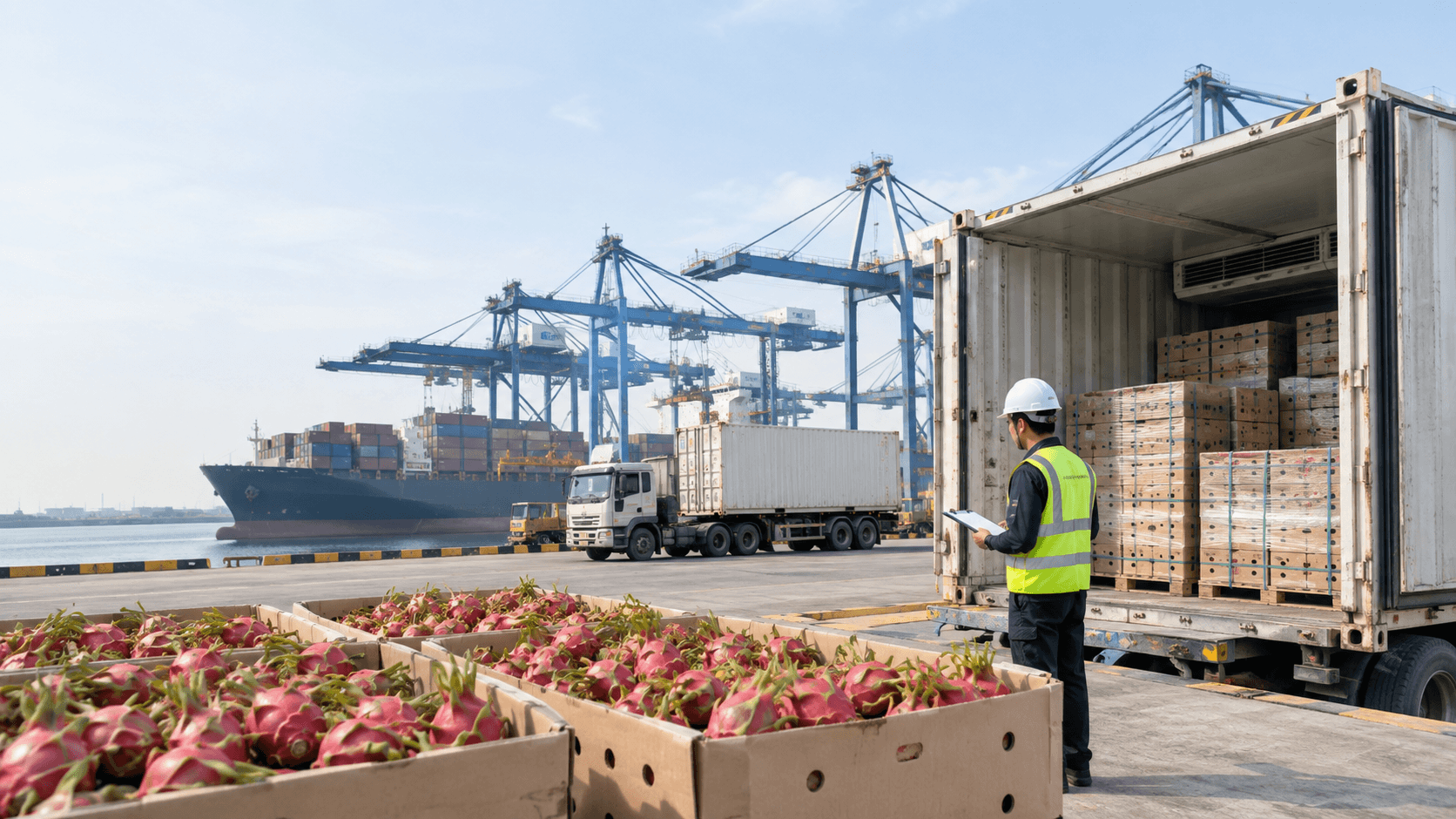
Identify the export gateway in the HCMC area and the options for connecting to the Port of Shanghai based on the shipping lines' actual operating schedules
During the transportation and customs clearance process for shipping dragon fruit to Shanghai, businesses with dragon fruit consolidated in Ho Chi Minh City or neighbouring provinces often consider exporting containers through the Cat Lai port complex or another suitable terminal in the Ho Chi Minh City port area. The choice should not be based solely on geographical distance; it is also necessary to check vessel schedules, reefer container availability, terminal cut-off times, transport times from packing facilities, and the phytosanitary requirements for each shipment.
To optimise costs and shipping schedules for dragon fruit shipments to Shanghai, the destination port shown on the booking, the expected terminal, whether the route is direct or involves transhipment, the number of transhipments and the estimated port arrival schedule should all be confirmed for the Shanghai route. Do not assume that all sailings from Cat Lai follow the same route. HNT Logistics can assist in checking sailing schedules and operational arrangements, as well as planning Refrigerated container transportation and coordinating cargo collection and delivery based on the cargo details, shipping line and actual shipment date.
Analysis of the differences between time at sea, port waiting time and the time required to complete procedures at the destination
Transit time should be divided into three separate periods. The first is the time from the vessel's departure from the port of origin to its arrival at the port of Shanghai, according to the published schedule. The second is the waiting time before loading onto the vessel, during transshipment or while waiting for a berth. The third is the time required to complete import procedures, quarantine inspections and delivery arrangements after the vessel arrives. Using only the time at sea to commit to a cargo delivery date will make sales planning unreliable.
Before booking, businesses should request confirmation of the ETD, ETA, container gate-in cut-off, documentation cut-off and the free storage period at the destination port, where applicable. The ETA is only an estimated arrival time and does not guarantee that the goods will be cleared through customs on that date. For fresh produce, the plan should allow for vessel schedule changes and import inspection times, while ensuring that the Chinese partner is ready to receive the goods as soon as delivery requirements are met.
Cross-check China's dragon fruit import requirements against the shipment's growing area, packing facility and traceability documentation.
Fresh dragon fruit exported to China must meet the phytosanitary conditions and import management requirements applicable to this product. Businesses must verify the growing area code, packing facility code, approval status by the Chinese authorities, and the ability to trace each shipment back to its actual production source. Having a code or having submitted a registration application does not automatically prove that the facility is eligible to export at the time of shipment.
Before purchasing, verify the growing area and packing facility information against the official lists published by the Vietnamese regulatory authorities and the approval status of China's General Administration of Customs, commonly known as GACC. Lists and requirements may change, so do not rely solely on copies of documents from previous shipments. Buyers in Shanghai should also confirm the quality requirements, specifications, packaging labels, import documentation and commercial standards stipulated in the contract.
Develop shipping and handling arrangements based on the trade terms, freight payment responsibilities and scope of services between the exporter and importer.
Incoterms determine the scope of delivery obligations, the allocation of costs and the point at which risk transfers from the seller to the buyer. For containerised cargo, businesses should consider the terms that best match the actual handover point to the carrier, rather than automatically using FOB in every case. FCA, CPT, CIP, CFR or CIF may be considered depending on the transaction structure, mode of transport and agreement between the two parties.
The contract must clearly specify who is responsible for paying the ocean freight, charges at the port of origin, charges at the port of destination, import customs clearance procedures, import duties, and any additional costs arising from container storage or cargo inspections. The scope of services must be clearly defined, specifying whether delivery is to the port of destination or directly to a warehouse in Shanghai. If using an all-inclusive dragon fruit shipping service to Shanghai, the quotation must clearly state which items are included, which charges are to be paid directly by the buyer, and the conditions under which surcharges may apply.
Exporting Dragon Fruit to Shanghai: Establishing Traceability Documentation and Controlling Customs Clearance Requirements

Cross-check the growing area codes, packing facility codes and traceability information against the phytosanitary quarantine requirements applicable to dragon fruit exports to China
The growing area code identifies the place of production, while the packing facility code identifies the location where receiving, sorting and packing operations are carried out. These two codes must correspond to the actual source of the goods and the facility used for the export consignment. When consolidating produce from multiple farms, businesses must maintain records linking each source of supply, harvest date, quantity, batch code and volume delivered to the packing facility.
The status of each registration code should be checked before every shipment, particularly when changing suppliers, packing facilities or raw material sources. Vietnamese regulatory authorities publish lists of growing areas and packing facilities approved for fruit exports to China. Businesses should check the latest data from the Department of Crop Production and Plant Protection and verify the official approval status with GACC. Registration codes belonging to other facilities should not be used to legitimise goods whose origins do not match the documented records.
Standardise the information in commercial contracts, invoices, packing lists, bills of lading and customs declarations to minimise discrepancies in documentation.
The commercial document set must be consistent in terms of product description, quantity, unit of measurement, net weight, gross weight, number of packages, seller and buyer details, and delivery terms. For dragon fruit, the product description must accurately indicate the type of product, its fresh condition and the trading specifications; the HS code must be determined in accordance with the current tariff schedule and the characteristics of the goods. Discrepancies between the invoice, packing list, customs declaration and booking data may prolong document amendments or incur additional costs.
Before issuing the official bill of lading, the documentation team should cross-check the booking details, shipping instructions, container number, seal number, port of loading, port of discharge and consignee information. The declared weight must be consistent with the weighing results and the shipping line's VGM requirements, where applicable. With regard to regulations issued by the General Department of Customs, businesses should verify the procedures currently in force and the documents required for each specific case, rather than using a single standard document set for every shipment.
Check the requirements for the phytosanitary certificate, declaration of origin and related documentation before entering the goods into the export process.
Fresh dragon fruit must be inspected to ensure it meets the phytosanitary requirements of the importing market and the applicable regulations in Vietnam. Businesses must register for phytosanitary inspection at the appropriate time, prepare origin documents and shipment information, and facilitate inspections or sampling by the competent authorities when necessary. The phytosanitary certificate must be issued in accordance with valid procedures and inspection results. A vessel booking or a registered customs declaration should not be regarded as proof that the shipment is eligible for export.
The documents that typically need to be reviewed include the contract, commercial invoice, packing list, customs declaration, bill of lading in accordance with the issuance schedule, traceability records, information on growing area codes and packing facilities, and a phytosanitary certificate where required. A Certificate of Origin (C/O) should only be prepared when requested by the partner or when proof of origin is needed to qualify for preferential treatment under the applicable arrangements. A C/O does not replace a phytosanitary certificate or China's requirements for accepting agricultural products.
Assigning responsibility for document processing among the cargo owner, logistics provider, quarantine authorities and importing partner to avoid delays at the destination port
The shipper is responsible for the accuracy of commercial information, the origin of the goods and quality commitments; the logistics provider coordinates bookings, transport and declarations under authorisation, and monitors progress. The competent quarantine authority carries out duties within its remit, while the importer or its agent in China is responsible for completing the import procedures falling within their scope. Identifying the responsible contact points and response deadlines from the outset helps prevent documents from being left pending between parties.
Businesses should prepare a tracking table listing the document name, person in charge, completion deadline, verification status and final approver. Before loading, they should confirm that the Shanghai side is ready to receive the goods, has all the information required for import declarations, and has agreed on how to handle requests from the authorities for additional documents. For perishable goods, having a complete set of documents ready before the container is delivered to the port is often more valuable than correcting discrepancies after the vessel has departed.
Transporting Dragon Fruit to Shanghai in Refrigerated Containers: Post-Harvest Physiological Control and Fresh Produce Quality
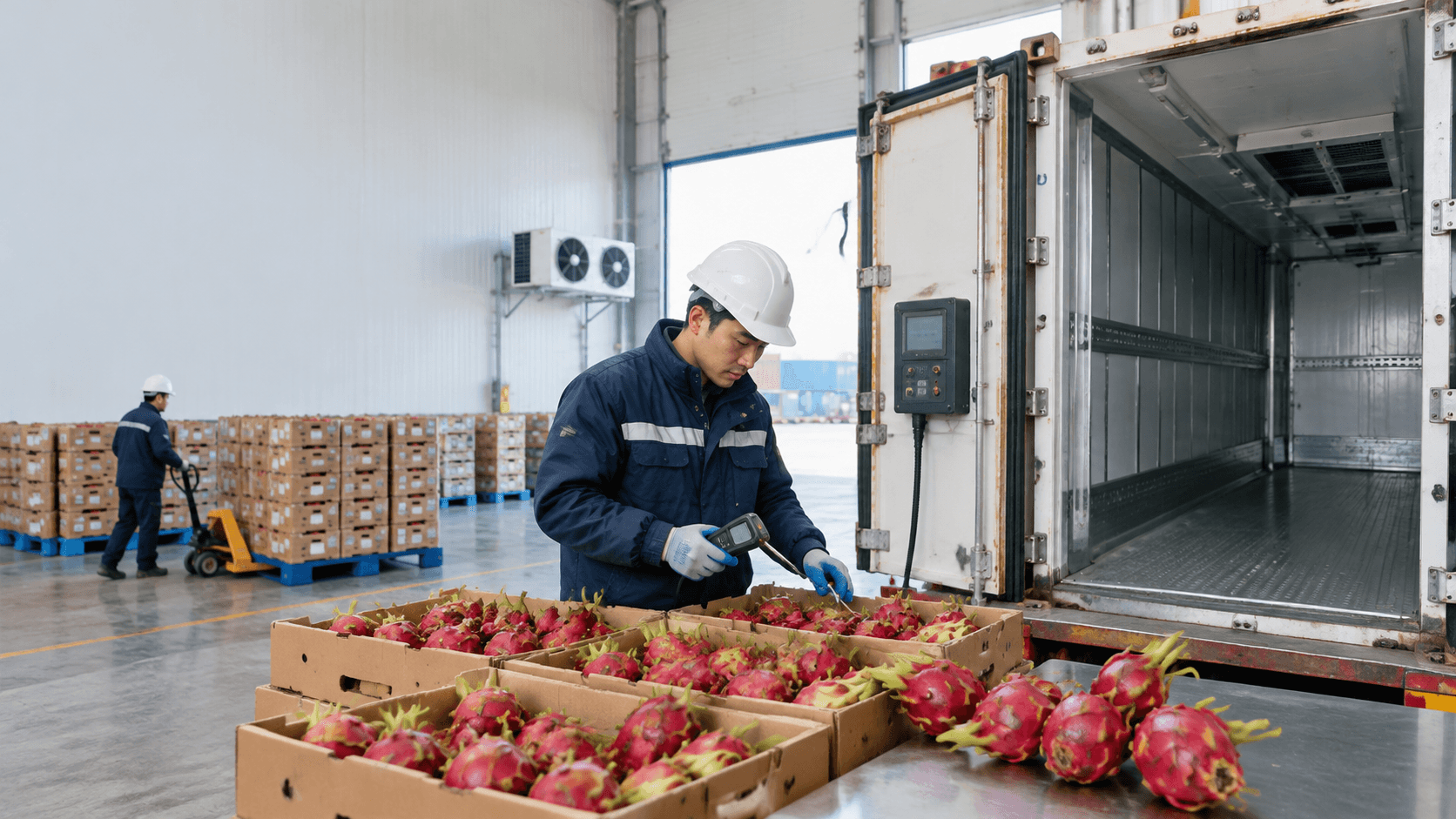
Assess the ripeness, condition of the green ears, skin integrity and risk of disease infection before deciding whether to place the dragon fruit in the transport chain
Dragon fruit should be harvested at the appropriate commercial maturity level to meet the buyer's requirements, with its characteristic skin colour, uniform shape and fresh, firm bracts. Fruit that is bruised, has cracked skin, deep scratches, signs of rot or unusual disease spots should be rejected. Damage to the skin and bracts can increase moisture loss, create conditions for spoilage microorganisms and result in a lower-than-expected proportion of compliant fruit upon arrival in Shanghai.
The grading process should record the dragon fruit variety, fruit size, defect rate, harvest date and post-harvest handling conditions. Dragon fruit does not continue to ripen according to the typical pattern of many climacteric fruits after harvest, so harvesting too early cannot be remedied simply by extending the transportation period. Businesses should agree on acceptance criteria with buyers from the outset, including colour, integrity, defect limits and procedures for handling non-compliant goods.
Develop a pre-cooling plan and select the set temperature based on the dragon fruit variety, cargo condition, transit time and appropriate storage guidelines.
Pre-cooling is an essential step in bringing the fruit pulp temperature down to the target storage level before container loading. Refrigerated containers are primarily designed to maintain the temperature of cargo that has already been properly cooled; they should not be regarded as a complete substitute for a pre-cooling system at the packing facility. If warm cargo is loaded into a container and a low temperature is then set, the cooling process may take longer, temperatures may vary between packages, and the risk of condensation may increase.
According to the technical guidance on dragon fruit storage from the UC Davis Postharvest Research and Extension Center, the recommended reference temperature for white- and red-fleshed dragon fruit is approximately 10°C, with a relative humidity of around 85–90%. Chilling injury may occur at approximately 5–6°C, depending on the variety, maturity and growing conditions. Therefore, when shipping dragon fruit to Shanghai, businesses should use 10°C as the initial reference point for red- or white-fleshed dragon fruit, then confirm the setting with their technical team, shipping line and receiving partner before finalising the set point.
Analyse the effects of ventilation, humidity, pallet stacking methods and air circulation gaps on condensation, spoilage and chilling injury.
Refrigerated containers require continuous airflow through the cargo, as specified by the equipment design. If the cargo exceeds the load line, covers the air return vents or blocks the air distribution channels, temperatures may vary significantly between different areas. Pallet arrangement must be suitable for the container dimensions, carton specifications and airflow direction. Do not attempt to maximise the available volume by filling every gap if doing so obstructs the cold chain.
Dragon fruit is prone to moisture loss, so packaging must protect the fruit surface and help maintain appropriate humidity without allowing water to accumulate on the skin. Ventilation settings must be confirmed based on the cargo characteristics, storage guidelines and the shipping line's reefer configuration; do not apply a fixed ventilation setting to every shipment. Before closing the container doors, inspect the floor, drainage outlets, refrigeration unit, sensors, air return flow and equipment cleanliness to reduce the risk of contamination or uneven air distribution.
Establish quality acceptance criteria at both the loading point and the receiving point to determine the cause of any losses in the event of a dispute.
The acceptance criteria should be agreed in writing before delivery and should include the proportion of fruit meeting the required standards, peel colour, stem condition, surface defects, size uniformity, weight and packaging requirements. At the loading point, businesses should take photos or videos of each stage, recording the pulp temperature, set temperature, container number, seal number and door-closing condition. These records provide a basis for comparison with the inspection results in Shanghai.
Upon receipt of the goods, the buyer should record the time the container is opened, the displayed temperature, the condition of the seal, any signs of condensation, the extent of bruising or damage, and the proportion of non-conforming goods, using the agreed sampling method. In the event of a dispute, retain the inspection report, photographs of the goods' condition, temperature data and, where necessary, documentation from an independent inspection company. It is not possible to conclude that the goods were damaged entirely due to transport solely from photographs of the fruit at the destination; the initial quality, temperature history, waiting time and storage conditions after delivery must also be taken into account.
Comparison of Dragon Fruit Shipping Rates to Shanghai and Reefer Container Operating Specifications

Breakdown of cost components, including transportation from the production area to Ho Chi Minh City, packing, phytosanitary inspection, customs declaration, port charges, ocean freight and handling in Shanghai
The cost of shipping dragon fruit to Shanghai is not a single fixed charge. The total cost depends on the harvesting area, packing location, container type, shipping line, departure schedule, delivery terms and scope of services at the destination port. The table below helps businesses identify the individual cost components for which separate quotations should be obtained. Specific charges must be confirmed for each shipment and at the time of booking; a fixed rate with no clearly defined validity period or scope of application should not be used.
| Cost component | Common calculation methods | Factors Affecting Costs | Required confirmation content |
|---|---|---|---|
| Transport from the cargo area to Ho Chi Minh City | Per trip, distance or vehicle type | Harvest location, waiting time, vehicle type and refrigeration requirements | Cargo collection point, container loading point, waiting charges and out-of-hours charges |
| Sorting, packaging and palletising | By kg, carton or pallet | Fruit specifications, packaging materials, and buyer requirements | Packaging weight, number of cartons, packaging costs, and additional materials |
| Refrigeration costs and quality inspection | Per batch or by equipment usage period | Warehouse capacity, throughput, and cooling time | Target fruit pulp temperature, pre-cooling time, and inspection report |
| Plant quarantine | According to the shipment documents and applicable charges | Inspection and sampling requirements and documentation status | Official fees, registration timing, and responsibility for cargo preparation |
| Export customs declaration | Per declaration or scope of services | Document complexity, number of cargo line items, and additional requirements | Declaration fees, amendment fees, and out-of-scope charges |
| Port fees and shipping line services at the port of departure | Per container and applicable tariff | Terminal, container type, gate-in timing, and services used | THC, documentation fees, seal fees, VGM weighing, and related surcharges |
| Ocean freight from Cat Lai or a suitable port to Shanghai | Per 20RF or 40RF container | Shipping line, season, reefer availability, route, and surcharges | Quotation validity, free time, sailing schedule, surcharges, and payment deadlines |
| Charges in Shanghai and final delivery | Per container, service, or truck trip | Terminal, import procedures, warehouse address, and waiting time | Destination port charges, import customs clearance, cargo hauling, warehouse delivery, and incidental charges |
To compare suppliers, businesses should request quotations covering the same scope, container type, destination port, and trade terms. A low ocean freight quote that excludes destination port charges, reefer electricity fees, or documentation handling costs may not offer a lower total cost. For dragon fruit shipments, cold-chain costs and the risk of product loss should also be evaluated rather than simply choosing the option with the lowest initial transportation rate.
Comparison table of 20-foot and 40-foot refrigerated containers by usable volume, operating payload, pallet arrangement capacity, and suitability for dragon fruit shipment volumes
A 20-foot refrigerated container is generally suitable for moderately sized shipments or when the amount of cargo held at any one time needs to be limited. A 40-foot refrigerated container offers greater volume and is suitable when businesses have sufficient quantities of quality-compliant dragon fruit and can organize uniform loading. However, nominal volume does not equal the volume available for fully loading cargo, as space must still be reserved for cold airflow and the equipment's loading limits must be observed.
| Reference specifications | 20-foot refrigerated container | 40-foot reefer container |
|---|---|---|
| Internal length | Approximately 5.4–5.5 m | Approximately 11.5–11.6 m |
| Internal width | Approximately 2.28–2.30 m | Approximately 2.28–2.30 m |
| Internal height | Approximately 2.25–2.27 m | Approximately 2.25–2.27 m |
| Reference nominal volume | Approximately 27–28 m³ | Approximately 58–60 m³ |
| Reference cargo capacity | Approximately 27–28 tons | Approximately 28–29 tons |
| Reference pallet arrangement | Approximately 10 pallets, depending on suitable dimensions and loading layout | Approximately 20–21 pallets, depending on suitable dimensions and loading layout |
| Operational suitability | Smaller shipments, with cargo supply easier to organize in separate batches | Large shipments, stable cargo supply, and sufficient capacity for rapid loading |
The specifications in the table are for reference only and do not constitute a guarantee of dimensions or load capacity for every container. Actual dimensions, usable volume, permitted payload, and pallet count depend on the manufacturer, the container allocated, pallet type, packaging, and road transport restrictions. Before booking, check the specifications of the specific equipment, the loading layout, total weight, and cold air distribution requirements. Do not choose a 40-foot container solely because of its larger volume if production is insufficient or the time spent consolidating cargo could reduce dragon fruit quality.
The specifications to confirm before loading include the set temperature, ventilation mode, loading limits, equipment condition, and container inspection data
Before accepting an empty container, the warehouse and dispatch teams must agree on the preservation configuration based on the dragon fruit variety, ripeness, transit time, and buyer requirements. The set temperature must not be selected solely based on the driver's habit or the configuration used for a previous shipment. The company must retain the approved settings and verify the actual configuration before loading to avoid discrepancies between the technical plan and the operating equipment.
| Inspection item | Reference specifications or requirements | Required action |
|---|---|---|
| Set temperature | Approximately 10°C as an initial reference point for white-fleshed or red-fleshed dragon fruit | Confirm based on the variety, fruit flesh temperature, and agreed storage guidelines |
| Relative humidity | Approximately 85–90% according to reference storage documentation | Choose suitable packaging and preservation methods; do not assume every reefer actively controls humidity |
| Ventilation | According to product requirements and container configuration | Confirm the fresh air supply mode, measurement units, and shipping line instructions |
| Pre-cooling | Bring the fruit pulp temperature close to the target storage temperature before loading | Measure and record actual temperatures at the sampling locations |
| Loading limits | Comply with the container's load line and return air circulation path | Check the pallet layout, clearances, and airflow circulation |
| Equipment condition | The container must be clean, dry, free of unusual odors, and equipped with a stable operating refrigeration system | Inspect the doors, seals, floor, evaporator, sensors, and equipment alarms |
| Temperature data | Record the set point, displayed temperature, and recorded data if supported by the equipment | Keep photos, inspection reports, loading timestamps, container number, and seal number |
For dragon fruit, particular caution is needed when setting the temperature too low. UC Davis technical documentation notes the risk of chilling injury at around 5–6°C, depending on conditions, with symptoms including darkened ears, wilting, fruit softening, or changes in flesh texture. Therefore, low temperatures used for certain frozen products should not be applied automatically. The equipment must be inspected before loading, and the settings must be confirmed according to appropriate storage guidelines.
Comparison table of potential surcharges arising from container detention, terminal storage, customs inspection, document amendments, vessel schedule changes, and extended cargo collection periods
Additional costs often arise when one link in the process fails to meet its deadline, such as when goods have not been quarantined but the truck has already arrived to collect the container, incorrect customs declaration documents require amendments, or the buyer cannot receive the goods when the vessel arrives. For refrigerated containers, waiting time is also related to power supply and maintaining equipment under operating conditions. Businesses should require quotations to clearly specify the free time, rates after the free period, and the party responsible for each situation.
| Potential additional costs | Common causes | Control measure |
|---|---|---|
| Container detention charges at or outside the port | Failure to return the empty container on time or an extended usage period | Confirm free time, chargeable dates, and the empty container return deadline |
| Terminal storage charges | Container remains at the port beyond the free period | Coordinate terminal gate-in timing, vessel schedules, and document processing progress |
| Inspection or customs examination fees | Authorities require inspections in accordance with regulations | Prepare documents, arrange personnel, and clarify the applicable fee schedule |
| Document amendment fees | Incorrect cargo description, consignee, weight, or bill of lading information | Cross-check shipping instructions before issuing the bill of lading |
| Booking amendment or vessel schedule change fees | Missing the cut-off, insufficient reefer space, or changes to the delivery plan | Finalize the harvest schedule, pre-cooling, and port delivery according to the timeline |
| Additional electricity and reefer service charges | Extended container waiting time or use of services outside the quotation scope | Confirm the charging period, rates, and scope of refrigerated power services |
| Charges at Shanghai port and delivery | Delayed customs clearance, missing delivery orders, or an unprepared warehouse | Coordinate with the import agent, prepare documents, and confirm the collection schedule |
Fee names and calculation methods may vary by shipping line, terminal, agent, and transportation contract. Businesses should ask their logistics provider to specify which charges are included in the freight rate, which are collected on behalf of third parties, and which arise only when an actual event occurs. Cost contingency planning should be based on plausible scenarios rather than an arbitrary percentage without identifying the risks being covered.
End-to-End Dragon Fruit Shipping to Shanghai: Optimize Total Costs and Control Commercial Risks
Develop a model to calculate the total cost per kilogram of dragon fruit meeting delivery quality standards rather than comparing only the initial freight rate
For fresh produce, the key economic metric is not the total freight cost of a container but the logistics cost per kilogram of dragon fruit that meets specifications and is accepted by the buyer. Total costs should include collection, sorting, packaging, pre-cooling, domestic transportation, quarantine inspection, customs declarations, port charges, ocean freight, charges at Shanghai, final delivery, and justified additional expenses. Fixed costs per shipment should be separated from variable costs per kilogram to evaluate efficiency at different shipment volumes.
The following formula can be applied: Cost per accepted kilogram = Actual total shipment costs divided by the quantity of dragon fruit meeting acceptance standards at the receiving point. For example, if total logistics costs are VND 100 million and the buyer accepts 18,000 kg, the corresponding cost is approximately VND 5,556 per accepted kilogram. If the total costs remain the same but only 16,000 kg meet the standards, the cost rises to VND 6,250 per kilogram. This example illustrates the calculation method and is not a quotation for the Shanghai route or a default loss rate.
Analyze the break-even point between transit time, cold chain costs, and the expected loss rate to select the most suitable operating option
The lowest freight rate does not necessarily deliver the highest profit if the journey takes longer, transit times are difficult to control, or vessel schedules are unreliable. Conversely, choosing a faster service may not be worthwhile if the additional freight cost exceeds the value of the losses that could be avoided. Businesses should compare each option on the same basis, including the time from loading to receipt, total cold chain costs, and the commercial value of the goods that remain within specification.
Break-even analysis should use actual data from previous shipments, including the proportion of goods meeting standards at loading, the rejection rate in Shanghai, average waiting time, container detention costs, and selling prices by grade. When historical data is unavailable, at least three scenarios should be developed: normal operations, vessel schedule delays, and delayed acceptance at the destination port. This approach helps businesses determine a reasonable contingency budget without assuming that every shipment has the same loss rate.
Establish contingency plans for changes to vessel schedules, additional quarantine documentation requirements, cargo being held at the port, or import partners not being ready to receive the goods
If the shipping line changes its schedule, the logistics provider must immediately assess the revised cut-off time, whether the reefer settings can be maintained, the impact on delivery times and any associated costs. If additional quarantine documentation is required, the cargo owner must coordinate with the relevant authorities and customs declaration service provider to complete the documents in accordance with the requirements. Certificate details must not be amended independently, nor should declarations be made that do not accurately reflect the condition of the goods. All schedule changes must be communicated to the buyer so that warehouse and sales plans can be adjusted accordingly.
If the cargo is held at the Port of Shanghai or the buyer is not yet ready to receive it, the parties must determine the cause, the party responsible under the contract, and the arrangements for maintaining proper storage conditions. Any transfer of the container to a cold storage facility, extension of the power supply period, change of delivery location, or handling of non-conforming cargo must be agreed with the relevant authorities and the carrier before implementation. The contract should specify the approval process for emergency costs, notification procedures, and the principles for allocating losses to avoid prolonged disputes.
Establish procedures for updating progress, storing temperature data, recording handover details, and documenting the cargo's condition to control liability when losses occur.
Each shipment should have a centralised operational file containing the booking, shipping schedule, commercial documents, quarantine records, container and seal information, loading report, condition photographs, temperature data, and delivery and receipt documents. The logistics provider should update key milestones, including empty container collection, loading, delivery to the terminal, vessel departure, vessel arrival, and completion of delivery. Whenever changes occur, the person in charge must clearly record the time, reason, corrective action taken, and the parties notified.
For refrigerated containers, temperature data should be retained to the extent permitted by the equipment and checked against the confirmed set point. If an equipment alarm is triggered, the shipping line or operator should be asked to provide the relevant data and technical report. Such evidence does not automatically establish legal liability, but it helps the parties distinguish between issues arising from initial product quality, pre-cooling, transportation, port storage time, or storage conditions after handover. A consistent record-keeping system also supports supplier performance assessments on a shipment-by-shipment basis.
HNT Logistics Accompanies Dragon Fruit Transportation to Shanghai from Ho Chi Minh City with a Transparent Logistics Solution
Advise on dragon fruit transportation solutions to Shanghai based on shipment volume, shipping schedule, storage conditions, and the Chinese partner's receiving requirements
HNT Logistics receives transport requirements based on the actual shipment details, including the harvesting region, loading location, volume, packaging specifications, expected export date and storage requirements. These details form the basis for assessing the choice of 20RF or 40RF containers, collection plans, pre-cooling arrangements and suitable vessel schedules. For dragon fruit shipments, the transport plan should be worked backwards from the time when the buyer can receive the goods in Shanghai.
The proposed solution should clearly distinguish between information that has been confirmed and conditions that are still awaiting a response from the shipping line, quarantine authorities or import partner. HNT can coordinate checks on operating schedules and propose transport options within the scope of services agreed by both parties. Businesses should provide shipment details as early as possible to minimise the risk of having to change bookings or adjust loading plans close to the vessel's departure date.
Coordination of road transport, refrigerated containers, sea freight, customs declarations and phytosanitary procedures within the agreed service scope
Integrated logistics solutions that coordinate every stage, from collecting goods at production areas and transporting them to packing facilities to pre-cooling, container loading, phytosanitary inspections, customs declarations and port delivery. HNT Logistics provides road and sea container transport, refrigerated container transport, customs declaration support and coordination of related procedures within the agreed scope. The aim is to reduce information gaps between service providers and help cargo owners monitor progress throughout the entire process.
For Refrigerated container transportation, coordination involves more than just arranging transport; it also requires confirmation of the equipment, set temperature, loading time and key deadlines. Businesses need to agree on a point of contact responsible for each item, the notification procedure when vessel schedules change, and how to handle cases where the documentation does not yet meet the requirements. Services such as quarantine inspection, C/O or import procedures in China may only be carried out within the scope, legal conditions and capabilities of the relevant parties as confirmed.
Provide a cost estimate for each item, clarify any exclusions and specify potential additional charges before confirming the transport plan.
HNT Logistics aims to provide itemised quotations so that businesses can review the scope of services and compare operational options. The estimate should specify domestic transport charges, ocean freight, port fees, documentation fees, customs declaration costs, quarantine-related services and final delivery, if required. Any exclusions, quotation validity period, payment terms and potential surcharges must be clearly stated before the customer confirms the booking.
As ocean freight rates and surcharges may vary depending on the shipping line, departure schedule, equipment availability and booking date, businesses should obtain an up-to-date quotation rather than rely on an indicative figure that may no longer be valid. For costs incurred in Shanghai, it is important to clarify which charges are payable by the seller and which are payable by the buyer or importing agent. This breakdown helps control the budget and minimise discrepancies between the initial quotation and the actual costs after delivery.
HNT Logistics accompanies exporters in managing documentation, shipment schedules and dragon fruit quality throughout the journey from Ho Chi Minh City to Shanghai
The success of an exported dragon fruit shipment depends on the coordination of valid documentation, suitable equipment, a feasible vessel schedule and the buyer's ability to receive the goods. Businesses should check the source of the goods before booking transport, complete documentation in accordance with the actual shipment details and confirm the preservation arrangements before loading the container. They should also consult information from the Vietnam Maritime and Waterway Administration and the port operator when verifying regulatory and port operation matters within their respective remits.
HNT Logistics We can work with your business to develop a dragon fruit transportation plan from Ho Chi Minh City to Shanghai, based on shipment volume, export schedule, cold chain requirements and the desired scope of services. To obtain an accurate quotation, your business should prepare the collection address, estimated cargo volume, packaging specifications, container type, cargo readiness date, destination port details and traceability documentation status. Contact HNT Logistics on 0911 446 060 or 0949 393 300, or visit hntshipping.com.vn to discuss the proposed arrangements and receive a quotation for each shipment.
In summary, shipping dragon fruit to Shanghai should be managed as a complete fresh produce supply chain, rather than simply as a sea freight transaction. Standardising growing area codes, phytosanitary documentation, refrigerated container specifications and inspection procedures helps reduce customs clearance risks, minimise losses and control costs per kilogram of compliant produce. When all parties agree on schedules, responsibilities and contingency arrangements before shipment, businesses will be better placed to protect agricultural product quality and commercial performance in the Chinese market.