


incorrect reefer container temperature settings by just one degree can cause mangoes, dragon fruit, or durian to lose quality right from Cat Lai Port.
In 2026, Vietnam's seafood exports reached approximately USD 11.3 billion, up 12.4% compared with 2026. In the first six months of 2026, seafood export turnover was estimated at USD 5.8 billion, up 12.7%. The fruit and vegetable sector is also forecast to reach approximately USD 9.5 billion in 2026 if growth momentum is maintained.
With rapidly increasing demand for refrigerated shipments, this article focuses on selecting temperature ranges, defrosting, and monitoring reefer containers. The focus is on protecting cargo quality, reducing claims, and helping cargo owners control risks from the packing warehouse to the destination port.
reefer container temperature settings by export produce category
reefer container temperature settings must start from the physiological characteristics of the cargo, not from the habits of the driver or yard. Fresh produce continues to respire after harvest. Therefore, temperatures that are too low can cause chilling injury, while temperatures that are too high accelerate ripening and increase water loss.
HNT LOGISTICS recommends that cargo owners confirm the temperature range using cargo technical specifications, sales contracts, and phytosanitary requirements. For fruit shipped to China, the United States, or the European Union, temperature range deviations can cause temperature data to conflict with quality documentation.
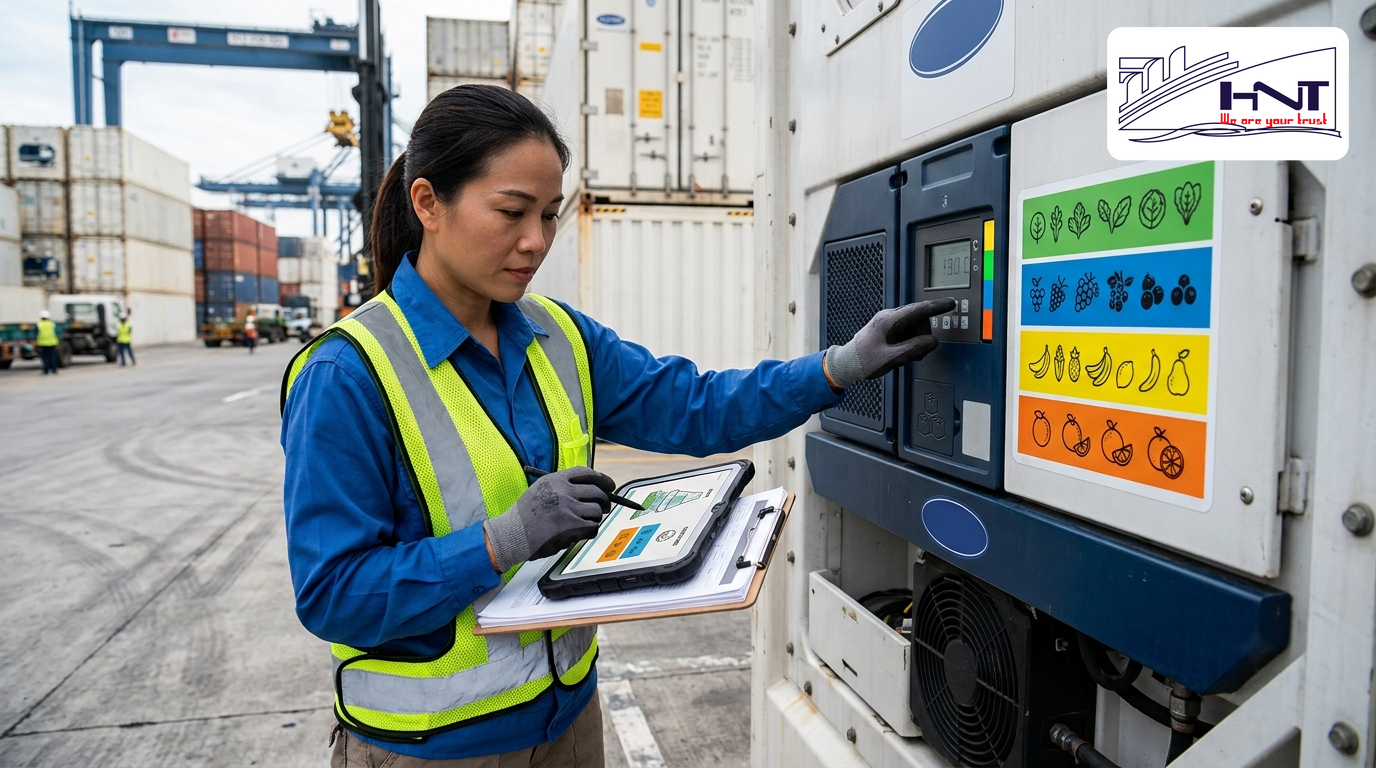
- Determine the core cargo temperature after preprocessing, because a reefer container only maintains temperature and does not rapidly cool hot cargo.
- Check ventilation requirements to prevent ethylene buildup from accelerating fruit ripening during long journeys.
- Select the appropriate cooling mode for chilled and frozen cargo, avoiding one setting for multiple product codes.
- Clearly record the set temperature on shipping instructions, packing sheets, and booking confirmations.
- Cross-check phytosanitary requirements with the destination market before issuing the bill of lading.
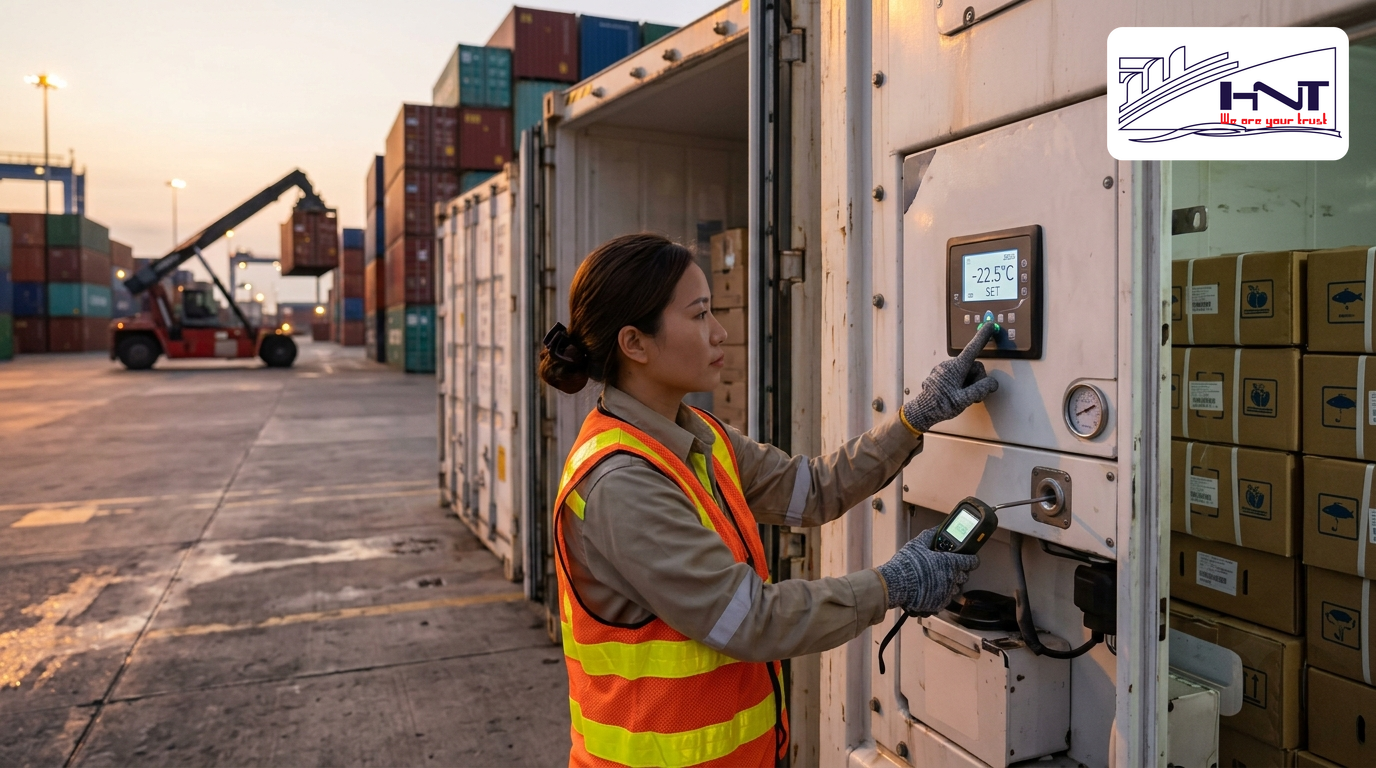
- Request a photo of the controller screen before the container leaves the packing warehouse.
Why precooling the cargo matters more than precooling the container
Reefer containers are not designed to rapidly pull down the core temperature of hot cargo. If mangoes are packed at 28°C into a container set at 10°C, the refrigeration unit must work hard. As a result, defrosting occurs more frequently, humidity fluctuates significantly, and surface quality deteriorates rapidly.
Example 1: An Phu Fresh Company in Tien Giang exported 18 tons of mangoes to Shanghai via Cat Lai Port. When the cargo was precooled to 12°C before packing, the transit temperature remained stable within a 0.8°C range. The previous lot without precooling deviated by 2.6°C on the first day.
Example 2: Long Hoa Cooperative in Can Tho exported seedless limes to Singapore. The warehouse team reduced outdoor waiting time from 90 minutes to 25 minutes. As a result, the reefer container temperature setting at 8°C was not pulled upward during the yard drop-off stage.
Reference temperature range table for fresh produce
| Group of goods | Reference temperature range | Reference ventilation | Risks if incorrect |
|---|---|---|---|
| Dragon Fruit | 5°C to 7°C | Low to medium | Chilling injury or ear wilt |
| Mango | 10°C to 13°C | Standardized, inspected | Rapid ripening or skin browning |
| Fresh durian | 13°C to 15°C | Standardized, inspected | Increased odor and thorn cracking |
| Seedless lime | 7°C to 9°C | Low | Yellowing skin and water loss |
| Leafy vegetables | 0°C to 2°C | Infrastructure | Leaf wetness or hot spots |
Practical summary: record the cargo core temperature in the container packing report. This is important evidence when the shipping line, buyer, or insurer requests an explanation of temperature data.
reefer container temperature setting and proper reefer container defrost cycle
reefer container defrosting is the process of removing ice from the evaporator coil so that cold airflow circulates evenly. For agricultural produce, defrosting is not merely a technical operation. It directly affects humidity, respiration rate, and temperature uniformity between the door end and machinery end.
According to technical documentation from Carrier Transicold, some controllers offer automatic defrost options, and the system can activate before a 12-hour cycle when excessive ice buildup is detected. This shows that cargo owners need to understand operating data, not just look at the set temperature.
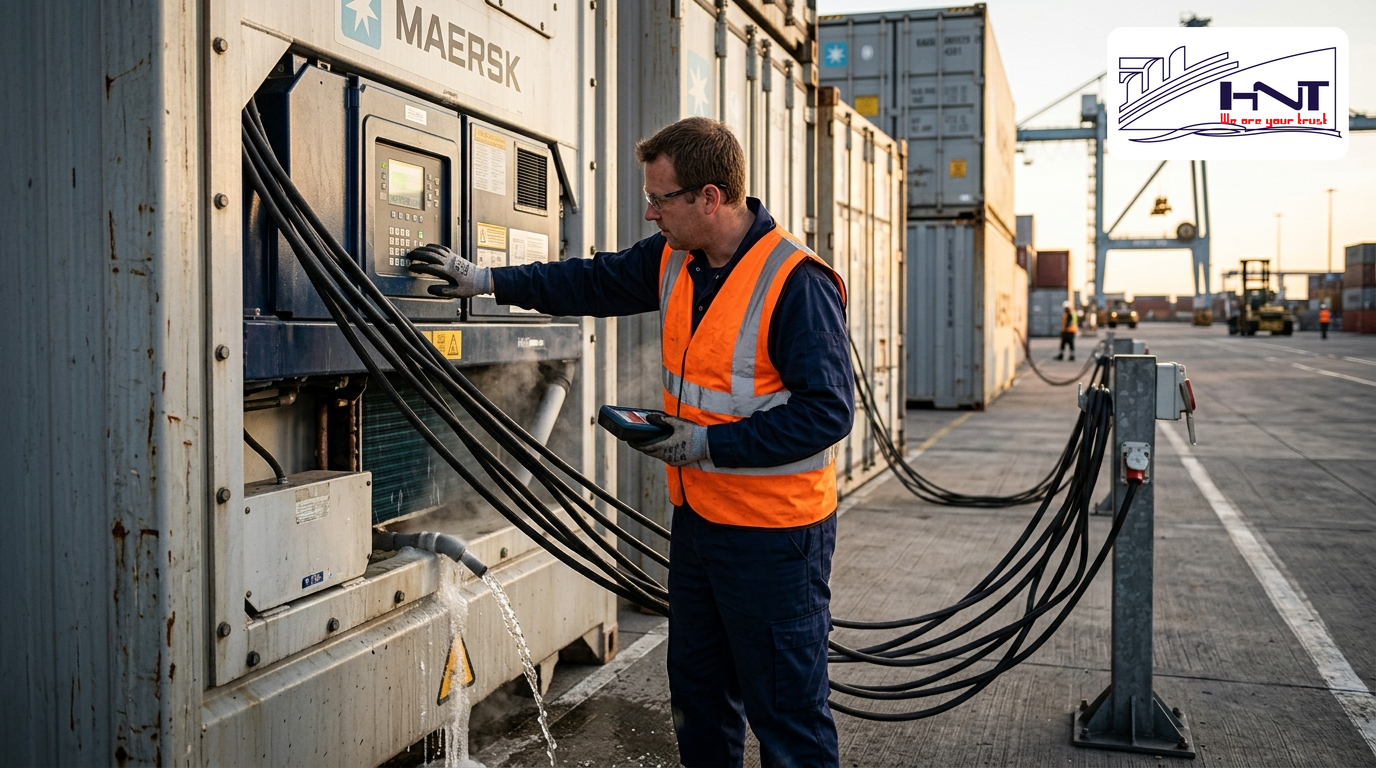
- Do not force manual defrost when cargo temperature is stable and there are no signs of restricted airflow.
- Check the difference between supply air and return air to identify ice buildup on the evaporator.
- Do not leave the container door open for long when the refrigeration unit has just completed a defrost cycle.
- Record the defrost time if the cargo requires strict temperature control.
- Ensure the drain line is not clogged before the container leaves the warehouse.
- Compare temperature data with the reefer yard power connection time to identify the cause of deviations.
When to use automatic defrost and when manual defrost is needed
automatic defrost is suitable for most fresh produce shipments when the container has been inspected before the trip. Manual defrost should only be used when there are signs of restricted airflow, abnormal ice buildup, or ineffective refrigeration operation. This operation requires confirmation by a technician.
Example 1: Mekong Green Company in Ben Tre exported pomelos to Hong Kong. After the inspection door was left open too long, return air temperature increased by 3°C. The technician inspected the evaporator, activated manual defrost, and restored stability after 48 minutes.
Example 2: Phu Minh Packing House in Dong Thap exported fresh jackfruit to Shanghai. The warehouse team did not intervene with defrosting while supply-air data remained stable. As a result, the shipment maintained a temperature deviation of less than 1°C during four days of transport.
Signs of an iced-over evaporator causing temperature deviations
The most visible sign is rising return-air temperature while supply-air temperature remains low. This indicates that airflow is not distributed evenly through the cargo. Based on HNT LOGISTICS experience, pallet arrangement, air gaps, and load-limit markings should also be checked.
| Sign | Common causes | Technical action | Time to check |
|---|---|---|---|
| Return air rises rapidly | Door left open too long | Check the door gasket and door log | After packing |
| Supply air fluctuates | Evaporator iced over | Assess the need for defrosting | Before depot drop-off |
| Water on the floor | Drain clogged | Clean the drain hole | When inspecting an empty container |
| Packages against the ceiling | Block airflow | Rearrange below the red line | During packing |
| Report sensor error | Sensor out of calibration | Request a container change | Before sealing |
Practical summary: do not handle defrosting based on intuition. Use supply air, return air, door-opening times, and evaporator photos to decide whether intervention is needed.
reefer container temperature setting in the reefer container defrost process at the yard
the reefer container defrost process at the yard requires coordination among the cargo owner, transport team, port yard, and shipping line. Errors often occur in the gap between container drop-off and power connection. This gap creates temperature risk, especially for highly respiring cargo.
Regarding customs procedures, Decree 167/2026/ND-CP amends certain provisions of Decree 08/2015/ND-CP and takes effect on 15/08/2026. Circular 39/2018/TT-BTC remains an important basis for customs procedures, inspection, and supervision.
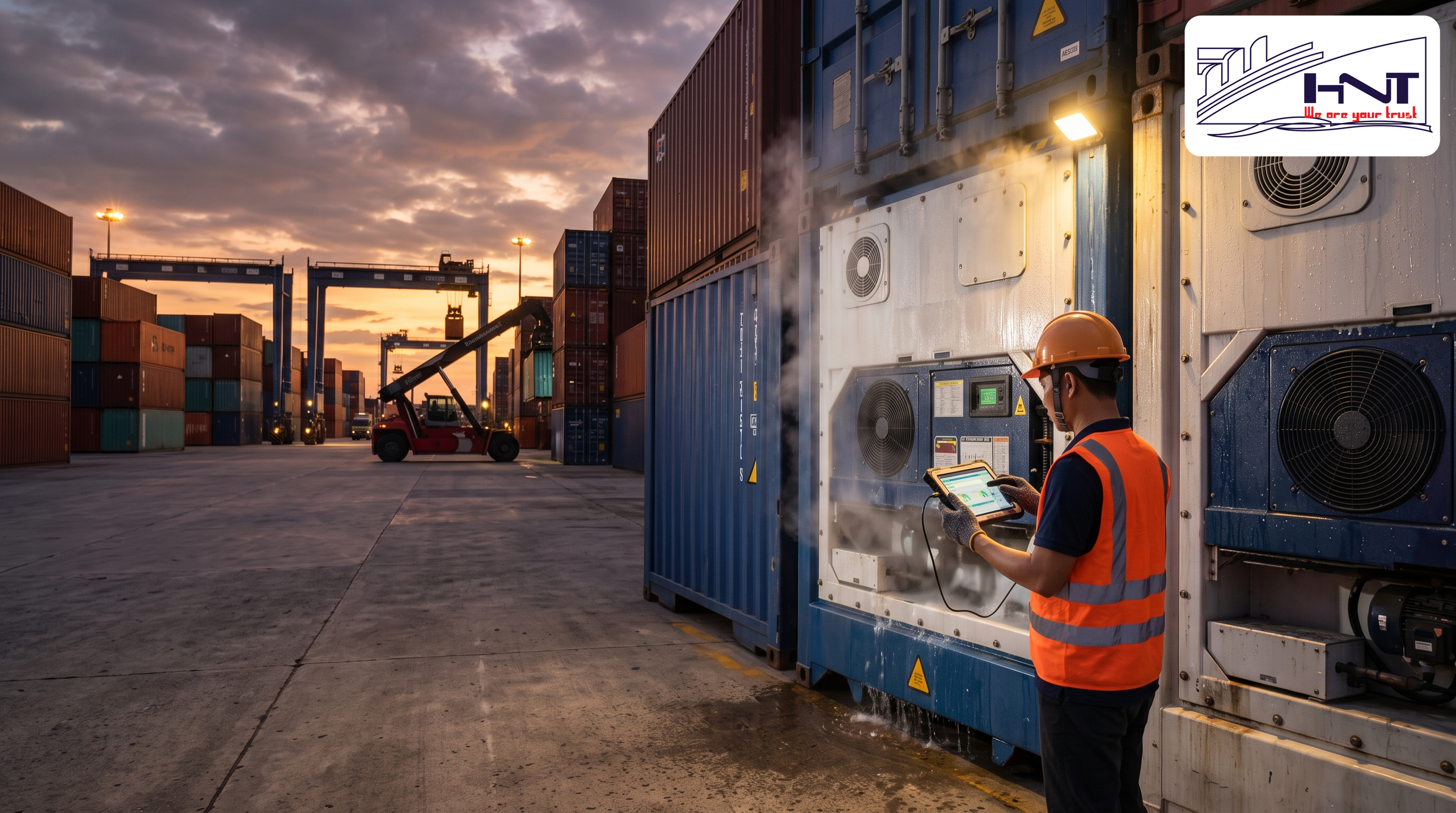
- Schedule the truck appropriately around the cut-off time to reduce the time the reefer container waits outside the yard.
- Request confirmation of the yard power socket before the truck enters the gate, especially during peak fruit season.
- Take screenshots of the temperature, ventilation mode, and container number immediately upon handover.
- Check the seal after plugging in the power, avoiding reopening the door due to missing documents.
- Send written temperature instructions to the port agent and shipping line before yard drop-off.
- Maintain an emergency communication channel with the yard to handle power loss or error alerts.
Checklist when plugging in a reefer container at the yard
plugging in a reefer container at the yard is not merely a power-supply operation. The field team must confirm the correct container number, temperature, ventilation mode, and seal condition. Without photographic evidence, it is difficult for the cargo owner to prove at which stage an error occurred.
Example 1: Hai Nam Foods Company in Ca Mau exported frozen shrimp to Long Beach via Cat Lai Port. By sending temperature instructions 12 hours in advance, the container was connected to power 18 minutes after yard drop-off. The previous lot waited 74 minutes because the booking code was missing.
Example 2: Da Nang Agro Company in Da Nang consolidated herbs for shipment to Bangkok. When the yard reported overloaded power sockets, the coordinator moved the drop-off window three hours later. The shipment avoided temperature increases during the hot midday period.
Coordinating documents, sealing, and yard drop-off timing
Reefer documentation should be consistent across the packing sheet, shipping instructions, customs declaration, and bill of lading (Bill of Lading). If phytosanitary inspection is required, the business must prepare the phytosanitary certificate before entering the port. The EU requires many types of plants and plant products imported into the region to meet phytosanitary requirements.
| Control point | Evidence to save | Person in charge | Risks if missing |
|---|---|---|---|
| Before loading goods | Core temperature photo | Packing warehouse | No proof of precooling |
| After packing | Photo of the controller display | Warehouse monitoring | Incorrect temperature setting |
| At gate exit | Weighing and sealing sheet | Driver | Seal number mismatch |
| At yard drop-off | Power connection confirmation | Field team | Temperature loss outside the yard |
| Before vessel loading | Yard temperature log | Transport agent | Difficult to dispute claims |
Practical summary: build a separate temperature file for each container. This file should accompany the export documentation and customs brokerage service documents.
reefer container temperature setting and remote reefer container temperature monitoring
remote reefer container temperature monitoring helps detect risks early during sea transit. However, data is only useful when the business knows how to interpret the context correctly. A brief temperature increase during a defrost cycle is not the same as a prolonged power outage.
Maersk states that reefers serving fresh produce generally maintain a cool environment, approximately 0°C to 13°C depending on the cargo type. Many modern units also control humidity and use controller software to maintain stable conditions.
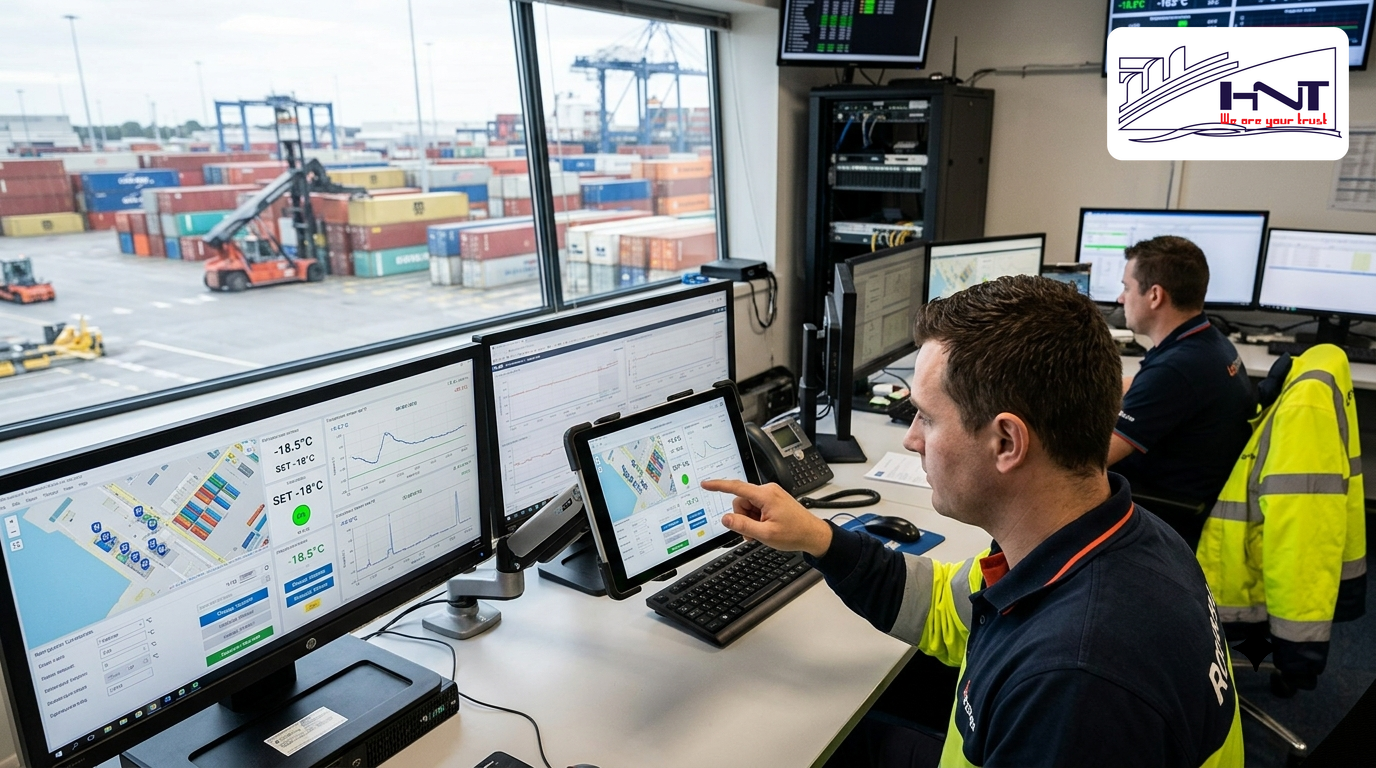
- Monitor set temperature, supply air, return air, humidity, and power status simultaneously.
- Mark temperature increases that coincide with defrost cycles to avoid false alarms.
- Set separate alert thresholds for each cargo category rather than using one common threshold.
- Request the shipping line to provide data extracts when temperature deviations exceed the permitted duration.
- Compare data from external devices with the container controller data.
- Save all alert emails, images, and responses to protect your interests in the event of a dispute.
Data to monitor throughout the journey
Do not look at only one temperature line. Cargo owners need to examine the relationship between supply air, return air, and defrost status. According to HNT LOGISTICS experts, the most useful alerts are based on the duration of temperature deviation, not just an instantaneous temperature point.
Example 1: Tay Nguyen Fruit Company in Dak Lak exported avocados to Busan. The data showed return-air temperature increasing by 1.4°C for 32 minutes, coinciding with a defrost cycle. The company did not rush to file a claim and avoided an unnecessary dispute.
Example 2: Binh Duong Pack Company exported fresh mushrooms to Yokohama. An external device reported a temperature increase lasting 96 minutes after transshipment. By retaining the data, the company asked the shipping line to investigate and change the power socket at the transshipment port.
How to handle temperature alerts before they become claims
When an alert occurs, the business should respond through a standardized sequence of actions. First, determine whether the alert occurred at the warehouse, yard, main vessel, or transshipment port. Then request the original data from the shipping line and compare it with the independent device log.
| Data | Operational significance | Threshold requiring attention | Action |
|---|---|---|---|
| Set temperature | Controller target | Mismatch with shipping instruction | Request immediate adjustment |
| Supply air | Temperature blown onto cargo | Abnormal fluctuation | Inspect evaporator |
| Return air | Temperature returning to unit | Prolonged high temperature | Check load and airflow |
| Power status | Container powered | Power loss over 30 minutes | Notify yard or vessel |
| Defrost cycle | Ice removal | Abnormally excessive buildup | Review door openings |
Practical summary: build an alert matrix by product. A durian shipment has different temperature tolerance from a leafy vegetable shipment, even though both use reefer containers.
reefer container temperature setting to reduce delivery risks and claims
reefer container temperature setting is part of commercial risk management. Buyers often view temperature data as objective evidence. Therefore, cargo owners need to control temperature, defrosting, documentation, and transport responsibilities from the booking stage.
In the context of stricter traceability requirements, green standards, and technical barriers, the Ministry of Agriculture and Environment emphasizes raw material zones, standards, processing, logistics, and markets. This makes reefer documentation a competitive advantage, not merely a transportation cost.
- Define temperature responsibilities in the sales contract, including the temperature range, handover time, and acceptance evidence.
- Clearly state trade terms such as FOB, CIF, or DDP together with the scope of reefer responsibility.
- Standardize the packing report with core temperature photos, seal photos, and controller screen images.
- Request temperature data extracts before unloading if the buyer reports damage.
- Prepare a container replacement plan if the pre-trip inspection detects a sensor or refrigeration-unit fault.
- Prioritize routes with short transshipment times for highly respiring and high-value cargo.
Two practical scenarios for Vietnamese exporters
Example 1: Song Tien Produce Company in Tien Giang exported dragon fruit to Los Angeles on the Cat Lai Port to Long Beach route. The company chose a route with fewer transshipments, used consulting for the sea freight route to the US, and reduced transshipment waiting time by 22 hours compared with the previous option.
Example 2: Nam Trung Bo Herbs Company in Khanh Hoa exported herbs to Sydney. After standardizing reefer container dimensions and the pallet-stacking layout, the hot-spot package rate fell from 4.8% to 0.9% over three consecutive shipments.
Final checklist before closing the container door
Before closing the door, the supervisor should reread the entire shipping instruction in clear Vietnamese. Terms such as bill of lading (Bill of Lading), container storage charges (Demurrage/Detention), and full-container load/less-than-container load (FCL/LCL) need to be understood consistently among sales, warehouse, and forwarding teams.
| Final item | Confirmation method | Timing | Approver |
|---|---|---|---|
| Core temperature | Randomly measure multiple pallets | Before loading | Quality inspection |
| Set temperature | Reefer screen photo | After packing | Warehouse monitoring |
| Airflow | Do not exceed load line | During packing | Loading team |
| Sealed | Match sheet and photos | When locking the door | Driver |
| Reefer file | Store with the document set | Before depot drop-off | Coordinate |
Practical summary: do not consider a reefer container to be a completely self-operating piece of equipment. Its value lies in data discipline, field coordination, and early response capability.
proper reefer container temperature settings help businesses maintain produce quality, reduce claim risks, and protect export profit margins. As reefer volumes increase rapidly, processes need to be standardized with data, not just word-of-mouth experience.
- Confirm the cargo core temperature before packing, because a reefer container does not replace the precooling warehouse.
- Set temperatures by produce category rather than using one temperature range for every product.
- Understand the defrost cycle to distinguish normal fluctuations from actual technical failures.
- Control yard power connection with photos, timing, and confirmation from the field team.
- Monitor remote data by the duration of temperature deviations, not just instantaneous temperature points.
- Keep the reefer file together with the documentation for handling claims, insurance, and quality inspections.
If your business is exporting fresh fruit, agricultural produce, or seafood, HNT LOGISTICS can support route selection, reefer container booking, yard drop-off coordination, and document control. A clear reefer process today will significantly reduce dispute costs tomorrow.