When researching road exports of durian, a container of durian may arrive at the border checkpoint on schedule but still experience delivery delays because quarantine documents have not been completed, Chinese-side vehicles are not ready, or congestion occurs in the inspection area. For high-value commercial fruit that continues to ripen after harvest, every hour of waiting affects transportation costs, cargo quality, and the buyer's acceptance of the shipment.
Activities of road export of durian to China is therefore not simply a matter of hiring trucks to transport goods from growing areas to the border. Businesses need to choose the right border checkpoint, control growing area codes, organize appropriate packaging, confirm import requirements, and develop a feasible cross-border handover plan.
For road export solutions for durian, businesses commonly consider three transportation options: Mong Cai in Quang Ninh, the Lang Son border checkpoint cluster, and Chi Ma. Each route has different characteristics in terms of geographical location, cargo handling capacity, receiving partners, and potential risks. HNT Logistics analyzes these options from the perspective of practical transportation operations while clarifying how to estimate freight costs, control documentation, and minimize durian losses during transportation.
During road transportation and customs clearance for durian exports, Scope of analysis: fresh whole durians exported to China through official channels. Legal and operational information is cross-checked against published sources available as of October 21, 2026. Customs clearance schedules, checkpoints authorized to receive specific types of goods, inspection requirements, and actual costs must be reconfirmed before the shipment date.
Road Export of Durian Through Mong Cai, Lang Son, and Chi Ma: Choosing Border Checkpoints Based on Actual Operating Conditions
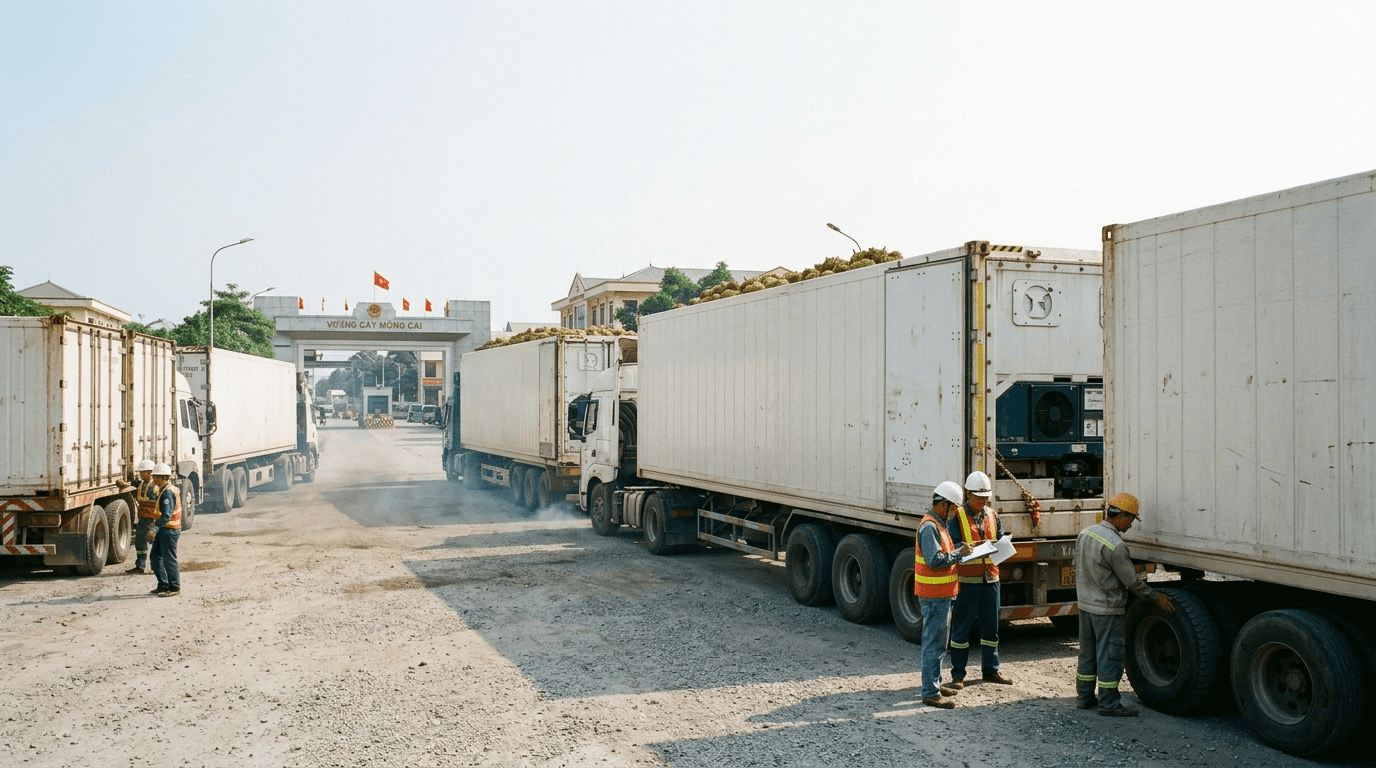
Analyze the operational characteristics of the three border checkpoints, Mong Cai, Lang Son, and Chi Ma, based on geographical location, vehicle handling capacity, cargo handover arrangements, and customs clearance conditions at different times
Mong Cai is located in the border area of Quang Ninh, connecting with Dongxing in Guangxi, China. The Bac Luan II Bridge area plays an important role in international freight transportation. This route is worth considering when the importer arranges cargo receipt in Dongxing or has a distribution network with convenient access to coastal Guangxi.
Durian transportation to Mong Cai must be organized according to the actual receiving schedules on both sides of the border. Starting March 7, 2026, the Bac Luan II area began piloting weekend customs clearance for goods. However, this schedule does not mean that all agricultural shipments are accepted at all times. Businesses must still confirm operating schedules, commodity requirements, and vehicle arrangements before dispatching trucks.
Information about the weekend customs clearance program was published on the Quang Ninh Provincial Information Portal at https://www.quangninh.gov.vn/Trang/ChiTietTinTuc.aspx?nid=163370. This is a reference source for border checkpoint operations and does not replace confirmation of acceptance for a specific durian shipment.
Lang Son Border Checkpoint Cluster offers convenient connections to major trading hubs in Guangxi, particularly through Huu Nghi and Tan Thanh. In August 2026, active exports of fresh durians through these two checkpoints were reported. Therefore, when businesses refer to transporting durians to Lang Son, they need to specify the intended border checkpoint rather than simply listing the province name on the transport order.
Huu Nghi and Tan Thanh have distinct operating characteristics, staging locations, receiving methods, and coordination procedures. Shippers must check cargo handover schedules, the scope of permitted vehicle operations, and the availability of tractors or receiving trucks from China. Businesses should not assume that an arrangement currently used at Huu Nghi can be transferred unchanged to Tan Thanh.
Chi Ma is a border checkpoint in Lang Son Province, connecting with the Aidian area of China. Durian transportation to Chi Ma can be included among the options to evaluate when the Chinese partner can arrange cargo handling in the corresponding area. However, general cargo handling capacity does not mean that every shipment of fresh durians is necessarily permitted to clear customs there.
Before choosing Chi Ma, businesses must confirm through updated operational information that the border checkpoint pair is accepted by the importing side for fresh durians, appropriate quarantine conditions are available, an importer can complete the required procedures, and compliant receiving vehicles are available. Without these confirmations, Chi Ma should only be considered a conditional backup route, not a guaranteed export route.
Develop a route selection matrix based on the growing area, packing facility, durian volume, delivery deadline, and receiving location in China
Route selection should begin with the address of the packing facility and the final delivery point in China, rather than focusing solely on the distance from Vietnam to the border. A truck departing from Dak Lak may take several different road routes, but the shortest route to a border checkpoint does not necessarily result in the shortest total delivery time.
For durians sourced from the Central Highlands, Southeast Vietnam, or the Mekong Delta, businesses need to factor in collection distances, packing time, trucking routes to northern Vietnam, and connectivity from the border checkpoint to warehouses in China. For cargo consolidated in Binh Duong or Dong Nai, the departure distance differs significantly from that of goods packed in Tien Giang, Dak Lak, or Lam Dong.
| Selection Criteria | Mong Cai | Huu Nghi/Tan Thanh | Chi Ma |
|---|---|---|---|
| Target Market | Dongxing and suitable distribution networks in Guangxi | Pingxiang and trading networks connected through Lang Son | Aidian area and receiving points confirmed by the partner |
| Pickup Location in Vietnam | Calculate the route to Quang Ninh | Calculate the route to the specific Lang Son border checkpoint | Calculate the route to Chi Ma and connecting roads |
| Large volume | Depends on the receiving schedule and vehicle availability | Vehicles must be allocated according to the capacity of each border gate | Allocate only after the handling conditions for the shipment have been confirmed |
| Urgent shipment | Suitable when the Dongxing receiving facility is ready and customs clearance schedules are favorable | Suitable when the Pingxiang receiving facility or connecting route is ready | Not recommended if full operational confirmation has not been obtained |
| Main risks | Differences in receiving schedules between the two sides | Vehicle traffic density, quarantine schedules, and traffic diversion capacity | Conditions for accepting the commodity, delivery and receiving capacity, and import arrangements |
This matrix is intended as a guide, not a ranking of border gates. Businesses should score each route across five categories: delivery time, total cost, procedural certainty, preservation capability, and incident-handling capacity. Among these, the validity of the import route is a mandatory condition, and cannot be offset by freight cost advantages.
Assess the impact of border waiting times, vehicle traffic density, agricultural produce receiving schedules, and congestion risks on the commercial quality of fresh durian
Durian continues to respire, generate heat, and ripen after harvest. When trucks have to wait for extended periods in high temperatures, ripening may accelerate, changing firmness, aroma, flesh condition, and impact resistance. A shipment may still meet the required weight but may be discounted because it no longer meets the expected sales window.
Waiting time should be divided into three categories: waiting before entering the border gate area, waiting for inspection or completion of procedures, and waiting for the receiving vehicle on the Chinese side. Each category has different causes and responsible parties. If only the total waiting hours are recorded, businesses will find it difficult to accurately analyze the causes of additional costs.
During peak harvest periods in particular, an increase in fruit transport vehicles may put pressure on staging yards, inspection areas, and transshipment capacity. Before authorizing trucks to depart from the production area, transport operators should check vehicle queues, agricultural produce receiving schedules, and the capacity to handle refrigerated cargo.
Establish a rerouting plan between border gates when the planned route experiences disruptions, taking into account the ability to amend documents, arrange vehicles, and adjust handover plans
A border-gate change plan must be developed before the truck departs, especially for durian shipments with a short sales window. The backup route must meet three conditions simultaneously: the Chinese side accepts imports through the alternative border gate, the Vietnamese documentation can be processed accordingly, and the business has sufficient vehicles and handover capacity.
If the shipment declaration has already been registered, quarantine procedures have been completed, or the shipment is under customs supervision, the border gate cannot be changed simply by replacing the delivery address on the transport order. Businesses must coordinate with the competent authorities to determine the applicable amendment, supplementary declaration, cancellation, or re-registration procedures based on the specific operational status.
For example, a shipment planned for Mong Cai that encounters a disruption may be assessed for rerouting through Huu Nghi or Tan Thanh. However, the plan should only be activated after the import-side recipient confirms its capacity to receive the shipment, customs authorities agree on the handling procedure, and the vehicle is eligible for rerouting. Chi Ma should not be used as a default alternative without first verifying whether it is authorized to receive the commodity.
Road Export Procedures for Durian: Cross-Border Transport Coordination and Control of Handover Points
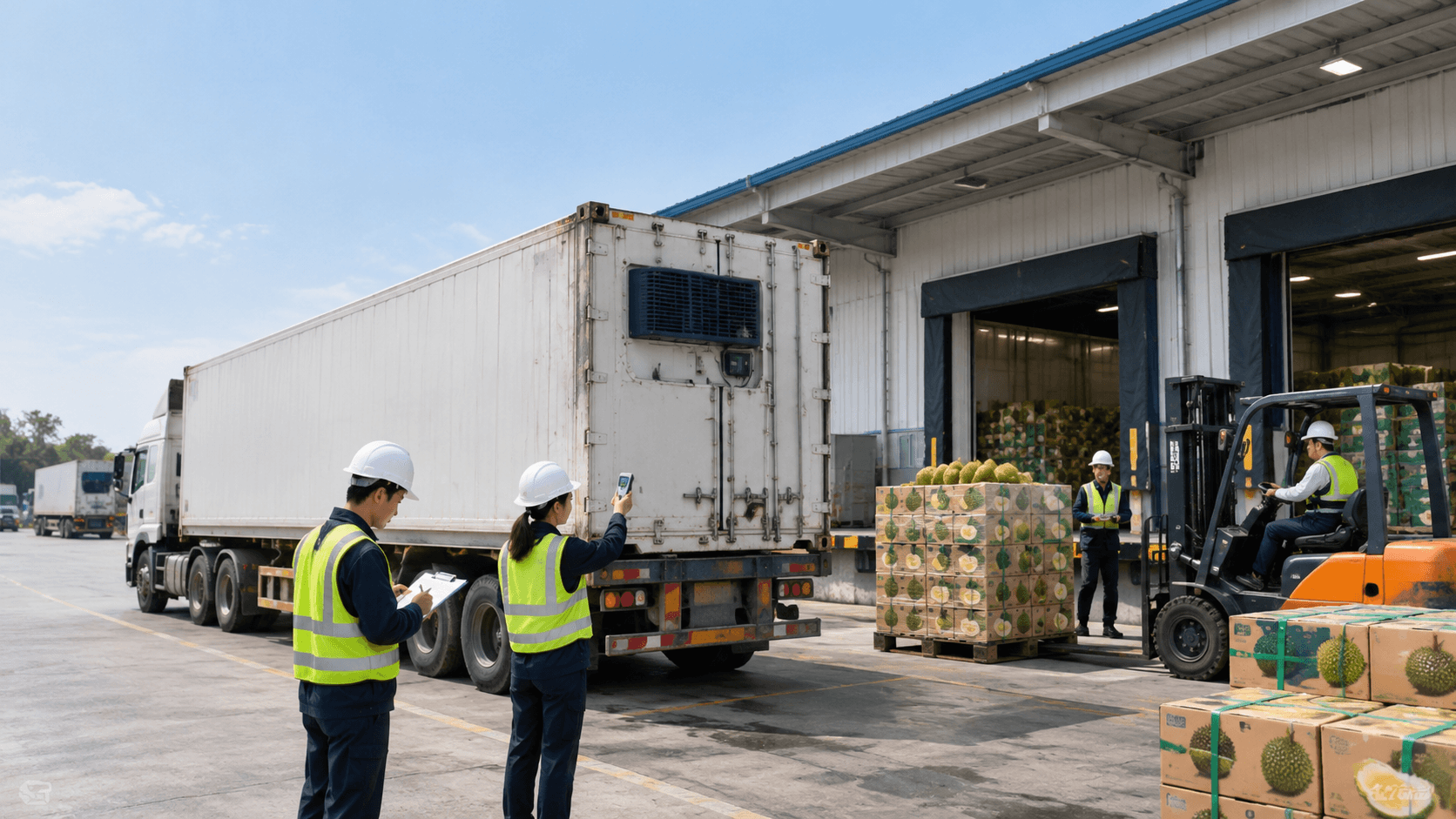
Design the transport flow from the production area to the packing facility, staging point, export border gate, and the Chinese partner's receiving location based on a reverse delivery schedule
Road export procedures for durian should be designed around a reverse delivery schedule. Instead of looking for trucks only after harvesting is complete, businesses should first determine when the buyer needs to receive the shipment, then work backward by deducting the time required for transportation within China, customs clearance, domestic transport in Vietnam, packing, and quality inspection.
Suppose the partner requires delivery at 10 a.m. on Friday. The operations team must calculate when the truck needs to complete customs clearance, its expected arrival time at the staging yard, its departure time from the packing facility, and the deadline for completing quarantine procedures. Each stage should have its own buffer time; the entire buffer should not be added only at the end of the journey.
The standard cargo flow includes a registered and managed growing area, a compliant packing facility, an inspection and sealing point, a domestic transport vehicle, the border gate area, a receiving vehicle on the Chinese side, and the final delivery warehouse. At each handover point, the responsible party for cargo counting, preservation, documentation, and handling discrepancies must be clearly identified.
Determine whether to use direct transport or transshipment at the border based on vehicle conditions, tractor-unit connectivity, and requirements for preserving the shipment's original condition
The direct transport option uses vehicles that meet the requirements for cross-border operations under the regulations applicable to the route. Its advantages include fewer cargo compartment door openings, less handling, and a lower risk of discrepancies in package counts. However, permit requirements, vehicle registration, drivers, insurance, and the permitted operating area must be checked in advance.
The transshipment option uses Vietnamese trucks to transport the cargo to a handover area, where it is transferred to vehicles arranged by the Chinese partner. This approach is flexible when direct transport cannot be arranged, but it adds handling costs, waiting time, potential impact damage, and the risk of temperature-control interruptions.
For refrigerated containers, businesses may assess the option of changing tractor units or handing over the intact container, provided that infrastructure and border regulations permit it. This differs from opening the container to transfer the cargo. All procedures involving seals, customs supervision, refrigeration power supply, and responsibility for maintaining the container must be agreed upon in advance.
The key principle is minimize door openings and direct handling of durian. If transshipment is unavoidable, a packaging condition checklist, photos before and after transshipment, a package count record, the times when temperature control is interrupted and restored, and confirmation from all parties are required.
Establish procedures for controlling vehicle dispatch orders, payload capacity, package quantities, seals, departure times, and handover confirmation at each transportation stage
The vehicle dispatch order must fully specify the trip code, vehicle license plate and trailer plate if applicable, driver's name, cargo pickup point, expected border crossing, delivery location, weight, package count, vehicle type, and preservation requirements. For containers, the container number, seal number, and refrigeration equipment information must be recorded for verification throughout the journey.
Operational payload capacity must be checked against the vehicle's registration inspection, road weight limits, and actual route conditions. The container's nominal payload must not be treated as the maximum weight of durian that can be loaded. Packaging weight, pallets, the container itself, and load distribution across axles all affect the trip's compliance.
Before closing the vehicle doors, warehouse representatives and the driver must count the packages, inspect the condition of the fruit, confirm the cargo temperature, check the cleanliness of the vehicle compartment, and photograph the seal. Upon handover, the recipient must cross-check this same set of data to distinguish losses incurred during transportation from discrepancies that existed when the cargo was loaded.
Establish a coordination mechanism among cargo owners, transport providers, customs brokers, and receiving partners to handle vehicle schedule discrepancies, delivery point changes, or disruptions to border crossing operations
A shipment typically involves at least four groups responsible for operations: the cargo owner makes commercial decisions, the transport provider is responsible for the vehicle, the customs broker handles authorized procedures, and the importer organizes customs clearance and cargo receipt in China. Without clearly defined points of contact, the driver may be notified of a change while the documentation team remains uninformed.
Businesses should use a single shipment code and an operations log recording update times. Every change to the border crossing, license plate, arrival time, seal number, or delivery location must be communicated simultaneously to all relevant parties. A route change takes effect only after confirmation by the persons responsible for commercial and operational matters.
When a vehicle arrives late, the operations team should not simply ask the driver to drive faster. Instead, it should update the estimated arrival time, check the revised receiving schedule, assess the remaining preservation time, and adjust the delivery schedule in China. This mechanism helps reduce the risk of a vehicle traveling at a compliant speed but failing to meet the entire delivery plan.
Road Export of Durian to China: Controlling Customs Clearance Conditions and the Validity of Documentation
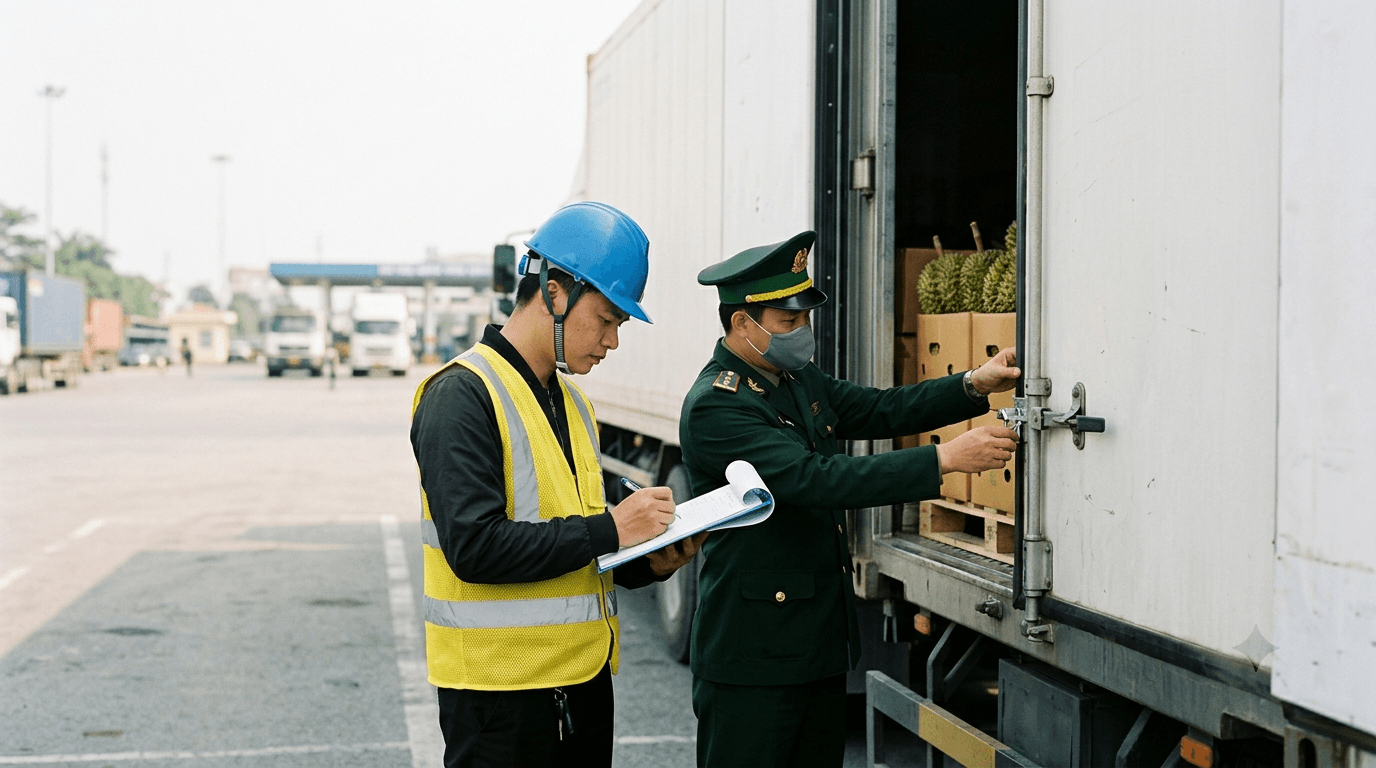
Verify the acceptance requirements for fresh durian in the Chinese market, including growing area codes, packing facility codes, traceability, and currently effective phytosanitary requirements
Vietnamese fresh durian is exported officially to China under the Protocol on Phytosanitary Requirements signed on July 11, 2026, and other relevant current requirements of both countries. Key control areas include growing areas, packing facilities, quarantine pests, traceability, quality, and food safety.
Businesses must verify that growing area codes and packing facility codes appear on the list approved by the Chinese authorities, remain valid, and correspond to the actual shipment. The fact that a facility has previously exported successfully does not guarantee that its code remains authorized for use if its status subsequently changes or management measures are imposed.
According to information from Plant Production and Protection Department, exported fresh durian must comply with pest management requirements, including pests of concern to China such as Bactrocera correcta fruit flies and mealybugs. Packing facilities must ensure sanitation, control harmful organisms, and maintain traceability in accordance with regulations.
The Protocol was published at https://www.ppd.gov.vn/tin-moi-nhat-289/nghi-dinh-thu-ve-yeu-cau-kiem-dich-thuc-vat-doi-voi-sau-rieng-tuoi-xuat-khau-tu-viet-nam-sang-trung-quoc.html. Businesses should read the full text and subsequent updates rather than relying solely on summarized information.
In addition to phytosanitary requirements, cadmium testing and the yellow dye Auramine O have significantly affected durian exports during the 2026–2026 period. Businesses must confirm the testing requirements applicable to the shipment, accepted testing facilities, test results, and agreement with the importer before dispatching the cargo.
In May 2026, the Government Electronic Information Portal reported difficulties related to testing, traceability, and the recognition of testing laboratories. Reference information is available at https://baochinhphu.vn/bai-2-go-nut-that-cadimi-tai-thiet-chuoi-sau-rieng-de-giu-thi-truong-xuat-khau-102260524220023812.htm. This serves as a basis for identifying risks, not as confirmation that one fixed set of testing requirements will apply to every future shipment.
Establish a standardized declaration data set across the contract, commercial invoice, packing list, customs declaration, phytosanitary certificate, and transportation vehicle information
The export documentation package must use a single, consistent source of master data. If the invoice states 18,500 kg while the packing list states 18,650 kg, or the packing facility code on the packaging differs from the declared data, the shipment may be subject to requests for explanation, inspection, or document amendments.
Before making the declaration, the cargo owner must standardize the product name, variety, growing area code, packing facility, net weight, gross weight, number of packages, unit price, delivery terms, recipient, and expected border crossing. The HS code must be determined based on the nature of the goods and the applicable tariff schedule. For whole fresh durian, the code heading commonly considered is 0810.60, but the complete declaration code must be verified against the current classification schedule.
The operational documentation package should generally be prepared according to the scope of the transaction as follows:
- Foreign trade contract or equivalent commercial document specifying the terms of sale.
- Commercial Invoice with consistent quantities, values, seller, and buyer information.
- Packing List specifying the number of packages, weight, packaging specifications, and lot code.
- Export customs declaration and related documents in accordance with current regulations.
- Phytosanitary certificate meeting the requirements applicable to the shipment.
- Growing area code, packing facility code, labeling, and traceability data.
- Test reports, Certificate of Origin (C/O), and supplementary documents when required by regulations or the transaction.
- Vehicle information, driver details, container number, seal number, and corresponding delivery and receipt documents.
A C/O is not automatically a mandatory document for every durian shipment. Applying for a C/O must be based on rules of origin, preferential tariff eligibility requirements, and the agreement with the importer. Similarly, test results must satisfy the operational requirements currently in force rather than merely relying on the fact that the business already possesses any test report.
Analyze potential control points that may delay customs clearance, such as discrepancies in growing area codes, inconsistent shipment information, incomplete phytosanitary documentation, or the importer's failure to confirm acceptance conditions
Rủi ro đầu tiên là sử dụng mã số vùng trồng hoặc mã số đóng gói không đúng với hàng thực tế. Trường hợp này không thể khắc phục bằng cách thay một mã số khác trên hóa đơn nếu hàng hóa không có nguồn gốc tương ứng. Doanh nghiệp phải xác minh dữ liệu gốc và xử lý theo hướng dẫn của cơ quan chức năng.
Rủi ro thứ hai xuất hiện khi hồ sơ kiểm dịch chưa hoàn tất nhưng xe đã khởi hành. Việc xe đến cửa khẩu không làm cho chứng thư được cấp nhanh hơn nếu thiếu điều kiện chuyên môn, kết quả kiểm tra hoặc hồ sơ truy xuất nguồn gốc. Đây là lý do phải xác lập mốc kiểm tra chứng từ trước khi điều xe.
Rủi ro thứ ba nằm ở phía nhập khẩu. Nếu đối tác chưa hoàn thiện thủ tục cần thiết, chưa bố trí đầu nhận hoặc chưa xác nhận cửa khẩu tiếp nhận, hàng hóa có thể bị chờ dù thủ tục phía Việt Nam đã tiến triển. Điều kiện giao hàng trong hợp đồng cần quy định rõ trách nhiệm của người mua ở giai đoạn này.
Doanh nghiệp có thể theo dõi các hướng dẫn nghiệp vụ và thủ tục của Customs authorities tại https://pus.customs.gov.vn/faces/Procedure. Đối với các trường hợp cần khai bổ sung, thay đổi địa điểm hoặc xử lý chứng từ đã đăng ký, phải áp dụng đúng thủ tục hiện hành, không tự ý sửa dữ liệu sau khi hàng đã chịu giám sát.
Xây dựng quy trình kiểm tra tính sẵn sàng của hồ sơ trước khi điều xe, xác nhận đầu mối xử lý nghiệp vụ và phương án bổ sung chứng từ khi phát sinh yêu cầu từ cơ quan chức năng
Trước giờ xe nhận hàng, bộ phận chứng từ cần lập một biên bản xác nhận sẵn sàng gồm trạng thái mã số vùng trồng, mã cơ sở đóng gói, kết quả kiểm tra chất lượng, hồ sơ kiểm dịch, dữ liệu khai báo và thông tin người nhập khẩu. Nếu còn điều kiện bắt buộc chưa hoàn thành, quyết định điều xe phải được đánh giá lại để tránh biến rủi ro chứng từ thành chi phí lưu xe.
Quy trình nên có hai lần đối chiếu. Lần đầu thực hiện trước khi đóng hàng nhằm phát hiện sai lệch từ nguồn nguyên liệu. Lần thứ hai thực hiện sau khi cân xe và xác nhận số kiện, số niêm phong, nhằm bảo đảm thông tin cuối cùng phù hợp với hồ sơ dự kiến sử dụng khi thông quan.
Khi cơ quan chức năng yêu cầu bổ sung, một đầu mối được chỉ định phải tiếp nhận yêu cầu, ghi nhận thời hạn xử lý và xác định đơn vị cung cấp tài liệu. Đại lý thực hiện khai báo hải quan chỉ nên sửa hoặc bổ sung dữ liệu theo hồ sơ có căn cứ và sự chấp thuận cần thiết. Việc thiếu chứng từ không được giải quyết bằng dữ liệu không phản ánh đúng lô hàng.
Bảng So Sánh Xuất Khẩu Sầu Riêng Đường Bộ Qua Móng Cái, Lạng Sơn Và Chi Ma: Cước Vận Chuyển Và Chỉ Số Khai Thác
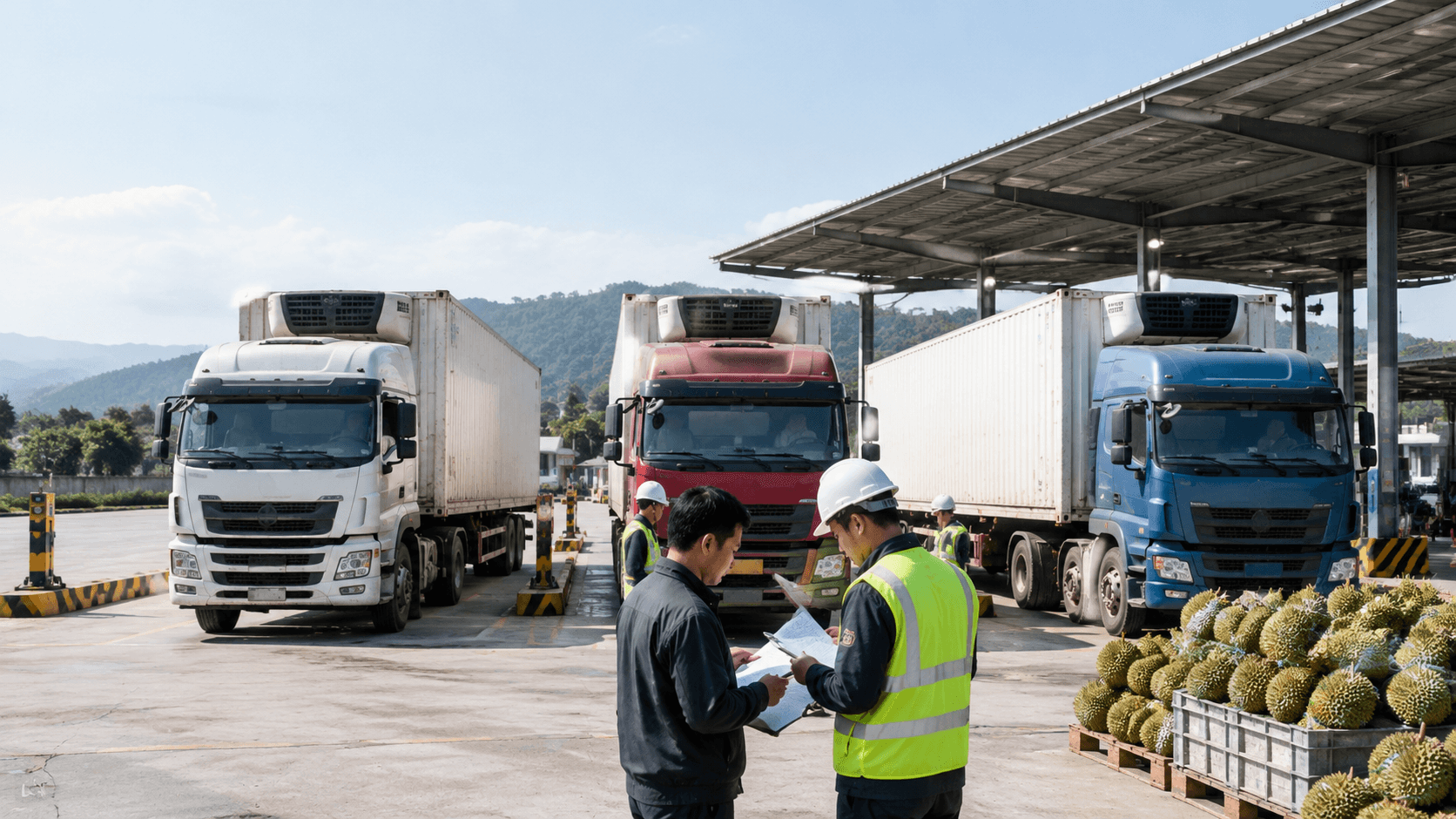
Bảng so sánh ba tuyến Móng Cái, Lạng Sơn và Chi Ma theo cự ly từ điểm lấy hàng, thời gian vận chuyển dự kiến, điều kiện tiếp nhận và các yếu tố ảnh hưởng đến thời gian thông quan
Để so sánh hợp lý, cần sử dụng cùng một điểm lấy hàng. Bảng dưới đây giả định xe nhận sầu riêng tại khu vực thành phố Buôn Ma Thuột, Đắk Lắk, vận chuyển đến khu vực cửa khẩu phía Việt Nam. Đây là kịch bản lập ngân sách, không phải kết quả đo tuyến thực tế hay cam kết thời gian vận chuyển của HNT Logistics.
| Chỉ tiêu | Mong Cai | Hữu Nghị/Tân Thanh, Lạng Sơn | Chi Ma |
|---|---|---|---|
| Cự ly đường bộ tham chiếu | Khoảng 1.850–2.050 km | Khoảng 1.550–1.750 km | Khoảng 1.600–1.850 km |
| Thời gian chạy xe để lập kế hoạch | Khoảng 45–60 giờ | Khoảng 38–52 giờ | Khoảng 40–55 giờ |
| Thời gian chờ cửa khẩu dự phòng trong mô hình | 6–24 giờ | 6–24 giờ | 8–30 giờ nếu đã xác nhận tiếp nhận |
| Đầu tiếp nhận phía Trung Quốc | Đông Hưng | Khu vực Bằng Tường và các điểm tiếp nhận tương ứng | Khu vực Ái Điểm |
| Trạng thái lựa chọn | Khảo sát điều kiện nhận sầu riêng tại thời điểm xuất | Ưu tiên khảo sát Hữu Nghị hoặc Tân Thanh dựa trên hoạt động sầu riêng được ghi nhận | Chỉ kích hoạt khi có xác nhận chấp nhận mặt hàng và phương án giao nhận |
| Rủi ro vận hành nổi bật | Lịch tiếp nhận, phương tiện phía Đông Hưng và hành trình nội địa | Mật độ xe, kiểm dịch, bãi tập kết và lịch giao nhận | Điều kiện tiếp nhận, hạn chế phương tiện và phương án xử lý hồ sơ |
Các khoảng cách và thời gian trong bảng là giả định sơ bộ để minh họa việc lựa chọn tuyến, chưa được xác nhận bằng bản đồ định tuyến cho một địa chỉ kho cụ thể. Thời gian chạy xe bao gồm giả định nghỉ ngơi, nhiên liệu và vận hành an toàn, nhưng chưa bao gồm thời gian thu hoạch, đóng gói, thông quan thực tế hoặc vận chuyển sâu vào nội địa Trung Quốc.
Để lập kế hoạch chính thức, HNT Logistics cần xác minh điểm đóng gói, loại xe, lộ trình được phép lưu thông, giới hạn tải trọng, lịch tiếp nhận và điểm giao cuối. Không nên lấy giá trị trung bình trong bảng làm cơ sở cam kết hợp đồng khi chưa có dữ liệu chuyến xe cụ thể.
Bảng cấu thành chi phí vận chuyển sầu riêng đi Móng Cái, Lạng Sơn và Chi Ma gồm xe lấy hàng, nhiên liệu, phí đường bộ, phí cửa khẩu, chi phí chờ xe, chuyển tải và giao nhận tại điểm đến
Giá vận chuyển sầu riêng phải được bóc tách theo phạm vi dịch vụ. Một báo giá chỉ ghi tổng cước xe dễ khiến chủ hàng hiểu nhầm rằng đã bao gồm toàn bộ phí tại cửa khẩu, chi phí chờ, chuyển tải và vận chuyển tại Trung Quốc. Trên thực tế, những khoản này phụ thuộc cách giao nhận và trách nhiệm thương mại giữa người bán với người mua.
| Cấu phần chi phí | Mong Cai | Lang Son | Chi Ma | Căn cứ xác định |
|---|---|---|---|---|
| Xe gom hàng và vận chuyển đến kho đóng gói | Phát sinh theo địa chỉ | Phát sinh theo địa chỉ | Phát sinh theo địa chỉ | Số điểm lấy hàng, trọng lượng, loại xe |
| Cước vận tải chính | Theo tuyến Quảng Ninh | Theo cửa khẩu cụ thể | Theo tuyến Chi Ma | Cự ly, phương tiện, nhiên liệu và chiều xe |
| Phí cầu đường và hạ tầng | By route | By route | By route | Lộ trình và biểu phí áp dụng |
| Phí bãi, nâng hạ và dịch vụ cửa khẩu | As incurred | As incurred | As incurred | Đơn vị khai thác, loại dịch vụ |
| Phí chờ phương tiện | Theo số giờ hoặc ngày tính phí | Theo số giờ hoặc ngày tính phí | Theo số giờ hoặc ngày tính phí | Thời gian miễn chờ và biểu phí thỏa thuận |
| Phí chuyển tải | Nếu phải chuyển tải | Nếu phải chuyển tải | Nếu phải chuyển tải | Số kiện, thiết bị, nhân công và giám sát |
| Vận chuyển phía Trung Quốc | Theo địa điểm nhận | Theo địa điểm nhận | Theo địa điểm nhận | Hợp đồng và đơn vị vận tải phía nhập khẩu |
| Thủ tục hải quan, kiểm dịch, kiểm nghiệm | Theo phạm vi dịch vụ | Theo phạm vi dịch vụ | Theo phạm vi dịch vụ | Yêu cầu pháp lý và dịch vụ được ủy quyền |
Doanh nghiệp cần phân biệt chi phí vận tải đã được nhà xe tính vào cước trọn tuyến với các khoản thu hộ hoặc thanh toán trực tiếp cho đơn vị cung cấp dịch vụ khác. Không nên cộng thêm nhiên liệu và cầu đường lần thứ hai nếu hợp đồng vận chuyển đã quy định những khoản đó nằm trong cước cơ bản.
Bảng đối chiếu phương án xe thùng kín, xe tải phù hợp hoặc container lạnh theo sản lượng, đặc tính sầu riêng, điều kiện bảo quản và giới hạn tải trọng khai thác
Sầu riêng có gai cứng, khối lượng lớn và khả năng phát sinh nhiệt hô hấp. Chọn phương tiện không chỉ dựa trên số tấn chuyên chở mà còn phải xét mức độ chín, thời gian vận chuyển, khả năng thông gió, diện tích xếp hàng và yêu cầu kiểm soát nhiệt độ.
| Vehicle | Operating characteristics | Quy mô hàng tham khảo | Điều kiện sử dụng |
|---|---|---|---|
| Xe tải thùng kín không có máy lạnh | Che mưa nắng, bảo vệ bao bì nhưng khó kiểm soát nhiệt | Tùy tải trọng đăng kiểm, thường khảo sát cho các lô nhỏ | Chỉ cân nhắc khi thời gian vận chuyển, độ chín và điều kiện môi trường cho phép |
| Xe tải có điều hòa nhiệt độ | Kiểm soát nhiệt tốt hơn, linh hoạt vào điểm lấy hàng | Phụ thuộc cấu hình xe và tải trọng hợp pháp | Phù hợp lô cần theo dõi nhiệt độ và giao nhận linh hoạt |
| 20-foot refrigerated container | Có hệ thống làm lạnh và ghi nhận thông số vận hành tùy thiết bị | Khối lượng thực tế phải tính theo tải trọng pháp lý và sơ đồ xếp | Phù hợp khi cần bảo quản có kiểm soát nhưng phải xét hiệu quả chi phí |
| 40-foot reefer container | Dung tích lớn, phù hợp khai thác chuyến hàng nguyên container | Có thể lập phương án hàng từ khoảng 18–24 tấn nếu tải trọng hợp pháp và điều kiện kỹ thuật cho phép | Cần kiểm tra đường vào kho, nguồn điện và phương án giao nhận tại cửa khẩu |
Container lạnh 40 feet cao thường có chiều dài lọt lòng khoảng 11,5–11,6 m, chiều rộng khoảng 2,28–2,29 m và chiều cao khoảng 2,5 m, tùy hãng sản xuất và thiết bị. Kích thước này chỉ phục vụ bước lập sơ đồ xếp hàng; thông số chính xác phải lấy từ container thực tế.
Đối với sầu riêng tươi, Trung tâm Nghiên cứu Sau thu hoạch của Đại học California, Davis công bố nhiệt độ bảo quản tối ưu tham khảo khoảng 13–15°C và độ ẩm tương đối khoảng 90–95%. Thông tin kỹ thuật tại https://postharvest.ucdavis.edu/produce-facts-sheets/durian. Đây không phải mức cài đặt bắt buộc cho mọi lô hàng, vì giống, độ già, độ chín và điều kiện xử lý sau thu hoạch có thể làm thay đổi phương án phù hợp.
Doanh nghiệp cần đặc biệt tránh cài nhiệt độ thấp một cách tùy tiện. Nghiên cứu về bảo quản sầu riêng đã ghi nhận nguy cơ tổn thương lạnh đối với trái ở một số mức độ trưởng thành và điều kiện nhiệt độ. Vì vậy, thông số cài đặt phải được xác nhận với đơn vị kỹ thuật bảo quản và người mua trước khi đóng container.
Bảng tính tổng chi phí trên mỗi kilogram hàng giao nhận theo từng cửa khẩu, có phân tách cước cơ bản, phụ phí dự kiến, chi phí dự phòng và các khoản chưa bao gồm trong báo giá
Để minh họa cách so sánh, giả định doanh nghiệp có một lô sầu riêng tươi 20.000 kg, đóng tại Buôn Ma Thuột, sử dụng phương tiện kiểm soát nhiệt độ phù hợp. Các số liệu dưới đây hoàn toàn là giả định tài chính phục vụ lập ngân sách, not surveyed market prices and not quotations from HNT Logistics.
| Assumed Cost Item | Mong Cai | Lang Son | Chi Ma |
|---|---|---|---|
| Basic Transportation Cost | VND 48,000,000 | VND 43,000,000 | VND 45,000,000 |
| Planned Surcharges | VND 5,000,000 | VND 5,000,000 | VND 6,000,000 |
| Contingency for Waiting and Delivery Adjustments | VND 7,000,000 | VND 6,000,000 | VND 9,000,000 |
| Total Assumed Budget | VND 60,000,000 | VND 54,000,000 | VND 60,000,000 |
| Assumed Delivery Volume | 20,000 kg | 20,000 kg | 20,000 kg |
| Planned Cost/kg | VND 3,000/kg | VND 2,700/kg | VND 3,000/kg |
| Excluded Costs | Procurement, packaging, inspection, taxes and import duties, domestic costs in China, cargo insurance, and items not confirmed within the scope of services | ||
The calculation formula is: planned logistics cost per kilogram equals the total estimated cost divided by the expected delivery volume. When calculating the actual cost per kilogram of accepted goods, the denominator must be replaced with the quantity accepted by the buyer, not the initial number of kilograms loaded onto the truck.
For example, the Lang Son route has an assumed budget of VND 54 million for 20,000 kg, equivalent to VND 2,700/kg. If only 19,200 kg are accepted, the allocated transportation cost rises to VND 2,812.5 per accepted kilogram, excluding commercial losses. Therefore, a lower freight rate does not necessarily deliver better economic efficiency.
For Chi Ma specifically, the presence of financial figures in the table does not confirm the feasibility of clearing durian through customs at the time of export. Businesses must complete verification of acceptance conditions before considering this route's costs as a viable option.
Optimizing Road Export Costs for Durian: Managing Waiting Times and Cargo Shrinkage Risks
Analyze the relationship between transit time, customs clearance waiting time, vehicle costs, and the rate of durian quality deterioration to determine the most efficient transportation option
The actual cost of a durian shipment includes transportation costs, waiting costs, additional handling costs, and the commercial value lost due to quality deterioration. If businesses compare only truck freight rates, they may choose an option that is cheaper when booking the truck but more expensive when settling the shipment.
Assume the durian shipment is worth VND 1.2 billion. If a transportation option saves VND 5 million but causes the proportion of cargo value lost to increase by 1%, the loss increases by the equivalent of VND 12 million. The freight savings are insufficient to offset the reduction in value, even though the number of packages and the shipped weight remain unchanged.
Physical shrinkage must be distinguished from commercial losses. Physical shrinkage refers to the quantity or weight of goods lost, while commercial losses include cases where the fruit remains intact but is downgraded, discounted, or rejected during acceptance. For durian, the second indicator is often particularly important because buyers assess ripeness, flesh quality, rind condition, and remaining distribution shelf life.
Businesses should calculate the total expected cost for each route by adding transportation charges, surcharges, contingency costs weighted by their probability of occurrence, and the expected value of quality-related losses. Loss rates must be based on actual shipment data rather than a fixed rate applied to every durian variety or growing season.
Develop a vehicle dispatch plan based on actual production volume, loading capacity, receiving time windows, and border checkpoint operating schedules to minimize truck waiting times and prolonged cargo staging.
Vehicle dispatch must closely follow the actual loading rate. If the warehouse can load only 40 tons per day but four vehicles with a combined capacity of 80 tons are scheduled to arrive at the same time, at least some of the vehicles will have to wait. Vehicle detention costs will increase, while harvested fruit may continue to ripen before being loaded onto suitable vehicles.
For programs involving multiple container shipments, vehicle schedules should be divided into batches based on cargo readiness, documentation completion, and the buyer's receiving capacity. Each shipment should have its own loading time, expected sealing time, departure time, and estimated border arrival window. This approach helps prevent multiple vehicles from converging at the same time.
When transporting durians to Lang Son or Mong Cai during peak agricultural export periods, traffic and border crossing conditions should be monitored while the vehicles are en route. If the number of waiting vehicles increases sharply, the operations team should assess whether to adjust the approach speed or use a suitable stopover location with appropriate storage conditions, rather than allowing all vehicles to gather near the border crossing.
Establish vehicle selection criteria based on ripeness, ventilation, protection from rain, sunlight, and vibration, as well as temperature control conditions appropriate for each durian shipment.
Before selecting vehicles, the packing facility should provide the durian variety, harvest date, maturity level, loading time, packaging specifications, and quality requirements upon delivery. This information is more important than simply labeling the cargo as fresh fruit on the transport order.
Enclosed trucks can protect cargo from rainwater and direct sunlight but may still accumulate heat if ventilation is inadequate. Refrigerated containers provide better temperature control, but they are not designed to rapidly cool all freshly harvested cargo. Durians must undergo appropriate incoming temperature conditioning before loading, in accordance with the shipper's technical procedures.
Loading must ensure adequate airflow and must not obstruct the return air path or the refrigerated unit's air supply outlets. Packaging must withstand stacking weight, fruit spikes, and vibration. For refrigerated containers, the refrigeration unit, power supply, fuel for the generator set if used, and temperature recording equipment must be inspected before accepting the cargo.
For long-distance north-south transportation, temperature alert thresholds and procedures for handling refrigeration unit failures must be established. However, a single temperature threshold should not be applied to all durian varieties. The setpoint, acceptable fluctuation range, humidity, and ventilation requirements must be confirmed based on the characteristics of each shipment.
Develop a response matrix for situations involving border congestion, vehicle breakdowns, changes to delivery arrangements, requests for additional documentation, or cargo failing acceptance criteria.
For agricultural products that are prone to quality deterioration, effective incident management depends on responsibilities being clearly assigned before an incident occurs. Each scenario should have a warning signal, a decision-maker, a response time limit, and a plan to preserve the cargo.
| Situation | Warning signs | Priority measures | Responsible party |
|---|---|---|---|
| Border gate congestion | Waiting time exceeds the planned threshold | Update the estimated arrival time, check storage conditions, and assess legitimate route alternatives. | Transport operations team and shipper |
| Vehicle or refrigeration equipment breakdown | Inability to move or abnormal temperature readings | Move the vehicle to a safe location and arrange repairs or a replacement vehicle in accordance with regulations. | Transport provider |
| Change of delivery location in China | The partner requests a different location | Check the contract, vehicle arrangements, import conditions, and documentation. | Shipper and importing partner |
| Additional documentation required | Authorities request clarification | Cross-check the original data, provide supplementary documents through the proper procedures, and update the vehicle schedule. | Customs broker and shipper |
| Cargo fails acceptance inspection | Discrepancies in package count, damage, or quality below the agreed standard | Prepare an inspection report, record supporting evidence, and resolve the matter in accordance with the contract. | Shipper, transport provider, and recipient |
In the event of refrigeration equipment failure, the temperature log, GPS location, downtime, and on-site photographs must be retained as evidence. If a container must be opened or cargo under customs supervision must be transferred, this must be carried out in accordance with the instructions and required approval of the competent authorities.
If the goods are rejected by the buyer, the acceptance criteria agreed upon in the contract and the actual condition at the time of delivery must be determined. Losses should not automatically be attributed entirely to the carrier, nor should every deduction be accepted without supporting inspection findings, documentation, and a clear allocation of responsibility.
HNT Logistics Supports Road Exports of Durian Through Mong Cai, Lang Son, and Chi Ma with Transparent Logistics Solutions
Consultation on durian transportation routes to Mong Cai, Lang Son, or Chi Ma based on the pickup location, shipment volume, delivery schedule, and actual receiving conditions confirmed by Chinese partners
HNT Logistics approaches durian transportation by considering the entire journey from the pickup point to the delivery destination. Rather than simply quoting a truck freight rate, the proposed solution must take into account the warehouse location, loading time, shipment volume, characteristics of durian, border crossing route, and delivery conditions confirmed by the Chinese partner.
With the demand to door-to-door durian transportation to Mong Cai, the service scope can be developed to include domestic transportation, vehicle coordination, document support, and cross-border delivery coordination as agreed. Services performed by other partners, especially within Chinese territory, must have clearly defined responsibilities and costs in the quotation.
For Lang Son, HNT Logistics needs to clarify whether the planned route is through Huu Nghi or Tan Thanh. For Chi Ma, confirmation that both sides of the border crossing can accept fresh durian must be obtained before establishing an official export plan. This helps cargo owners avoid the risk of booking trucks for a route that is not yet operationally feasible.
Coordination of tractor units, suitable transport vehicles, customs declarations, and plant quarantine procedures within the agreed service scope
HNT Logistics has experience in freight forwarding, container transportation, refrigerated cargo transportation, and import-export procedures. For durian, the advantage of an integrated solution lies in the ability to arrange suitable vehicles, control transportation schedules, and coordinate documentation with the actual progress of each shipment.
Within the scope authorized and agreed upon by the customer, HNT can coordinate operational procedures customs declaration, prepare relevant documents, work with quarantine authorities, and organize transportation plans. Issuing phytosanitary certificates, making customs clearance decisions, and granting import approvals fall under the authority of the relevant competent agencies and are not guarantees that a logistics company can independently provide.
Refrigerated container transportation must be coordinated with the loading team to check equipment condition, loading arrangements, and required temperature settings. When using transshipment or tractor-unit replacement arrangements, HNT must agree in advance on handover points, confirmation documents, seal management responsibilities, and the designated contact for incident handling.
Providing quotations broken down by cost component, clarifying estimated transportation time, applicable conditions, exclusions, and potential additional charges
A useful durian transportation quotation must clearly specify the service origin, service destination, vehicle type, cargo weight, validity period, and method for determining additional charges. In particular, for transshipment arrangements at the border, handling costs, Chinese-side trucking costs, and the timing of the transfer of responsibility must be clearly defined.
HNT Logistics aims to prepare quotations based on controllable total costs, rather than just the nominal freight rate. Businesses should be provided with information on estimated driving time, any free waiting period, waiting charges after the free period, conditions for surcharge increases, and procedures for handling situations that require a route change.
Excluded items such as specialized testing, cargo insurance, warehousing, costs for handling non-compliant shipments, import duties in China, and expenses arising outside the transportation scope must be presented transparently. An official quotation can only be finalized once sufficient shipment information is available and delivery conditions have been confirmed.
HNT Logistics supports businesses exporting durian by road in controlling cross-border schedules, optimizing logistics costs, and preserving cargo quality from Vietnamese growing regions to delivery points in China
The success of a durian export shipment is not measured solely by whether the truck arrives at the border on time. The final outcome must be reflected in the ability to deliver the correct goods with the correct documents to the correct receiving point, keep costs under control, and maintain commercial quality according to the buyer's requirements.
Through container transportation, refrigerated cargo services, road transport coordination, and cooperation on import-export procedures, HNT Logistics aims to help businesses reduce disruptions between growing regions, packing facilities, border crossings, and Chinese partners. Factors such as receiving schedules, transshipment arrangements, vehicle capacity, and quarantine requirements must be checked in advance rather than addressed only after the truck has reached the border.
For businesses that regularly export durian by road, building historical data for each route also helps improve forecasting accuracy. Key indicators to monitor include driving time, waiting time, cost per kilogram accepted upon inspection, the rate of documentation-related issues, and the number of changes to delivery and receiving plans.
Efficient road export of durian means choosing a route that offers practical customs clearance, effective quality control, and a reasonable total cost, not necessarily the route with the lowest trucking rate. Mong Cai, Huu Nghi, Tan Thanh, or Chi Ma becomes a suitable option only when documentation, border crossing, vehicle, and receiving-point requirements have all been fully confirmed.
Businesses seeking durian transportation to Mong Cai, durian transportation to Lang Son, or an assessment of the Chi Ma route can contact HNT Logistics to discuss a solution suited to their shipment. Provide the pickup address, cargo volume, packaging specifications, expected delivery time, and receiving location in China to receive advice on the transportation route, vehicles, and specific cost components.
HNT Logistics – Supporting businesses at every stage of durian export transportation. Website: https://hntshipping.com.vn. Hotline: 0911 446 060 or 0949 393 300. Email: anhdao@hntshipping.com. Contact information is referenced from the company's official website.