When researching durian transportation to Lao Cai, a truck carrying 20 tons of durians from the Central Highlands to a northern border gate can incur significant costs if the loading time does not match the vehicle dispatch schedule, quarantine documents are incomplete, or the Chinese partner changes the receiving time. For goods with high commercial value and sensitivity to storage conditions, delivery delays not only increase transportation costs but also directly affect the proportion of fruit meeting export standards.
Solution durian transportation to lao cai must be designed as a continuous logistics chain, starting with identifying the raw material area, checking the growing area code, planning the harvest, selecting vehicles, controlling quality, and completing export procedures to China. Each stage is related to the final cost per kilogram of durian accepted by the importer.
For durian transportation to Lao Cai, in addition to the Lao Cai route, the option durian transportation to ha giang should also be evaluated when the enterprise has a suitable forwarding partner in the Vietnam–China border area. However, it cannot be assumed that every border gate is permitted to receive fresh durians or has the same customs clearance capacity. Route selection must be based on the actual conditions of each shipment, the operational scope of the border gate, and confirmation from the importer.
During the transportation and customs clearance process for durian transportation to Lao Cai, hNT Logistics approaches this task by analyzing the total supply chain cost, combining road transportation, cold-chain solutions, delivery coordination, and export documentation services. The following content clarifies the technical criteria, operating options, and cost estimation model so that enterprises can build a feasible delivery plan rather than simply selecting vehicles based on the lowest freight rate.
Durian Transportation to Lao Cai: Designing a Logistics Corridor from the Harvest Area to the Export Point to China
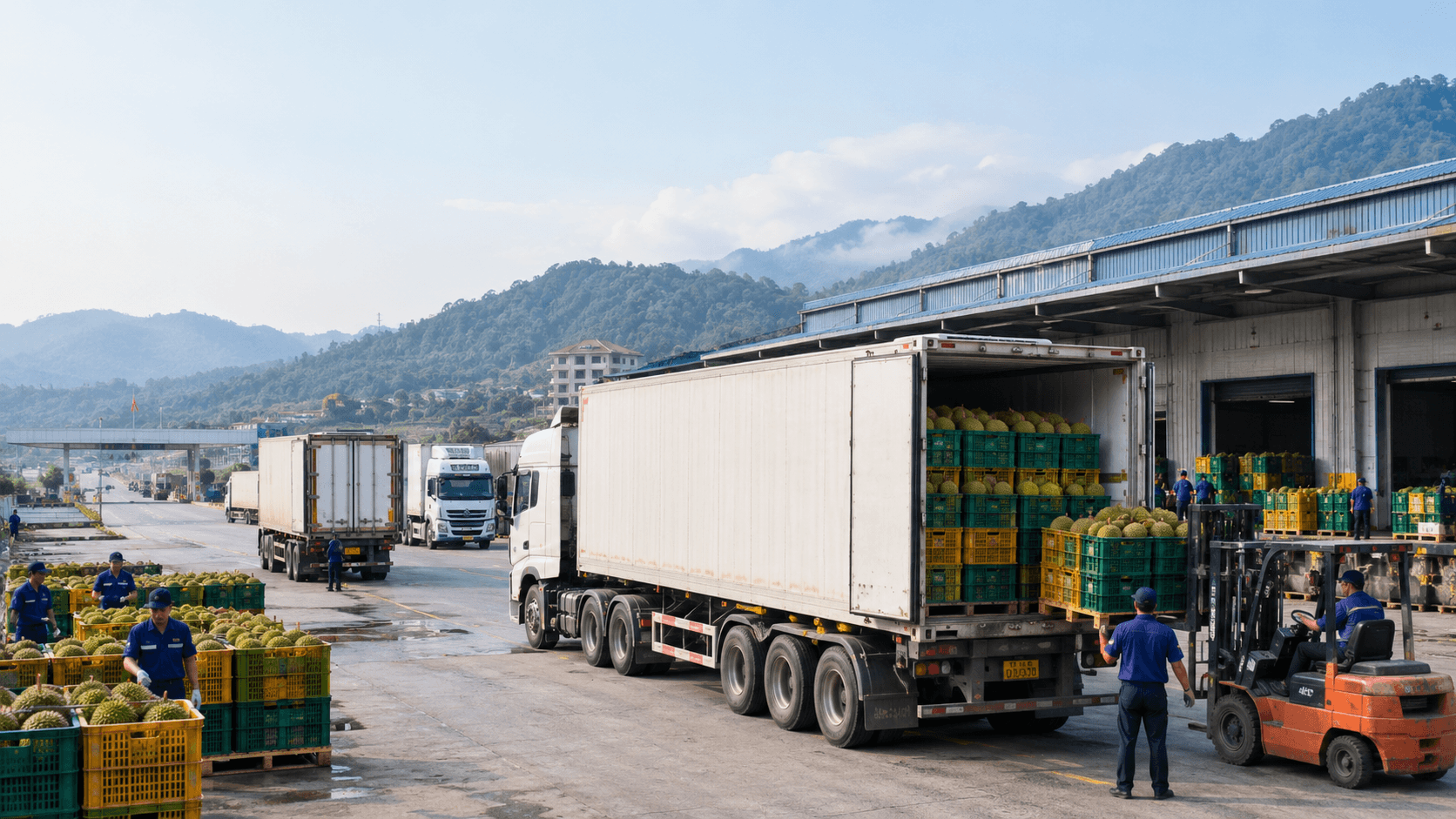
To optimize the cost and schedule of durian transportation to Lao Cai, the durian logistics corridor must connect three areas with different operational requirements: the harvest area, the long-distance transportation route, and the border delivery point. An effective plan needs to clearly determine who is responsible at each handover point, how long the goods remain outside a controlled storage environment, and how to handle potential delays.
Analysis of durian flows from the Central Highlands and Southeast Vietnam to the Lao Cai area based on raw material area locations, consolidation capacity, and actual harvest timing
Based on HNT Logistics' practical operating experience with durian transportation to Lao Cai, export durian supplies are concentrated in many areas of the Central Highlands and Southeast Vietnam, including Dak Lak, Lam Dong, Dong Nai, and neighboring production areas with different road connectivity conditions. For exporters, the orchard location is not the only factor determining the truck route. Pre-sorting capacity, packaging, container reception, and the distance from the packing facility to the national highway network are the parameters that need to be evaluated simultaneously.
For shipments originating from Dak Lak, vehicles can be dispatched from the packing facility to inter-regional roads to connect with the North–South corridor before approaching Lao Cai. Goods from Dong Nai or the Southeast region can use suitable expressways, national highways, and consolidation points. The specific route must be checked according to vehicle load capacity, road conditions, warehouse location, and delivery requirements.
Harvest seasons vary by locality, cultivar, climate conditions, and cultivation methods. Therefore, truck schedules should not be based solely on the expected seasonal calendar. The coordination team needs confirmation of the quantity that can be harvested each day, the proportion of fruit meeting standards after sorting, and the actual capacity of the packing line before determining the number of vehicles.
For example, a facility planning to harvest 60 tons over three days but having a packaging capacity of only 15 tons per day cannot ensure a plan to dispatch three 20-ton trucks to collect the goods simultaneously. In this case, the truck schedule should follow the quantity that has been inspected and fully packaged, while maintaining a buffer period for quarantine activities and handling goods that do not meet standards.
Develop a cargo routing plan through transit points to minimize empty running distance, loading and unloading waiting time, and vehicle coordination costs
Each transit point creates operating costs but can provide benefits if it helps consolidate sufficient loads, reduces the distance that large trucks must travel on orchard roads, or improves vehicle coordination. Enterprises need to compare direct transportation costs with cargo consolidation, loading and unloading, warehouse rental, storage equipment operation, and risks arising at the transshipment point.
A suitable option for many dispersed raw material areas is to use small trucks to collect goods and bring them to a qualified packing facility, then transfer them to large trucks or refrigerated containers for long-distance transportation. This arrangement reduces the number of times long-distance vehicles have to change pickup locations. However, goods must be traceable by each growing area and must not be mixed in a way that prevents identification of individual lots.
Empty running costs should be calculated from the available vehicle location to the pickup point and from the delivery point to the next operating location. A unit capable of combining transport directions or using a fleet already operating near the packing area can reduce dispatch costs. Nevertheless, schedule coordination must ensure that vehicles are cleaned, cargo compartment conditions are inspected, and there is no risk of cross-contamination.
To control waiting time, the packing facility should notify the number of completed pallets or packages at each time milestone. When the actual volume reaches the truck-loading threshold, the coordination team should then confirm the time for the vehicle to enter the warehouse. This approach limits situations where the tractor arrives too early and incurs waiting fees while the goods are still undergoing quality inspection or completing traceability labels.
Determine a cross-border delivery model using direct transport, tractor replacement, or transshipment at an appropriate handover point based on operating conditions
Activities of exporting durians through Lao Cai can use different delivery models depending on vehicle conditions, international transport permits, customs supervision requirements, and the receiving arrangements of the Chinese side. Enterprises need to clearly distinguish domestic transportation to the border gate from the activity of taking vehicles or goods across the border, as the two stages may be performed by different units.
The direct transport option keeps the same cargo vehicle from the point of origin to the final delivery point, helping minimize loading and unloading operations. However, this form is only feasible when the vehicle, driver, intermodal transport permits, insurance conditions, and border gate management mechanisms meet the requirements of both sides. Direct transport to China should not be committed to before all those conditions have been fully checked.
For the tractor replacement option, the container can continue using the same cargo equipment while the tractor is replaced in an authorized area. The advantage is reduced direct handling of the durian fruit and maintained sealing. The limitation is that compatibility of the trailer, power supply system for the refrigerated container, equipment permits, and responsibility for operating the refrigeration unit during the handover must be checked.
Transshipping goods onto vehicles on the Chinese side usually creates additional requirements for personnel, loading and unloading locations, and temperature control. When applied, enterprises should use a handover record documenting the number of packages, weight, seal numbers, packaging condition, and cargo temperature. For fresh durians, the time the container doors are open and the degree of impact during transshipment need to be controlled particularly carefully.
Establish a reverse transportation schedule from the expected delivery time to the Chinese partner to synchronize harvesting, packaging, vehicle dispatch, and document completion
Instead of starting the plan with the harvest date, the enterprise should determine when the Chinese partner is able to receive the goods and then calculate backward the time required for each stage. The operating schedule must include driving time, legally required rest periods, vehicle inspection, waiting at the border gate, quarantine, customs clearance, and delivery.
For example, a durian shipment needs to be present at the border delivery area on Friday morning. If the domestic transportation plan is expected to require approximately three days, the loading time must be determined at the beginning of the week with an appropriate buffer period. This is only an illustrative planning method; the official timing must be calculated based on the actual address, road conditions, and working schedules of the parties.
The reverse schedule should have three control milestones. The first milestone confirms the growing area, packing facility, and export conditions. The next milestone confirms that the goods have sufficient quantity and quality and are ready for loading. The final milestone confirms the documents, vehicle, and border receiving conditions before the vehicle departs for the long-distance leg.
If the importer has not confirmed its ability to receive the goods, sending trucks to the border gate too early may increase vehicle storage fees and the risk of quality deterioration. A good plan needs a schedule lock-in time, a person responsible for approving changes, and a unified notification mechanism for the orchards, packing facility, transport unit, and Chinese forwarding agent.
Durian Transportation to Lao Cai and Ha Giang: Controlling Operational Risks on the Road Journey
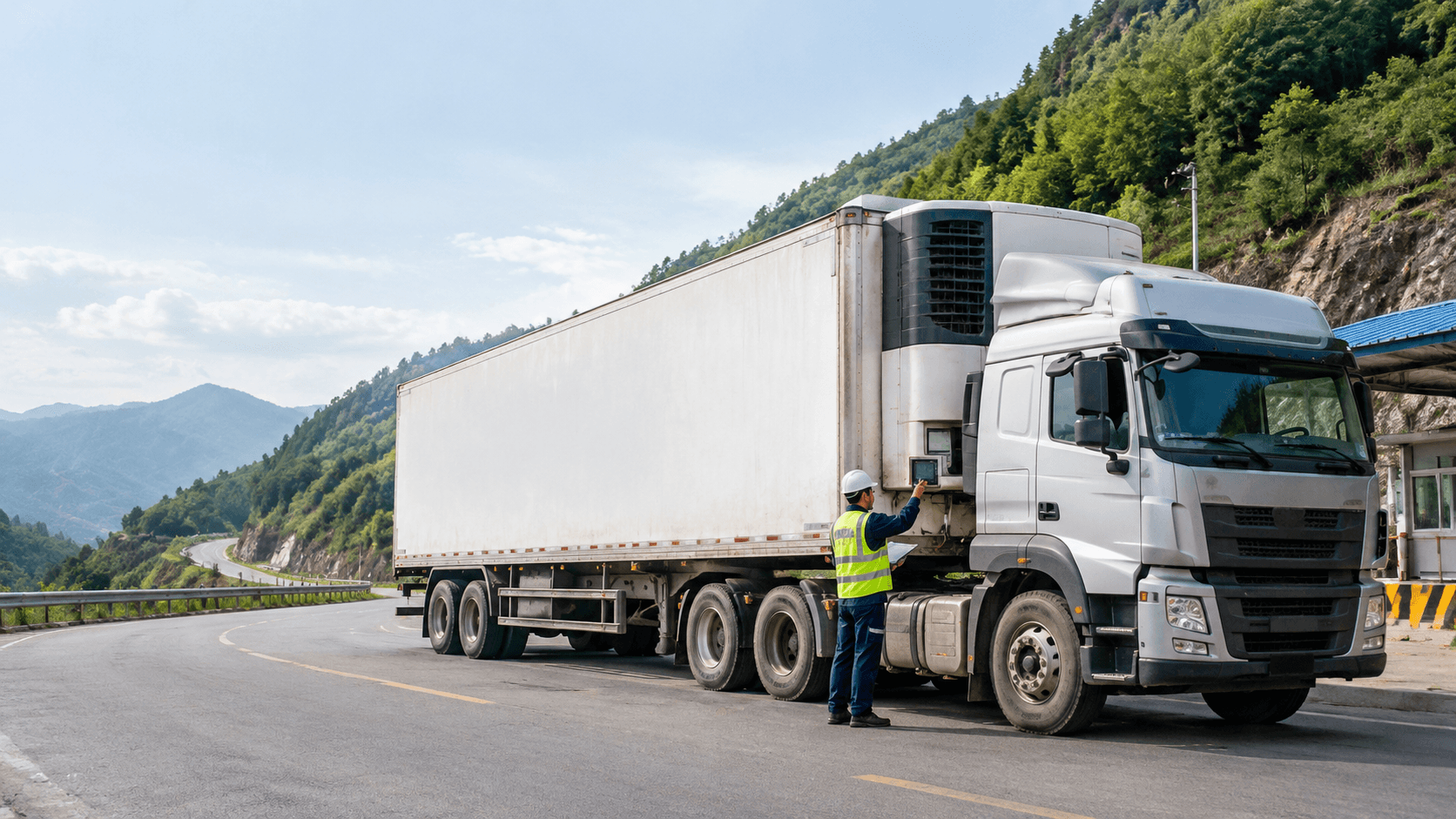
Road transportation from southern growing regions to the northern border area spans various terrains and climate zones. The quality of durian upon delivery depends not only on transit hours but also on loading conditions, temperature fluctuations, vibration, and the ability to handle incidents throughout the journey.
Assess the impact of mountain passes and steep slopes, traffic density, weather conditions, and load limits on durian transportation schedules
Routes from the Central Highlands may have to cross steep mountain passes before connecting to the interregional road network. Upon reaching the northern mountainous region, operating conditions continue to vary according to gradient, road curve radius, fog, and freight vehicle traffic. Therefore, transportation time cannot be determined by simply dividing the total distance by a fixed average speed.
In particular, the transportation plan durian transportation to ha giang requires careful assessment of road sections approaching the Thanh Thuy border gate area and locations where road geometry is restrictive. Heavy-duty trucks, tractor-trailers, and refrigerated containers must be checked for route accessibility based on traffic signs, bridge and road load limits, vehicle dimensions, and traffic organization regulations in effect at the time of operation.
During the rainy season, the risk of landslides, localized flooding, and reduced visibility can extend travel time. The dispatch team must monitor traffic and weather alerts and establish alternative routes that have been verified for load limits. Heavy containers should not be rerouted onto local roads solely because a map shows a shorter distance.
Permitted cargo weight must be calculated together with the tare weight of the vehicle, container, trailer, packaging, and accompanying equipment. A container with sufficient capacity to hold 25 tons of durian does not mean the vehicle is permitted to transport that weight on every route. The final decision must be based on vehicle documentation, axle load limits, bridge and road conditions, and the actual gross weight after loading.
Establish criteria for selecting enclosed box trucks, temperature-controlled trucks, or refrigerated containers based on fruit condition, shipment volume, and the preservation requirements of each consignment
Enclosed box trucks protect cargo from rain and dust, and their operating costs are generally lower than those of refrigerated vehicles. However, standard enclosed trucks cannot actively maintain temperature. For long journeys and changing weather conditions, this option should only be considered after evaluating the fruit characteristics, transportation time, and the level of quality risk acceptable to the cargo owner.
Refrigerated trucks are suitable when a shipment requires stable temperature conditions and its volume matches the vehicle's usable payload. 20-foot or 40-foot refrigerated containers may be considered for full-load shipments that require controlled storage conditions during long journeys. However, the choice also depends on access to packing facilities, delivery and receipt conditions at the border gate, and power supply equipment.
For whole durian fruit, a range of 12–15°C can be used as an initial reference temperature range for certain storage plans, but it is not a mandatory setting for every variety and shipment. The operating temperature must be determined based on the variety, ripeness, pre-cooling conditions, technical guidelines from the packing facility, and requirements agreed upon with the buyer.
Setting the temperature too low may cause chilling injury in sensitive fruit, while excessively high temperatures increase respiration and accelerate ripening. In addition to supply air temperature, the actual fruit temperature, ventilation, and gas dissipation capability must be monitored. Refrigerated containers cannot fully replace the pre-cooling process before loading.
| Reference technical specifications | 20-foot refrigerated container | 40-foot High Cube refrigerated container |
|---|---|---|
| Internal length | Approximately 5.4–5.5 m | Approximately 11.5–11.6 m |
| Internal width | Approximately 2.28–2.30 m | Approximately 2.28–2.30 m |
| Internal height | Approximately 2.25–2.30 m | Approximately 2.50–2.55 m |
| Nominal capacity | Approximately 28–29 m³ | Approximately 67–68 m³ |
| Equipment temperature setting range | Depends on the model; typically capable of operating below 0°C and above 20°C | Depends on the model; typically capable of operating below 0°C and above 20°C |
| Planned durian shipment volume | Must be calculated based on package arrangement, load limits, and airflow requirements | Must be calculated based on package arrangement, load limits, and airflow requirements |
| Conditions to be checked | PTI, power supply, refrigeration system, ventilated floor, load limits | PTI, power supply, refrigeration system, ventilated floor, load limits |
The dimensions above are for reference only, as container designs and refrigeration units may vary by manufacturer. Before loading, the transport provider must supply the actual container specifications, pre-trip inspection status, and permitted load capacity. Nominal capacity must not be used as the sole basis for determining the quantity of durian loaded onto the vehicle.
Establish control points for vibration, ventilation, packaging condition, and stacking capability to reduce the risk of skin bruising, fruit cracking, and quality deterioration
Sầu riêng có vỏ gai cứng nhưng vẫn có nguy cơ nứt trái, dập cục bộ và tổn thương cuống khi chịu lực va đập kéo dài. Bao bì cần có độ cứng thích hợp, khả năng phân bổ tải trọng và kết cấu hạn chế trái di chuyển trong kiện. Với hàng xếp pallet, cần kiểm tra độ ổn định của từng lớp, vật liệu chèn lót và khả năng chịu nén của thùng.
Before the vehicle leaves the warehouse, the supervisor must check the gaps between cargo units, the positions of the securing straps, and the points of contact with the container walls. The straps must not be tightened directly in a way that compresses and cracks the packaging or deforms the fruit. For refrigerated containers, the loading arrangement must ensure airflow circulates according to the design and must not exceed the equipment's cargo load limit line.
The quality control system should include a verification point at the loading site, authorized technical inspection stops, and the final delivery location. The data to be recorded should include loading photos, seal numbers, set temperatures, recorded temperatures, packaging conditions, and container door opening times. Logger data helps with cross-checking in the event of quality disputes.
Khả năng xếp chồng phải được xác định bằng đặc tính bao bì, không chỉ dựa trên chiều cao còn trống trong thùng xe. Nếu thùng carton không chịu được lực nén của nhiều lớp hàng, việc chất đầy không gian có thể làm hư hỏng các lớp dưới. Trong một số trường hợp, giảm vài phần trăm khối lượng xếp xe lại tạo hiệu quả kinh tế cao hơn nhờ tăng tỷ lệ hàng đạt chuẩn.
Xây dựng kịch bản xử lý xe hỏng, đường bị gián đoạn, thời gian giao nhận kéo dài hoặc thay đổi kế hoạch khai thác tại khu vực biên giới
Vehicle breakdowns must be handled in order of priority: ensuring human safety, protecting cargo, restoring proper storage conditions, and notifying relevant parties. For refrigerated trucks, it is necessary to distinguish between a tractor engine failure and a refrigeration unit failure. These two situations may require different solutions, such as replacing the tractor unit, repairing the refrigeration system, or transferring the cargo to a backup vehicle.
If the air conditioning system loses its ability to operate, dispatch staff need to record the time of the incident, the actual temperature, and the estimated recovery time. Transferring the cargo must be carried out in a location with safe conditions and adequate cargo protection. It cannot be assumed that simply keeping the cargo compartment doors closed will maintain the temperature for a sufficient period, as the rate of temperature increase depends on the initial temperature, the surrounding environment, and the characteristics of the equipment.
When the route is disrupted by heavy rain or landslides, alternative routes must be verified for legal compliance and vehicle accessibility. If no suitable route is available, a safe parking location with a power supply for refrigerated containers may be considered. For fuel-powered refrigerated vehicles, ensure refueling availability and continuous equipment monitoring.
At the border, if the Chinese side changes the cargo receiving schedule, HNT Logistics and the cargo owner need to coordinate to assess waiting costs, storage conditions, and the possibility of adjusting the customs clearance schedule. The decision to change border crossings should not be made without confirmation of the scope of goods permitted for export and the receiving capacity of the alternative location.
Exporting Durian Through Lao Cai and Ha Giang: Controlling Acceptance Conditions for Each Shipment
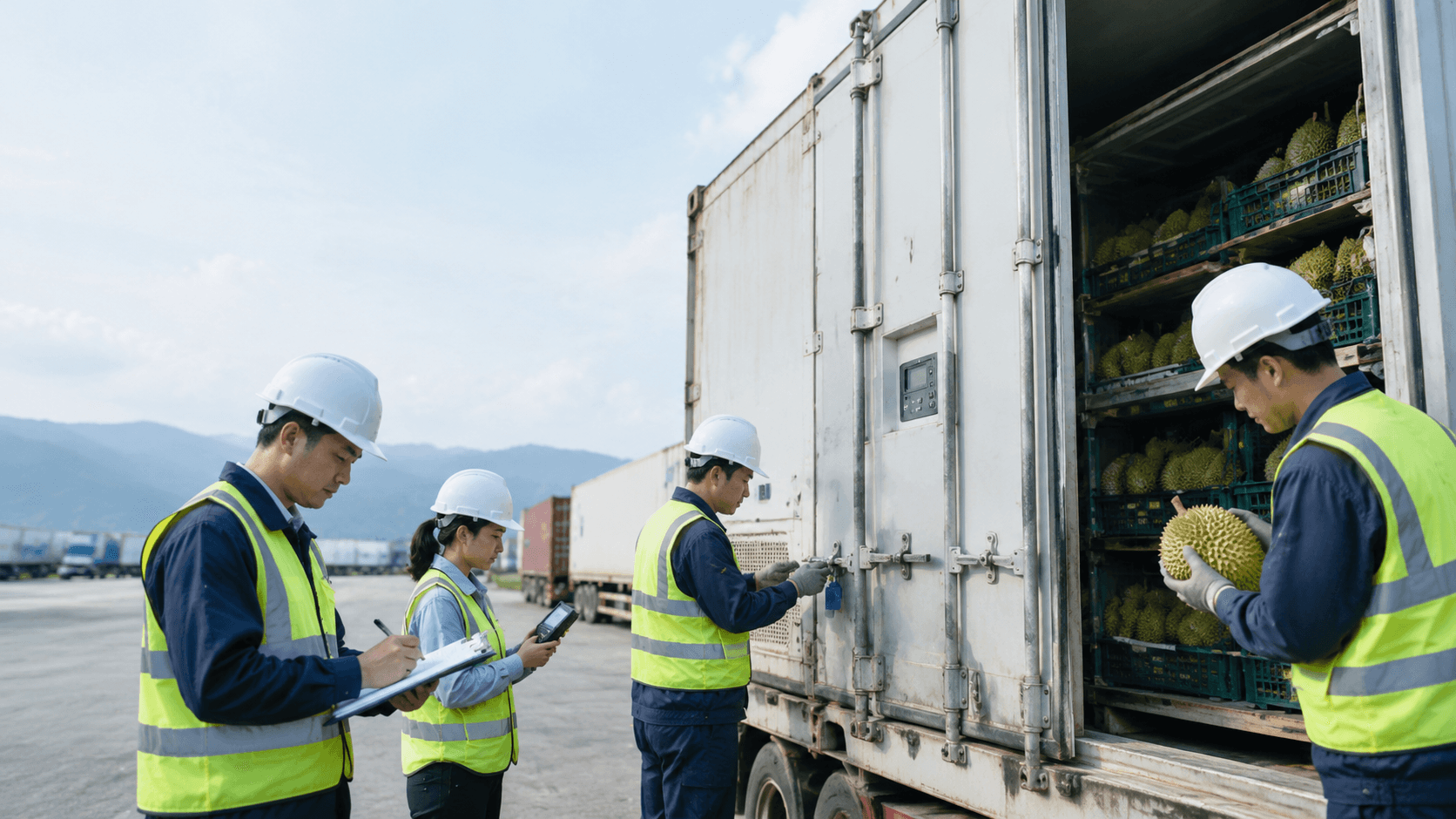
Transporting goods to the border gate does not mean that the shipment is eligible for import into China. Fresh durians belong to the agricultural product category and must meet current requirements for market access, plant quarantine, traceability, and food safety. For each shipment, the validity of the documentation and actual acceptance capacity must be verified before the truck departs.
Cross-check growing area codes, packing facility codes, and traceability information against current requirements for fresh durian exports to China
Điều kiện nền tảng của hoạt động xuất khẩu sầu riêng tươi chính ngạch sang Trung Quốc là nguồn hàng phải đáp ứng nghị định thư kiểm dịch thực vật và các yêu cầu liên quan của nước nhập khẩu. Doanh nghiệp cần xác minh mã số vùng trồng và mã số cơ sở đóng gói trong danh sách được phía Trung Quốc chấp thuận, đồng thời kiểm tra tình trạng hiệu lực và phạm vi sản phẩm của từng mã.
At the planning stage, information can be consulted in the section on growing area codes and packing facilities of the Plant Production and Plant Protection Department at https://ppd.gov.vn/ma-so-vung-trong—co-so-dong-goi.html. The most recently published or updated list must be cross-checked against the approval data of the competent authority in the importing country. A code for which an application has been submitted or that is awaiting approval does not mean it is authorized for use in exports.
Về quản lý trong nước, Nghị định 38/2026/NĐ-CP ngày 24/01/2026 quy định về mã số vùng trồng, mã số cơ sở đóng gói và các nội dung liên quan; Nghị quyết 36/2026/NQ-CP ngày 31/07/2026 điều chỉnh, đơn giản hóa một số thủ tục hành chính. Doanh nghiệp cần áp dụng văn bản hiện hành cùng những yêu cầu riêng trong nghị định thư song phương, tránh nhầm lẫn giữa việc được cấp mã tại Việt Nam và việc được thị trường Trung Quốc chấp thuận.
Thông tin truy xuất cần liên kết được giữa vùng trồng, ngày thu hoạch, cơ sở đóng gói, mã lô, số kiện và chứng từ thương mại. Trường hợp một container gom hàng từ nhiều vùng trồng đã được phê duyệt, hồ sơ nội bộ phải thể hiện rõ số lượng tương ứng của từng nguồn và bảo đảm việc phối trộn, nhận diện đáp ứng yêu cầu áp dụng. Tuyệt đối không sử dụng mã số của vùng trồng khác để hợp thức hóa nguồn hàng.
In addition to phytosanitary requirements, businesses must pay attention to food safety, including the risks of pesticide residues, heavy metals such as cadmium, and substances that are not permitted for use during production and storage. Testing activities must be organized in accordance with the applicable requirements of the competent authorities and the importing party; a single test report should not be regarded as a guarantee that the goods will definitely clear customs.
Establish a verification mechanism for the importing party's acceptance conditions, permitted export scope, and phytosanitary quarantine requirements before dispatching vehicles
For exporting durians through Lao Cai, the international border gate area of Lao Cai, including the Kim Thanh road bridge customs clearance route, is an area that needs to be assessed for its suitability for organizing cargo pickup and delivery. Decision 58/2026/QD-UBND dated July 29, 2026, regulates the monitoring and management of import and export procedures through Kim Thanh on the digital border gate platform and takes effect on August 10, 2026. Businesses should check the registration and coordination procedures currently in effect before each shipment.
For Export durian through Ha Giang, khu vực cửa khẩu Thanh Thủy là một hướng kết nối cần khảo sát, nhưng khả năng tiếp nhận sầu riêng tươi phải được xác nhận riêng với cơ quan cửa khẩu, hải quan, kiểm dịch và đối tác nhập khẩu. Không nên suy luận rằng việc một cửa khẩu được phép giao thương hàng hóa đồng nghĩa mọi mặt hàng trái cây tươi đều được phía Trung Quốc chấp nhận tại đó.
The verification mechanism should include written confirmation or storable electronic information from the importing unit and the delivery and freight coordination contact. The content should clarify the delivery location, export type, product categories, quarantine requirements, receiving schedule, transshipment method, working hours, and estimated fees.
Để kiểm soát tiến độ, doanh nghiệp có thể tham khảo hướng dẫn từ Plant Production and Protection Department tại https://ppd.gov.vn và thông tin quản lý hải quan từ Customs authorities at https://www.customs.gov.vn. These sources should be cross-checked against direct announcements from the relevant authorities at the border crossing, as vehicle traffic regulations and cargo acceptance conditions may change over time.
Decision 453/QD-TTg dated 18/03/2026 approving the smart border gate project at Kim Thanh and Ban Vuoc, but the project is being implemented in phases. Therefore, businesses should not assume that all infrastructure or automated delivery and receipt methods will be fully operational commercially in 2026. The specific plan must be confirmed based on the actual capabilities of the border gate.
Check consistency among the commercial contract, invoice, packing list, customs declaration, phytosanitary certificate, and shipment identification data
One common cause of delays in document processing is inconsistent cargo information across documents. The cargo name, weight, number of packages, exporter, importer, place of delivery and receipt, and container number must be checked according to the role of each document. Differences arising from presentation methods or unit conversions should also be explained before submitting the documents.
The commercial contract must specify the delivery terms and the responsibilities of the parties. The commercial invoice reflects the transaction value; the packing list shows the structure of the shipment; the customs declaration records the declared information required for export procedures. The phytosanitary certificate is issued in accordance with the procedures of the competent authority and is not a document that a business can independently issue to replace the results of an official inspection.
Với sầu riêng tươi, mã HS thường được tham chiếu trong nhóm 0810.60, nhưng mã khai báo chính thức phải được xác định theo biểu thuế và mô tả hàng hóa hiện hành. Chứng nhận xuất xứ C/O, nếu cần để hưởng ưu đãi thuế quan hoặc đáp ứng điều kiện giao dịch, phải được xem xét theo quy tắc xuất xứ của hiệp định áp dụng. C/O không thay thế giấy chứng nhận kiểm dịch thực vật.
The required documents must be checked against a standardized checklist before finalizing the vehicle schedule:
- Hợp đồng thương mại và thông tin người nhập khẩu thực tế.
- Commercial Invoice and Packing List with appropriate quantities, weights, and number of packages.
- Growing area codes, packing facility codes, and traceability records for each batch.
- Plant quarantine registration documents and phytosanitary certificates in accordance with applicable regulations.
- Export customs declaration and relevant specialized documents.
- Certificate of Origin (C/O) if required by the transaction and the shipment meets the issuance conditions.
- Vehicle information, container details, license plates, seals, and handover data.
- Food safety test results or quality documentation, if required.
The fact that a company prepares all the documents listed above does not mean that all of them must be submitted in every case. The official dossier requirements depend on the type of export, the requirements of the importing country, and the results of customs channeling and specialized inspections. The documentation department must distinguish between documents retained internally and documents that must be submitted to regulatory authorities.
Analysis of coordinated handling procedures when document discrepancies, requests for additional inspections, or changes to customs clearance plans arise in the border gate area
When discrepancies between the documents and the actual goods are detected, the first priority is to determine the nature of the discrepancy. If the error concerns commercial information that can be lawfully amended, the company must carry out the amendment procedures in accordance with regulations. If the discrepancy relates to the growing area of origin, packing code, or quarantine conditions, it must not be resolved simply by replacing product labels or modifying documents in a way that misrepresents the actual situation.
If a shipment is required to undergo sampling or additional inspection, the transport provider must arrange a suitable waiting area that meets the storage conditions. The cargo owner must assess the expected time for results, testing costs, the ability to maintain product quality, and the obligation to notify the importer. The goods may only proceed with further processing in accordance with the conclusions and instructions of the competent authority.
When customs clearance plans change, it is necessary to distinguish between changes to the receiving time, changes to the delivery method, and changes to the border gate. Rerouting from Lao Cai to Ha Giang or vice versa may entail additional road transport costs, adjustments to customs declarations, quarantine registration, vehicle scheduling, and reconfirmation of import conditions. Vehicles should not be redirected to another border gate before these verification steps have been completed.
Each situation should have a designated coordinator responsible for consolidating information from the packing facility, driver, customs broker, quarantine authorities, and buyer. Updates should record the time, cause, handling plan, estimated costs, and approving person. This is an important basis for minimizing disputes over surcharges after the shipment has been completed.
Comparison Table of Durian Transportation Options to Lao Cai and Ha Giang: Freight Costs, Transit Time, and Operational Capacity
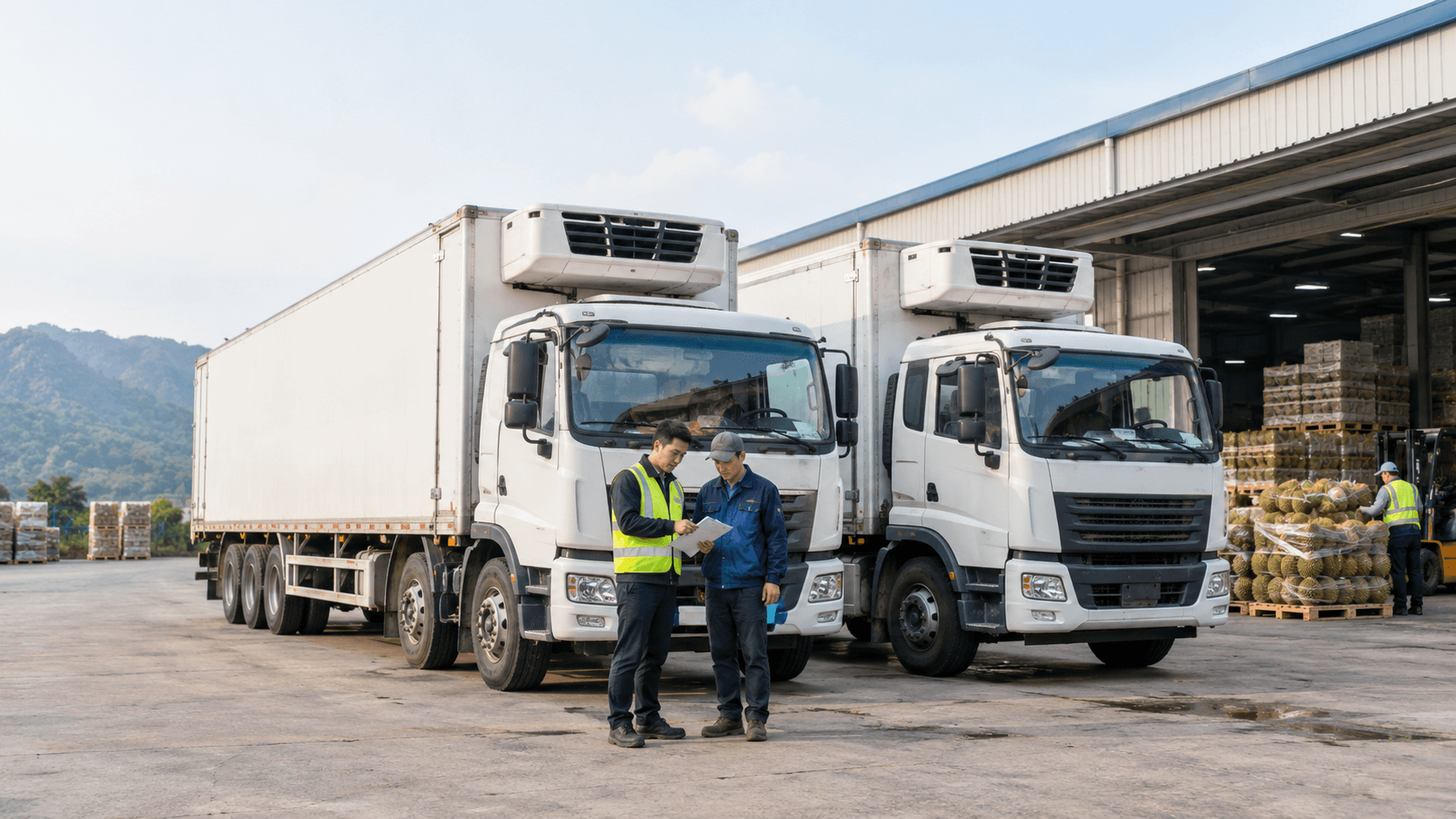
Comparing the two transport routes is meaningful only when the pickup point, payload, vehicle type, storage conditions, and scope of services are the same. A route with a shorter distance does not necessarily have a lower total cost if it requires multiple transshipments or incurs waiting time. The tables below use assumptions for budgeting purposes and are not commercial quotations confirmed by HNT Logistics.
Prepare a comparison table of transport options via Lao Cai and Ha Giang based on the origin, estimated distance, road conditions, journey time, and cross-border delivery connectivity
The distances in the table are rounded planning estimates between representative pickup areas and the border gate areas. They do not represent a journey that has been measured or verified using a routing system. Transit times are preliminary estimates for road transport, accounting for rest periods and normal operating conditions, but excluding quarantine, customs clearance, and waiting time for acceptance by the importer.
| Criteria | Lao Cai Route | Ha Giang Route |
|---|---|---|
| Surveyed Delivery and Pickup Point | Kim Thanh Area, Lao Cai | Thanh Thuy Area, Ha Giang |
| Originating from Dak Lak | Approximately 1,500–1,800 km | Approximately 1,500–1,850 km |
| Originating from Dong Nai | Approximately 1,750–2,050 km | Approximately 1,750–2,100 km |
| Estimated Domestic Transport Time | Approximately 3–5 days | Approximately 3–5 days |
| Road Conditions | Can combine suitable national highway routes and expressways | Carefully inspect access routes in mountainous areas and border gates |
| Vehicles to consider | Refrigerated trucks, refrigerated containers, and suitable box trucks | Refrigerated trucks and vehicles suitable for route restrictions |
| Cross-border delivery and receipt arrangements | Verify the methods currently in use at Kim Thanh and on the Ha Khau side | The scope of eligible goods and acceptance conditions at Thanh Thuy and on the Chinese side must be verified |
| Priority risks | Vehicle regulation, quarantine schedules, and waiting times | Goods acceptance conditions, delivery connections, and route capacity |
| Conditions determining the selection | Valid documentation, confirmed receiving partner, and suitable total transportation costs | Confirmation that durians are accepted, suitable vehicles, and appropriate total transportation costs |
The distance and time ranges above are intended for preliminary estimates and may vary significantly depending on the warehouse address, permitted routes, and actual travel time. For refrigerated vehicles, arrangements for supplying electricity or fuel to refrigeration equipment must also be included. Businesses should not use this table as a basis for committing to delivery dates in commercial contracts.
For the Ha Giang route, exporting durians through Ha Giang should only be finalized after specific confirmation of acceptance conditions from the competent parties. If confirmation is not yet available, the Ha Giang option should remain under consideration rather than being used as the default alternative to Lao Cai.
Develop a cost breakdown covering pickup vehicles, fuel, road tolls, loading and unloading fees, waiting costs, cargo preservation, and document-related service charges within the quoted scope
Durian transportation rates should be broken down into verifiable cost components. Even if a transport provider quotes a flat rate for the entire trip, businesses should still request clarification of the included charges, additional cost conditions, and waiting time limits. This approach allows quotations from different providers to be compared on the same scope of work.
| Component | Calculation basis | Scope to be clarified |
|---|---|---|
| Pickup vehicles at the production area | Per trip, kilometer, or vehicle shift | Number of pickup points, waiting time, and warehouse access roads |
| Long-distance transportation | Per trip or route contract | Vehicle type, payload capacity, distance, fuel, and labor |
| Road tolls | By route and vehicle type | Included in the freight rate or charged at actual cost |
| Loading, unloading, and transshipment | Per ton, package, pallet, or handling operation | Party responsible for the fees, lifting equipment, and location |
| Refrigeration equipment operation | Voyage, hours or days | Refrigeration fuel, electricity, and backup equipment |
| Vehicle waiting and storage | Hours or days exceeding the allowance | Free time and additional charges |
| Customs declaration | Dossier or declaration | Scope of operations and amendment processing |
| Quarantine and inspection | Based on actual fees and service charges | Distinguishing official fees from service charges |
| Certificate of origin | Additional documents, if applicable | Issuance conditions, official fees, and service charges |
| Cargo insurance | Insured value and contract conditions | Risk coverage, deductible, and exclusions |
Freight rates should be quoted in Vietnamese dong per trip or per kilogram of cargo, together with tax conditions, surcharges, and the validity period. For quarantine, inspection, and documentation services, avoid combining everything into a single unexplained charge, as the fee amounts and applicable payees may vary depending on the circumstances.
Compare vehicles based on payload capacity, cargo compartment volume, temperature control capabilities, level of fruit protection, and average transportation cost per kilogram.
Vehicle efficiency depends on the actual cargo weight that can be loaded legally and safely. A vehicle with a high nominal payload but limited by package volume or traffic conditions may achieve lower efficiency than expected. Conversely, a smaller vehicle with better warehouse access that eliminates one transshipment may offer a more competitive total cost.
| Reference vehicle | Assumed planned cargo weight | Consolidated (LTL) | Operational assessment |
|---|---|---|---|
| Box truck | Approximately 5–15 tons, depending on configuration | No active refrigeration | Suitable only when the preservation method has been assessed and deemed acceptable |
| Refrigerated truck | Approximately 5–15 tons, depending on configuration | Active temperature control based on equipment capabilities | Flexible pickup and delivery locations; temperature monitoring required |
| 20-foot refrigerated container | Subject to payload limits, loading arrangements, and route | Active operation; operational resources required | Limits direct cargo handling when changing tractor units |
| 40-foot High Cube refrigerated container | For example, 18–22 tons for calculation purposes, not a generally permitted payload | Active operation; operational resources required | Worth considering for large shipments when road conditions and pickup and delivery locations permit |
For example, a refrigerated truck is hypothetically quoted at VND 45 million for transporting 15,000 kg, resulting in a basic transportation cost of VND 3,000/kg. If only 12,000 kg is loaded, the cost increases to VND 3,750/kg. This difference results from payload utilization efficiency and excludes surcharges, losses, or export clearance costs.
For refrigerated containers, businesses must also consider equipment usage time, the ability to change tractor units, and power supply conditions during stops. A large-capacity container delayed for a long time at the border crossing may incur higher costs than a smaller refrigerated truck with a suitable pickup and delivery schedule.
Prepare a total cost estimate based on shipment volume, number of trips, expected waiting time, and a contingency budget for unexpected situations along the route.
To illustrate the budgeting method, assume a business has a 20,000 kg durian shipment packed in the Central Highlands and delivered to a northern border staging point using a suitable refrigerated vehicle. The following figures are entirely internal calculation assumptions, not market price lists, HNT Logistics quotations, or commitments regarding vehicle capacity.
| Assumed Cost Item | Estimated costs |
|---|---|
| Loaded cargo volume | 20,000 kg |
| Number of trips | 1 trip |
| Long-distance transportation and refrigerated operations | 56,000,000 VND |
| Cargo consolidation and handling | 3,000,000 VND |
| Documentation services and procedural coordination | 2,500,000 VND |
| Estimated waiting time | 1 day |
| Assumed waiting costs | 2,000,000 VND |
| Total costs before contingency | 63,500,000 VND |
| Contingency budget of 8% | 5,080,000 VND |
| Total estimated budget | 68,580,000 VND |
| Cost per kg of loaded cargo | 3,429 VND/kg |
The assumption table does not include the purchase price of durian, taxes and any financial obligations that may arise, specialized testing costs, insurance if purchased separately, import-side costs, or transshipment costs outside the scope of these assumptions. When preparing an actual quotation, each item must be confirmed through a service contract and the delivery terms of the commercial transaction.
The contingency budget of 8% is only an illustrative parameter in the risk management exercise, not a default surcharge rate. Businesses may choose a different rate based on historical data, seasonality, border gate conditions, and response capabilities. Unused contingency funds should not be treated as actual costs payable.
Door-to-Door Durian Transportation to Lao Cai: Optimizing Costs Based on Operational Efficiency and the Percentage of Compliant Goods
The lowest logistics cost does not necessarily correspond to the lowest transportation unit rate. If a cheaper option increases the proportion of rejected goods, results in multiple transshipments, or prolongs delivery and receipt times, the total economic cost may be higher. Businesses need to evaluate vehicle efficiency, the percentage of compliant goods, and the ability to control additional costs simultaneously.
Break-even analysis between full-truckload rental and vehicle allocation based on actual volume, harvest timing, and shipping frequency
Full-truckload rental is suitable when the volume is sufficiently large, the packing schedule is stable, and cargo control requirements are relatively strict. Conversely, for small shipments or dispersed supply sources, cargo owners may consider dispatching vehicles according to actual loads. However, consolidating cargo in the same vehicle must ensure compatibility of temperature requirements, traceability, phytosanitary conditions, and preservation responsibilities.
The break-even point can be calculated by comparing the fixed cost of a full truckload with the total cost of an alternative option. Assume the full-truckload freight rate is VND 56 million, while the volume-based transportation option has an assumed cost of VND 3,500/kg, excluding other costs that differ between the two options. The theoretical break-even point is 56,000,000 divided by 3,500, equivalent to 16,000 kg.
When the volume is below 16 tons, the per-kilogram pricing option may be more competitive under these assumptions. When the volume exceeds 16 tons, renting a full truckload may offer a unit freight cost advantage, provided the vehicle is loaded legally and safely. This is only a preliminary financial comparison; transshipment costs, quality risks, and service levels must be considered before making a decision.
For businesses that export regularly, weekly volume and delivery frequency are more important than any single trip. For example, organizing two full-load shipments per week may reduce vehicle dispatch costs compared with making three or four partially loaded trips. However, storage time should not be extended merely to consolidate sufficient volume if this affects the ripeness and quality of the durian.
Calculate logistics costs per kilogram of goods meeting delivery acceptance standards, taking into account payload utilization efficiency, loss rates, and additional handling costs.
An important metric for export businesses is logistics costs per kilogram of accepted goods, rather than calculating costs based only on the loaded weight. The formula used is: actual logistics costs divided by the weight of goods meeting delivery acceptance standards. The numerator should include freight charges, loading and unloading, preservation, documentation costs, and additional handling charges within the scope of the assessment.
Suppose a shipment loaded onto a truck weighs 20,000 kg and has a logistics budget of 68,580,000 VND. If the acceptance rate upon delivery is 98%, the accepted weight reaches 19,600 kg, and the corresponding cost is approximately 3,499 VND/kg. If the acceptance rate drops to 93%, the accepted weight falls to just 18,600 kg, increasing the cost to approximately 3,687 VND/kg.
| Assumed rate of goods meeting quality standards | Weight meeting quality standards | Logistics cost per kg meeting quality standards |
|---|---|---|
| 100% | 20,000 kg | 3,429 VND |
| 98% | 19,600 kg | Approximately 3,499 VND |
| 95% | 19,000 kg | Approximately 3,609 VND |
| 93% | 18,600 kg | Approximately 3,687 VND |
| 90% | 18,000 kg | 3,810 VND |
The table above keeps total logistics costs unchanged to isolate the impact of the rate of goods meeting quality standards. In practice, rejected goods may also incur additional costs for re-sorting, warehousing, disposal, or return transportation. These expenses should be recorded separately and incorporated into the model when actual data becomes available.
Payload utilization efficiency should also be included in the assessment. If a truck has an approved carrying capacity of 20 tons but transports only 15 tons, its payload utilization efficiency is 75%. When the full-truckload freight rate remains unchanged, the cost per kilogram will increase accordingly. However, the loaded weight must never exceed the permitted limit simply to improve financial indicators.
Optimize waiting times at pickup locations, vehicle dispatch schedules, packaging capacity, and handover times to reduce vehicle idle costs.
Truck waiting time often results from a lack of coordination between harvest volumes, packaging capacity, and vehicle dispatch plans. If a truck arrives at the warehouse at 8 a.m. but the goods are not ready until the afternoon, the shipper may have to pay additional labor, vehicle, and refrigeration equipment operating costs. This issue should be addressed through production scheduling, not merely by negotiating lower surcharges.
An effective approach is to establish loading schedules by time slot, linked to the volume of goods that have completed quality inspections. Once the packing facility confirms sufficient quantities and internal documentation, the coordinator can issue the order for the truck to enter the loading area. If the plan changes, the information must be communicated before the agreed deadline for canceling or rescheduling the vehicle.
For shipments involving door-to-door durian transportation to Lao Cai, reducing waiting time also depends on the delivery and receipt appointment schedule at the border crossing. The shipper should request that the importer confirm the receiving location and time slot while preparing extended preservation arrangements in case customs clearance schedules change.
Performance should be monitored using indicators such as waiting hours at the warehouse, waiting hours at the border crossing, the percentage of trips departing on schedule, and the percentage of deliveries completed within the confirmed time slot. With trip-by-trip data, businesses can identify recurring causes and improve dispatch plans for subsequent harvest periods.
Establish a freight reconciliation mechanism by route segment, verify surcharges with supporting evidence, and allocate financial responsibility when delivery schedules change or vehicle detention costs arise.
Freight reconciliation should begin by dividing the journey into segments with clearly defined handover points and responsibilities. The pickup segment, long-distance transportation segment, transshipment segment, and border delivery segment can be managed under a single contract or multiple service orders. Regardless of the arrangement, the documentation confirming completion of each segment must be agreed upon in advance.
Truck waiting surcharges must be supported by evidence, such as the vehicle's arrival time at the receiving location, the time it was authorized to begin loading, the time loading and unloading were completed, and the time it departed. For surcharges arising from route changes or schedule adjustments, the change request and fee confirmation must be documented before implementation, except in emergencies explicitly covered by the contract.
Financial responsibility must distinguish between carrier errors, causes attributable to the shipper, changes made by the importer, and objective circumstances beyond the parties' control. For example, a truck arriving on time when the warehouse has not prepared the goods differs from a vehicle arriving late due to a dispatching error. Responsibility must be determined based on the contract, written records, and operational evidence, rather than subjective judgments made after an incident occurs.
For exported goods, the Incoterms rules specified in the commercial contract also determine the allocation of costs and risks between the seller and the buyer. However, Incoterms do not automatically replace the transportation contract or determine the logistics provider's responsibility for every additional charge. Therefore, the three parties—the shipper, carrier, and importing partner—should agree in writing on the handover point and scope of responsibilities.
HNT Logistics Partners in Durian Transportation to Lao Cai and Ha Giang with a China Export Solution Based on an Integrated Control Chain
With a road freight delivery service platform, container transportation, refrigerated cargo transport, and import-export customs procedure support, HNT Logistics can coordinate with businesses to develop a delivery plan from the source area to the border area. The solution focuses on ensuring the feasibility of the route, storage conditions, documentation, and budget before implementation.
Consulting on road freight transportation plans based on the source area, volume, durian characteristics, and delivery plans in the northern border area
Before developing a transportation plan, HNT Logistics needs to collect the pickup address, expected volume, number of packages, packaged weight, durian variety, ripeness at the time of warehouse dispatch, and temperature requirements from the shipper. This information allows for the selection of suitable vehicles, estimation of loading capacity, and identification of points requiring control during the journey.
For cargo sourced from the Central Highlands or Southeast Vietnam, HNT Logistics can evaluate refrigerated trucks, reefer containers, or transshipment arrangements depending on operating conditions. If the shipment requires connections between multiple modes of transport, the solution multimodal transportation should only be considered when there are clear benefits in terms of cost, schedule, and the ability to maintain quality, rather than changing the mode simply to reduce the road distance.
The delivery plan must identify whether the handover location is domestic or cross-border, the party responsible for customs procedures, the receiving party in China, and the expected completion time. If the customer chooses Ha Giang, the conditions for exporting fresh durian through the intended border gate must be verified before confirming the vehicle dispatch schedule.
Coordinating vehicle dispatch, controlling handover points, customs declarations, and phytosanitary procedures according to the actual conditions of the shipment
Under the implementation model, HNT Logistics may undertake or coordinate tasks within the contractual scope, from arranging vehicles and monitoring progress to supporting customs declarations and preparing phytosanitary documents. The issuance of phytosanitary certificates falls under the authority of the competent authorities; HNT Logistics does not replace licensing authorities or guarantee inspection results in advance.
The process customs declaration needs to be coordinated with the shipper to verify commercial information, HS codes, declared value, product policies, and related documents. For exported durian shipments, the cultivation area code, packing facility code, and traceability records must be cross-checked before completing steps that could result in non-recoverable transportation costs.
At the handover point, the record should fully reflect weight, number of packages, container number, seal, packaging condition, and recorded temperature. If there is transshipment or a tractor change, each point of transfer of responsibility must be clearly recorded. This information helps the shipper handle well-founded claims and limit disputes over the causes of quality deterioration.
Developing a transparent quotation plan by leg, clarifying the service scope, expected time, responsibilities of the parties, and costs not included
HNT Logistics quotations should be prepared based on the pickup point, delivery point, vehicle type, volume, and expected time. For shipments requiring door-to-door durian transportation to Lao Cai, the quotation scope must clearly state whether the service includes cargo consolidation, refrigerated transportation, loading and unloading, phytosanitary support, customs declaration, and border delivery and receipt.
To make comparison easier for businesses, the quotation should show the value of each leg or service group, free waiting time, additional charges, and schedule-change conditions. Items such as testing fees, official charges, costs on the Chinese side, taxes, insurance, or unplanned transshipment costs must be listed as included, excluded, or to be determined later.
For shipments with a plan multimodal transportation, HNT Logistics needs to clearly determine the end point of responsibility for each mode and the cargo handover conditions. If the customer only hires domestic transportation, the quotation should not be presented as a full export service including customs clearance and delivery in China.
The transportation time stated in the quotation should be a conditional estimated time, accompanied by assumptions regarding road conditions, complete documentation, and the receiving schedule of the partner. Commercial commitments should be based on factors within the carrier's ability to control, while also specifying how events beyond its responsibility will be handled.
HNT Logistics accompanies businesses in optimizing durian transportation costs to Lao Cai, controlling cargo safety, and coordinating the implementation of export plans to China in accordance with actual operating conditions
An effective transportation solution must combine three objectives: optimizing total costs, maintaining durian quality, and ensuring the ability to complete export procedures. Only by controlling these factors simultaneously can a business accurately assess the effectiveness of a shipment, especially during peak harvest periods and when demand for refrigerated vehicles is high.
HNT Logistics aims to support customers from vehicle selection, loading capacity calculations, and transportation scheduling to coordinating import-export procedures within the agreed service scope. For shipments with specific requirements, the plan must be rechecked based on fruit condition, origin, pickup and delivery points, and the actual receiving conditions of the Chinese market.
Businesses that need to proceed durian transportation to lao cai can provide information about the pickup area, volume, expected packing date, preferred vehicle type, and delivery location so that HNT Logistics can develop a suitable plan. For the Ha Giang route, HNT Logistics will need to coordinate verification of border-gate conditions and the receiving partner before proposing a specific operating plan.
Contact HNT Logistics via the website https://hntshipping.com.vn, hotlines 0911.446.060 or 0949.393.300, email thaongan@hntshipping.com or anhdao@hntshipping.com to discuss transportation needs, receive advice on the service scope, and request a quotation based on the actual shipment.
The effectiveness of durian exports is not determined at the final leg at the border gate, but is shaped by how the business organizes the entire logistics chain. A plan with the correct load capacity, proper storage conditions, synchronized documentation, and clear delivery and receiving responsibilities will help limit additional costs, protect cargo value, and create a foundation for more stable export operations to China.