An export container shipped from Ho Chi Minh City can incur millions of Vietnamese dong in additional costs if a business chooses an unsuitable vessel schedule, collects an empty container too early or fails to complete documentation before the cut-off deadline. Even after a booking has been confirmed, a shipment may still miss its sailing due to missing VGM information, delayed customs clearance or changes to port operations.
Therefore, vessel booking is not simply a matter of reserving space on a vessel. It involves selecting a shipping route, checking cargo acceptance capacity, negotiating freight rates, and coordinating operational milestones. Businesses need to assess total logistics costs rather than simply comparing the ocean freight rates quoted by shipping lines or freight forwarders.
For export shipments originating in the Ho Chi Minh City area, HNT Logistics approaches export vessel booking through integrated container transportation, customs declaration and port freight forwarding coordination. This article analyzes how to select booking options, understand cost structures, meet documentation requirements, and manage critical control points to help shippers take greater control of their international delivery plans.
Export Vessel Booking from Ho Chi Minh City: Determining the Booking Strategy Based on Shipment Characteristics and Import Market

Analyse the booking requirements, including the port of loading, port of discharge, cargo type, weight, volume, cargo readiness date and delivery deadlines under the international trade contract.
Before requesting a vessel booking quotation, businesses must accurately identify the point of origin and the cargo receiving point in the destination market. The departure port is commonly referred to as POL (Port of Loading), while the discharge port is POD (Port of Discharge). These two details determine the shipping route, the available shipping lines, and the possibility of transshipment.
For exports from Ho Chi Minh City, businesses need to distinguish between the port where containers are loaded onto the vessel and the initial container delivery location. A shipment gated in at Cat Lai may be transported by barge or another connecting transport service to the port where the mother vessel loads the cargo. Therefore, the container drop-off location and the POL stated in the booking confirmation do not always match.
Cargo information should include the commercial name, technical description, expected HS code, number of packages, gross weight, volume, and packaging characteristics. For 20-foot containers, the actual cargo payload is generally limited by the equipment's permitted weight, road transport vehicle restrictions, and shipping route regulations. A 40-foot container is generally more suitable for cargo that occupies considerable volume without being excessively heavy.
The Cargo Ready Date must be determined based on production progress, packaging, and completion of export requirements. It is not the ETD because businesses still need to arrange trucks, collect empty containers, load cargo, obtain VGM, complete customs declarations, and gate in containers before the cut-off. Booking a vessel without confirming the cargo ready date may result in a schedule change or booking cancellation.
The delivery deadline in the international sales contract must also be checked against the applicable Incoterms and the buyer's requirements. If the contract specifies the delivery deadline based on the vessel loading date, the schedule calculation will differ from a situation where the cargo must arrive at the destination port or consignee's warehouse before a specified date. Shippers should clarify the legally binding delivery milestone before making a booking decision.
Distinguish between FCL and LCL bookings based on actual shipment volume, packaging characteristics, container utilisation and cargo control requirements during international transport.
FCL (Full Container Load) booking involves using an entire container for one shipment. It is suitable when a business has sufficient cargo volume or needs independent control over the loading and sealing process. Meanwhile, LCL (Less than Container Load) allows multiple shipments to be consolidated into one container at a CFS warehouse, helping reduce costs for smaller shipments.
The key difference is not simply the quantity of cargo. With FCL, businesses can arrange loading at their factory, inspect the container's condition, and seal it after loading is completed. With LCL, cargo must undergo receiving, sorting, and consolidation processes, and may require additional deconsolidation at the destination port, increasing the number of handover points throughout the journey.
FCL freight is generally quoted per 20-foot, 40-foot, or 40-foot High Cube container. In contrast, LCL freight is usually calculated based on weight or converted volume, depending on the W/M (Weight or Measurement) method and the service provider's minimum charge. One cubic meter is commonly compared with one freight ton under commercial LCL pricing rules, but businesses must confirm the applicable calculation method in each quotation.
For example, a shipment of machinery packed in wooden crates with a volume of 8 CBM and a weight of 2.5 tons may be suitable for LCL if the cargo is not oversized and the consolidation provider accepts it. However, if the equipment is high-value, susceptible to impact damage, or requires separate handling, businesses should also assess handling and damage risks before choosing between FCL and LCL.
For fresh fruit or food products requiring stable temperatures, using an FCL reefer container generally provides better conditions for cold chain management. Consolidated refrigerated cargo is only feasible when specialized services are available, temperature requirements are compatible, and operating procedures are clearly confirmed. Businesses should not assume that refrigerated cargo can be consolidated in the same way as ordinary dry cargo.
Determine whether to use dry containers, refrigerated containers or specialised equipment based on the characteristics of the export cargo, storage requirements and acceptance conditions at the destination port.
Dry Containers are commonly used for garments, industrial products, consumer goods, and packaged raw materials. These containers do not have active temperature control systems, so businesses must assess sensitivity to humidity, condensation, odors, and the risk of cargo shifting during transportation.
Reefer Containers feature refrigeration and temperature control systems, making them suitable for fruit, frozen seafood, and food products requiring special storage conditions. However, temperature settings must be based on the specific product requirements, pre-cooling conditions, ventilation, and humidity. There is no single standard temperature suitable for all exported agricultural products.
For example, many frozen seafood products require temperatures of approximately -18°C or lower, depending on product standards and contractual requirements. Some tropical fruits may require storage conditions ranging from approximately 5°C to 15°C. However, this is only a broad reference range, not an operating instruction for any specific fruit. Incorrect temperature settings can cause chilling injury or accelerate product deterioration.
For machinery exceeding standard container door dimensions or having unusual shapes, businesses may require Open Top, Flat Rack, or specialized equipment. This option requires dimensional drawings, total weight, center-of-gravity location, and lashing plans so the shipping line can assess cargo acceptance. Oversized cargo cannot be approved based solely on the number of packages and total weight.
| Type of Container | Reference internal dimensions | Reference nominal volume | Suitable application |
|---|---|---|---|
| 20-foot Dry | Length 5.90 m; width 2.35 m; height 2.39 m | Approximately 33 CBM | Dry cargo, high-density cargo |
| 40-foot Dry | Length 12.03 m; width 2.35 m; height 2.39 m | Approximately 67 CBM | High-volume cargo and palletized goods |
| 40-foot High Cube | Length 12.03 m; width 2.35 m; height 2.69 m | Approximately 76 CBM | Bulky cargo requiring additional loading height |
| 20-foot Reefer | Approximately 5.4–5.5 m long; 2.29 m wide; 2.25 m high | Approximately 28 CBM | Refrigerated cargo requiring temperature control |
| 40-foot High Cube Reefer | Approximately 11.58 m long; 2.29 m wide; 2.54 m high | Approximately 67 CBM | Export fruit, seafood, and food products |
The specifications above are for reference only because internal dimensions, capacity, tare weight, and maximum payload vary depending on the manufacturer, container age, and equipment design. Businesses must verify the actual container specifications, CSC plate, road weight restrictions, and acceptance capacity at the destination port before approving the loading plan.
Prepare a set of requirements for requesting vessel booking quotations to assess operational capacity, cargo acceptance conditions and the feasibility of the shipping schedule before confirming the booking.
A complete quotation request helps service providers identify the correct route, equipment, and required service scope. If a business only requests a freight rate from Ho Chi Minh City to Shanghai without specifying the cargo type, cargo ready date, and delivery terms, the quotation may omit important costs or fail to reflect actual cargo acceptance conditions.
The minimum data set should include the following information:
- Port of departure, port of destination, cargo pickup address, and final delivery point, if applicable.
- Cargo name, expected HS code, number of packages, gross weight, and total volume.
- Container type, container quantity, or the LCL option requiring a quotation.
- Cargo ready date, preferred ETD, and contractual delivery deadline.
- Incoterms, service scope, and freight payment requirements.
- Special requirements regarding temperature, ventilation, quarantine, dangerous goods, or specialized equipment.
- Requirements for direct routes, transshipment, transit time, and destination port free time.
When requesting a vessel freight booking, businesses should ask the freight forwarder to confirm both space availability and empty container availability. A shipping line may have available vessel capacity but no suitable container at the intended depot. In that case, changing the empty container collection depot or switching to another shipping line may affect trucking costs and the loading schedule.
Export Vessel Booking: Analysing Sea Route Structures, Shipping Schedules and Port Connectivity
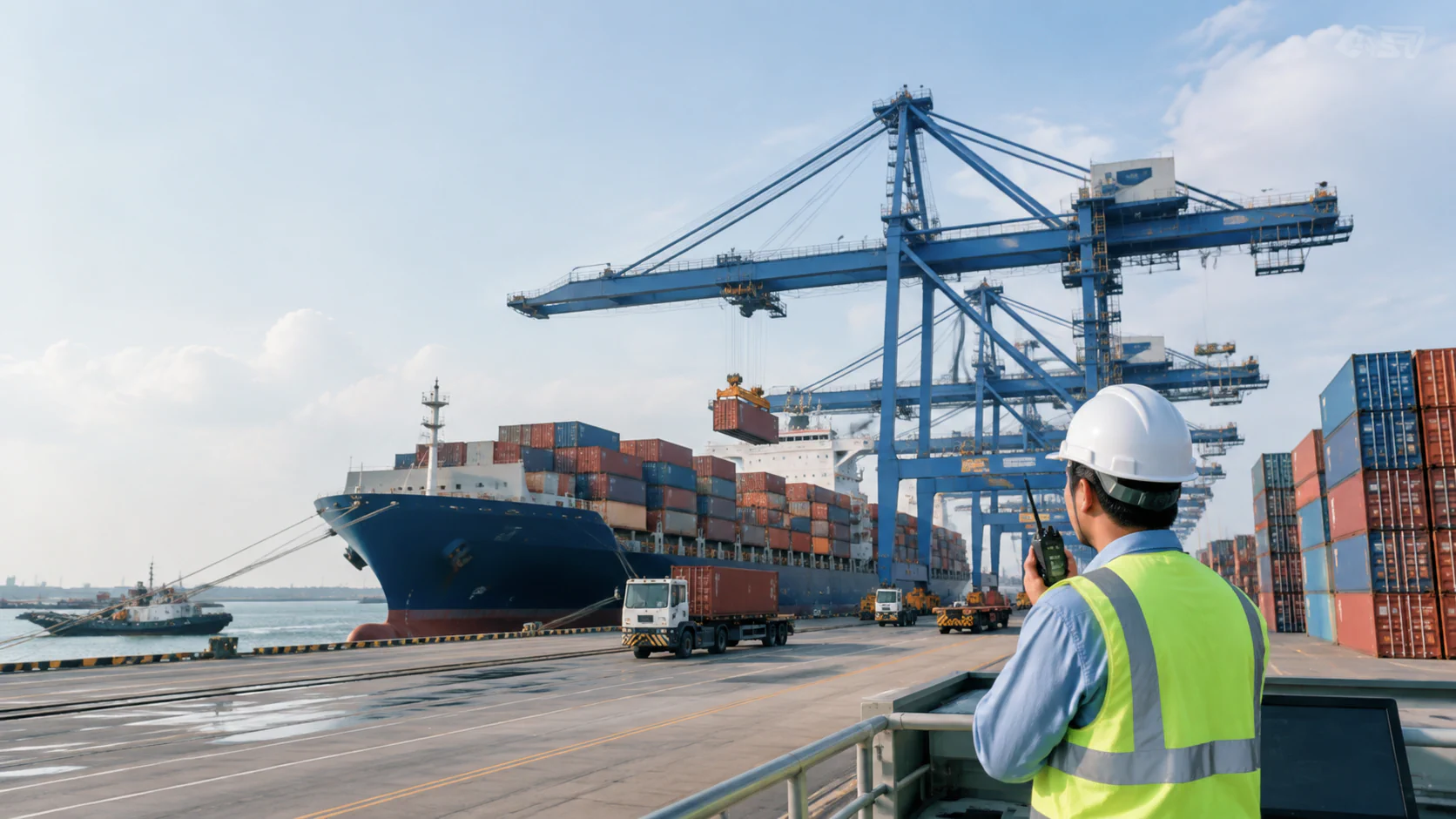
Assess direct shipping routes and transhipment routes via third-party ports based on the number of transhipments, estimated total transit time, sailing frequency and connection reliability.
A Direct Service is a route from the port of loading to the port of discharge without transferring the container to another vessel. A Transshipment Service transports the container to an intermediate port before connecting it to the next vessel. The key differences to evaluate include the number of transshipments, connecting vessel waiting time, and the ability to monitor the shipment when vessel schedules change.
For exports from Ho Chi Minh City to certain Asian ports, businesses may find direct services depending on the shipping line and operating schedule. For distant destinations or ports outside direct service networks, containers may be transshipped through Singapore, Port Klang, Hong Kong, or other major hub ports. The actual transshipment port must be confirmed against the current shipping schedule.
Direct services generally reduce the number of cargo handling operations and the risk of connection disruptions, but they are not necessarily faster than every transshipment service. A route with one transshipment, frequent departures, and short connection times may still be more suitable than a direct service that requires waiting several days for the next departure.
When comparing options, businesses should calculate the period from when cargo can be delivered at the departure port until it is expected to be available for collection at the destination port, rather than relying solely on the transit time published by the shipping line. Total transit time should include waiting time before ETD, ocean transit, transshipment, and destination handling.
| Criteria | Direct service | Transshipment route |
|---|---|---|
| Route structure | No container transfer to another vessel between POL and POD | At least one transshipment point |
| Transportation Time | Depends on vessel schedules and the number of port calls | Depends on vessel schedules and connection times |
| Risk of disruption | Fewer vessel handover points | Additional risk of missing connecting vessels |
| Port coverage | Limited to available direct service routes | Can extend to more destinations |
| Points to check | ETD, ETA, port calls, and frequency | ETD, ETA, transshipment port, connecting vessel, and waiting time |
Analyse the differences between loading ports in the Ho Chi Minh City area, including Cat Lai and other relevant operating locations, based on container acceptance requirements, inland transport options and actual vessel schedules.
Cat Lai is an important container freight forwarding hub in the Ho Chi Minh City area, connected to warehouse systems, depots, and road transportation networks. However, delivering cargo to Cat Lai does not mean that every international vessel directly loads cargo there. Businesses must distinguish between the container gate-in location, the designated port of loading, and the port where the mother vessel operates.
For certain long-distance routes, containers may be consolidated in the Ho Chi Minh City area and then connected to the Cai Mep–Thi Vai port complex by barge or another suitable transportation method. If the transport contract requires shippers to deliver containers directly to Cai Mep, inland transportation costs and transit times will differ from those under a Cat Lai delivery arrangement.
Selecting a container drop-off location requires consideration of the factory address, transportation route, estimated travel time, terminal receiving conditions, empty container availability, and gate-in deadline. For heavy containers, businesses must also check vehicle weight limits, required transport permits, and traffic restrictions along the intended route.
For example, businesses in Binh Duong or Dong Nai should compare the total distance to the empty container collection depot, loading location, and container drop-off terminal. An option with lower ocean freight but requiring empty container collection from a distant depot may significantly increase inland transportation costs. Therefore, inland delivery arrangements must be evaluated together with the vessel booking option.
To coordinate all stages, businesses can combine multimodal transportation within their freight forwarding plans, especially when the journey involves tractor trucks, barges, and ocean transportation. The coordination structure should clearly identify the person responsible for each handover point, delivery documents, and responsibilities for handling vessel schedule changes.
Identify the operational milestones affecting the ability to load cargo onto a vessel, including ETD, ETA, container acceptance deadlines, documentation cut-off times and VGM declaration deadlines, in accordance with shipping line requirements.
ETD (Estimated Time of Departure) is the vessel's expected departure time, while ETA (Estimated Time of Arrival) is the expected arrival time at the port. These are planning milestones rather than absolute operational guarantees. Businesses should monitor vessel schedule updates because changes to ETD may require adjustments to empty container collection, container gate-in, and document completion schedules.
CY cut-off is the deadline by which containers must be received at the yard or terminal under the applicable booking conditions. SI cut-off is the deadline for submitting Shipping Instructions. VGM cut-off is the deadline by which the shipping line or terminal must receive the verified gross mass information for the entire container. Each milestone serves a different purpose and cannot be considered interchangeable.
Under the SOLAS requirement effective from 01/07/2016, packed containers must have their gross mass verified before being loaded onto a vessel. VGM can be determined by weighing the entire packed container or by calculating the combined weight of its individual components using a method approved by the competent authority. The shipper, as defined under the regulations, is responsible for providing VGM information to the relevant parties within the required timeframe.
The technical reference is the Verification of the Gross Mass document published by the International Maritime Organization (IMO) at www.imo.org. According to this guidance, providing VGM is a necessary condition for vessel loading, but it does not guarantee that a container will be loaded if other operational requirements are not met.
Businesses should manage operational schedules using a unified timeline showing loading time, truck departure time, estimated port arrival, CY cut-off, SI cut-off, VGM cut-off, and ETD. Buffer time should be calculated based on actual operating conditions rather than applying one fixed period to every shipment.
Establish route selection criteria based on total delivery time, compatibility with production schedules, the risk of missing a sailing and the ability to respond when vessel schedules change or transhipment connections are disrupted.
The most suitable route is not necessarily the one with the lowest ocean freight rate. An exporter supplying raw materials to an overseas factory may face late delivery penalties if a container arrives late. In this case, selecting a route with a stable schedule and fewer transshipment points may deliver better economic results than the initial freight savings.
For comparison purposes, businesses should establish evaluation criteria covering total transit time from warehouse to delivery point, vessel frequency, the gap between cargo ready date and CY cut-off, the number of transshipment points, end-to-end costs, and alternative sailing availability. The weighting of each criterion should vary according to actual delivery requirements.
For fresh agricultural products, maintaining the cold chain and arrival time at the destination port generally deserve higher priority than small freight rate differences. Conversely, for raw materials without urgent delivery deadlines, businesses may consider lower-cost transshipment routes if sufficient buffer time is available and the buyer accepts the receiving schedule.
When evaluating two bookings with the same estimated ETA, businesses should check the frequency of subsequent sailings. A route with only one suitable sailing per week may force a shipment to wait a long time if it misses the cut-off. A route with additional alternatives provides greater flexibility, although the ability to change sailings still depends on space availability, freight conditions, and shipping line approval.
Booking Ocean Freight from Ho Chi Minh City: A Comparison of Quotations, Surcharges and Shipping Terms

Prepare a comparison table of vessel booking quotations by export route, shipping line, container type, port of loading, port of destination, estimated transit time and freight rate validity period.
When requesting a quotation for freight rates from Ho Chi Minh City, businesses should collect multiple options with the same service scope. Quotations from two shipping lines cannot be compared directly if one only quotes ocean freight while the other includes origin surcharges, documentation, and some terminal handling charges.
Each quotation should clearly state the shipping line or service provider, cargo receiving port, POL, POD, container type, ETD schedule, ETA, number of transshipments, and validity period. The price should also be specified in USD/container, USD/CBM, or another applicable unit, together with the exchange rate if payment is made in Vietnamese dong.
| Comparison criteria | Option A | Option B | Conditions to verify |
|---|---|---|---|
| Online | Ho Chi Minh City – destination port, direct | Ho Chi Minh City – transshipment port – destination port | Confirm POL, POD, and transshipment point |
| Shipping line | Shipping Line A | Shipping Line B | Verify the actual carrier |
| Equipment | 01 x 40HC | 01 x 40HC | Check empty container availability |
| Illustrative ocean freight | 850 USD/container | 730 USD/container | Hypothetical prices, not market quotations |
| Illustrative ocean transit time | 8 days | 12 days | Verify against the current vessel schedule |
| Rate validity | As confirmed in the quotation | As confirmed in the quotation | Expiry date and rate-holding conditions |
| Origin and destination charges | Request a detailed breakdown | Request a detailed breakdown | Avoid comparing ocean freight alone |
The table above uses hypothetical figures to illustrate the evaluation method and does not represent current freight rates from any shipping line. Vessel booking freight rates fluctuate according to route, shipping season, equipment type, shipment volume, market conditions, and the time space is confirmed. Businesses should obtain valid quotations for their actual planned shipping dates.
In addition to price and transit time, businesses should check accompanying conditions such as free time, booking cancellation fees, vessel change fees, payment terms, and the possible application of new surcharges. A quotation has commercial value only when factors affecting total financial obligations are presented clearly enough for the service buyer to evaluate.
Analyse the cost components, including ocean freight, documentation fees, VGM declaration fees, port handling charges, origin and destination handling charges, and other surcharges applicable to each route.
Ocean freight is the ocean transportation charge within the scope confirmed by the shipping line or freight forwarder. However, it is only one component of total logistics costs. Depending on the quotation terms, businesses may also need to pay documentation fees, port handling charges, VGM declaration fees, and route-specific surcharges.
THC (Terminal Handling Charge) generally relates to container handling operations at the terminal under the applicable tariff. Documentation Fees relate to the issuance and processing of transport documents. VGM fees may arise if the service provider performs declaration, weighing, or weight verification services under the agreement; the VGM declaration obligation itself does not mean that every shipment incurs the same fee.
Some routes may apply fuel surcharges, peak season surcharges, equipment imbalance surcharges, regional risk surcharges, or other special adjustments. Surcharge names, amounts, and allocation methods vary between shipping lines, routes, and contracts. Businesses should not assume that surcharges such as BAF, PSS, or EIS are always charged separately from the basic freight rate.
At the destination, consignees may need to pay local charges, delivery order fees, terminal handling charges, or container inspection and processing costs, depending on the transportation scope. This is why it is necessary to clearly identify whether the quotation is based on port-to-port, CY/CY, door-to-port, or door-to-door terms, while specifying which costs are borne by the seller and the buyer.
The verification principle is to require service providers to distinguish between included charges, excluded charges, actual pass-through expenses, and charges that arise only under special circumstances. For items without fixed tariffs, the calculation method should be clearly stated instead of grouping them into an unsupported miscellaneous surcharge.
Develop a checklist of free-time allowances and charges for container detention, demurrage and truck waiting time; distinguish between free-time periods at the port of loading and the port of destination to estimate potential financial liabilities arising from delays.
Free time is a period during which a specific charge is waived under the conditions set by the shipping line, terminal, or service provider. Businesses need to distinguish between detention, demurrage, and storage because these three cost categories have different characteristics, although actual contracts may use combined tariffs or different terminology.
Detention generally relates to container usage outside the terminal beyond the permitted period. Demurrage generally relates to the time a container remains at the terminal under the shipping line's charging conditions. Storage is a yard storage charge imposed by the port or yard operator. Truck waiting charges depend on the inland transportation contract and are not a standard charge imposed by the ocean shipping line.
| Charge | Common charge triggers | Data to be checked | Control measure |
|---|---|---|---|
| Origin detention | Keeping an empty or loaded container outside the terminal beyond the permitted period | Empty container pickup date, loading date, and free days | Coordinate empty container collection and loading schedules |
| Origin demurrage | Container remains at the terminal beyond the applicable free period | Gate-in date, ETD, and shipping line tariff | Avoid gating in containers too early when the schedule is uncertain |
| Storage | Container remains in the yard or terminal beyond the free period | Terminal tariff, gate-in date, and vessel loading date | Control container gate-in schedules and vessel changes |
| Destination demurrage | Container remains at the destination port beyond the permitted period | Discharge date, charge commencement time, and free time | Prepare cargo release documents before ETA |
| Destination detention | Empty container returned after the deadline | Cargo pickup date, empty return location, and return deadline | Arrange suitable trucking and cargo unloading schedules |
| Vehicle waiting fee | Truck waits at the warehouse, depot, or port beyond the agreed period | Free waiting time and hourly or daily rates | Confirm warehouse schedules and receiving conditions |
There is no universal number of free time days applicable to every vessel booking. Free periods depend on the shipping line, port, route, equipment type, contract, and commercial program at the time of booking. Businesses should confirm whether the calculation uses calendar days or another method, when charges begin, and whether free periods can be combined across different charges.
For example, if a container has three free days under the applicable conditions but incurs five chargeable days, there are two days beyond the free period. Actual costs cannot be accurately calculated without the daily tariff and applicable rate tiers. Some tariffs increase over time, meaning later overdue days may cost more than the first day.
Design a total logistics cost calculation sheet for a shipment based on Incoterms, the scope of quoted services, inland transport costs, export procedures and charges not included in the ocean freight rate.
To select an appropriate vessel freight booking option, businesses should prepare a total logistics cost breakdown based on the exact scope of responsibilities under the international sales contract. The calculation must separate the actual costs incurred throughout the entire journey from the costs that fall under the seller's obligations according to Incoterms. Without separating these two layers, businesses may miscalculate export costs.
For example, consider a hypothetical shipment using a 40HC container exported from a factory in Binh Duong through the Ho Chi Minh City area. The following figures illustrate a budgeting method and are not actual rates from HNT Logistics or any shipping line. The assumed planning exchange rate is 25,500 VND/USD, excluding taxes and unusual additional costs.
| Category | Assumed value | Scope |
|---|---|---|
| Inland transportation and container coordination | 4.500.000 VND | Factory – depot – terminal according to the specific arrangement |
| THC and origin handling charges | 3.200.000 VND | Assumed total of relevant origin charges |
| Documentation and VGM processing | 1.000.000 VND | According to the outsourced service scope |
| Export customs declaration | 1.200.000 VND | Assumed service fee |
| Ocean freight | 850 USD | Equivalent to 21.675.000 VND at the assumed exchange rate |
| Estimated costs before contingency | 31.575.000 VND | Total of the above items |
| Management contingency 5% | 1.578.750 VND | Internal budget, not a mandatory surcharge |
| Illustrative total budget | 33.153.750 VND | Excludes items outside the assumed scope |
This calculation does not include quarantine costs, C/O, customs inspection, destination charges, insurance, container detention, storage, taxes, or other obligations that may arise. Businesses should add each item based on the commodity, import market, commercial terms, and specific quotations to establish a total cost suitable for business decision-making.
According to Incoterms 2026 published by the International Chamber of Commerce (ICC), FOB is designed for situations where goods are delivered on board the vessel, while FCA is generally more suitable when containerized goods are handed over to the carrier at a terminal before being loaded onto the vessel. Under CFR or CIF, the seller must contract for carriage to the designated destination port; CIF additionally requires the seller to obtain insurance at the level specified by that rule.
For CPT and CIP, transportation can be arranged using multiple modes, while the insurance obligation under CIP differs from that under CPT. The application of each rule must be based on the delivery location, transfer of risk, and actual cost obligations, not merely the Incoterms name stated on the invoice. The professional reference is the Incoterms 2026 rules published by the ICC.
Export Vessel Booking: Controlling Documentation, Cut-off Times and Space Confirmation Terms

Establish a booking sequence covering rate requests, space confirmation with the shipping line or agent, receipt of the booking confirmation, container coordination and implementation of the cargo loading plan.
The export vessel booking process begins with receiving shipment information and identifying the transportation option. Freight forwarders use this information to check routes, vessel schedules, equipment types, and quotations. Shippers should review freight conditions, validity periods, and payment responsibilities before asking the service provider to proceed with the booking.
After the option is agreed upon, the shipping line or its agent receives the booking request and processes it according to space availability, equipment availability, and cargo policies. A booking confirmation typically states the booking number, vessel and voyage details, departure port, destination port, container type, empty container pickup location, and relevant operational deadlines. Confirmation details may vary between shipping lines.
Shippers must review the booking confirmation immediately after receiving it. In particular, they should verify the container type, equipment quantity, ETD schedule, receiving terminal, empty container pickup location, SI cut-off, and VGM cut-off. Receiving a space confirmation from the service provider does not mean that all subsequent operations will automatically be completed or that the container is guaranteed to be loaded onto the vessel.
Once the booking is approved, the coordination department can implement the plan for empty container collection, equipment inspection, vehicle arrangement, cargo loading, and port gate-in. For exports requiring quarantine inspection or permits, procedural timelines must be incorporated into the plan from the beginning rather than checking specialized requirements only after loading has been completed.
Cross-check the shipping instructions, commercial invoice, packing list, shipper and consignee details, cargo descriptions, HS codes where necessary, and bill of lading information before the documentation cut-off deadline.
Shipping Instruction (SI) is a set of instructions providing information for the shipping line or freight forwarder to prepare transport documents. SI generally includes the shipper, consignee, notify party, port of loading, port of discharge, place of delivery, container number, seal number, cargo description, number of packages, weight, and bill of lading issuance instructions. The information must be consistent with the transaction and the parties' documentation requirements.
The Commercial Invoice presents information about the commercial transaction, while the Packing List reflects packaging specifications, number of packages, weight, and related details. Both documents must be checked against the SI, customs documents, and actual cargo loading records. Differences in cargo descriptions, package quantities, or consignee details may cause difficulties when issuing bills of lading, filing import declarations, or processing international payments.
The HS code is used to classify goods under customs regulations and may be required in transport documents, security declarations, or import data in certain markets. However, the HS code is not always a mandatory field on every ocean bill of lading. Businesses should determine the specific requirements of the shipping line and importing country.
For shipments paid under a Letter of Credit (L/C), bill of lading information must be checked against the L/C terms and applicable documentary rules. Discrepancies involving the departure port, destination port, consignee name, delivery date, or cargo description may create documentary discrepancies. Shippers should review the draft bill of lading before the deadline and provide written confirmation.
For original bills of lading, sea waybills, or telex release arrangements, document issuance and delivery conditions must be agreed upon in advance. Businesses should not assume that all formats have the same legal status and cargo release procedures because cargo control rights and release processes may differ significantly.
Analyse the relationship between export customs declarations, specialised inspections where applicable, customs clearance confirmation and the conditions for delivering containers to the port for vessel loading.
Export customs procedures must be carried out based on the cargo type, regulatory policies, and commercial documentation. Businesses need to distinguish between declaration registration, customs channeling results, completion of inspections, and eligibility for passage through the customs supervision area. Acceptance of a customs declaration does not automatically mean that the goods are permitted to be loaded onto a vessel.
For ordinary exports, customs documentation may include the customs declaration, commercial invoice, and other documents depending on the applicable circumstances. If the goods are subject to specialized inspections, businesses must also meet requirements for permits, quarantine, quality inspections, or relevant certificates. The required documentation must be determined according to regulations effective at the time of declaration.
For fruit exports to China, businesses need to check market access requirements for each fruit type, growing area registration codes, packing facility registration codes, and phytosanitary requirements. These obligations may directly affect when the goods become eligible for export. A C/O, by contrast, is a certificate of origin under the relevant rules and does not replace a phytosanitary certificate.
Information about customs procedures should be checked against the guidance of Vietnam Customs authorities and currently applicable legal documents. The Vietnam Trade Information Portal at vntr.moit.gov.vn provides reference information about export documentation and procedures, including regulations related to cargo declarations.
When arranging transportation from the warehouse to the port, the service customs declaration must be coordinated with the container operations department to ensure that declaration information, container numbers, seal numbers, and processing status are updated promptly. If customs inspection occurs, the plan must include additional handling time, the inspection location, and the required seal handling arrangements.
Businesses must also distinguish terminal gate-in conditions from vessel loading conditions. A container may be accepted into the port while customs, documentation, or VGM obligations remain incomplete. Only when the relevant conditions are met and accepted by the operating parties can the container be included in the vessel loading plan.
Establish a change-control procedure for bookings, amendments to bill of lading details, vessel changes or cancellations; define when charges are incurred and the confirmation responsibilities of the cargo owner, freight forwarder and shipping line.
Booking changes may result from production delays, empty container shortages, incorrect documentation, or vessel schedule adjustments. Each change must be evaluated according to when it occurs, the container's status, and the conditions already confirmed with the shipping line. Amending a booking before empty container release generally involves a different process from changing one after the container has been loaded and gated into the port.
Amendment fees, booking cancellation fees, no-show charges, vessel change fees, and container storage costs do not have a single standardized rate across the market. Each shipping line may establish its own notification deadlines and charging conditions. Therefore, shippers should request the relevant policies before confirming bookings for shipments with uncertain schedules.
When amending bill of lading information, businesses must distinguish between changes made before the official bill of lading is issued and changes made after the document has been issued or data has been transmitted to the competent authorities. Changes after data lock may result in documentation fees, supplementary declarations, or processing requirements at the destination port.
The control process should clearly identify the party requesting the change, the party assessing its impact, the party approving the costs, and the party confirming the revised arrangement. Shippers should not rely entirely on verbal communication. Emails or system confirmations should record the booking number, reason for the change, estimated costs, and validity period of the revised arrangement.
Export Vessel Booking: Managing Cargo Risks and Carriage Obligations on International Routes
Identify safety checkpoints from the release of empty containers, cargo loading and sealing, through verified gross mass (VGM) confirmation to the handover of containers at the port of loading.
Safety inspections must begin when the empty container is collected. The person in charge should inspect the floor, walls, roof, doors, seals, signs of holes, water leaks, unusual odors, and damage that could affect the cargo. For refrigerated containers, inspections must also cover the refrigeration unit, equipment specifications, and relevant operational test results.
For refrigerated containers, a Pre-Trip Inspection (PTI) must be performed according to the service provider's requirements, and operating settings must be confirmed before loading. Cargo must be pre-cooled when required by the preservation process because reefer containers are primarily designed to maintain transportation conditions rather than completely replace product cooling at the factory.
During loading, weight distribution must comply with the container floor's load-bearing capacity, the center-of-gravity position, and axle load limits of the transportation vehicle. Cargo must be blocked, braced, secured, and protected against movement. For refrigerated containers, cargo must not obstruct critical air circulation areas specified by the equipment design.
After loading, shippers must confirm the container number, seal number, package quantity, total weight, and sealing condition. VGM must reflect the gross mass of the entire packed container, including cargo, packaging, dunnage, and container tare weight. Simply taking the cargo weight from the Packing List and using it as VGM does not comply with the verification principle.
Handover records, photographs of container conditions, loading photographs, seal numbers, weighing slips, and port handover documents are important evidence. Businesses should retain records for each container number to support verification in disputes involving shortages, damage, or information discrepancies after transportation.
Analyse the declaration requirements for dangerous goods, perishable cargo, oversized cargo or goods requiring special transport conditions to verify the shipping line's acceptance capabilities before booking.
Dangerous goods must be classified and declared according to applicable transportation regulations. The IMDG Code plays an important role in the sea transportation of packaged dangerous goods. Businesses must provide the correct proper shipping name, UN number, hazard class, packing group where applicable, and appropriate safety documentation so the shipping line can assess cargo acceptance.
Not all goods containing chemicals automatically belong to the same dangerous goods category. Classification must be based on the nature of the goods, applicable classification rules, and transportation route requirements. For lithium batteries, industrial chemicals, or equipment containing hazardous substances, documentation may require additional test reports, technical specifications, and specialized declarations under current regulations.
For perishable cargo, booking information must specify the set temperature, ventilation requirements, humidity if applicable, storage conditions, and special technical instructions. Some shipments may require temperature data monitoring or independent recording devices. Businesses should confirm the availability of power supply for reefer containers during port storage and at transshipment points.
Oversized or overweight cargo must be assessed by the shipping line based on actual dimensions, lashing arrangements, and equipment handling capabilities. Required specifications generally include length, width, height, weight, center-of-gravity position, lifting points, and technical drawings. If the cargo exceeds standard container dimensions, OOG surcharges may apply depending on shipment characteristics.
For requirements related to maritime transport safety, businesses should consult the guidance of the Vietnam Maritime and Waterway Administration at www.vimawa.gov.vn together with international regulations issued by the IMO. These documents help establish the regulatory framework, but final cargo acceptance conditions must still be checked with the shipping line according to the route and shipment characteristics.
Develop contingency plans for shortages of empty containers, vessel schedule changes, port congestion, missed cut-off times, delays in transhipment or documentation errors discovered shortly before departure.
Empty container shortages are a risk that may occur even after a business has received a booking confirmation. If the depot does not have the correct equipment type, the coordination department should verify whether the empty container pickup location can be changed, whether an equivalent unit approved by the shipper can be used, or whether another option can be arranged with the shipping line. All changes must be recalculated in terms of cost and transportation time.
When a vessel schedule is delayed, businesses must determine whether the container has already been collected empty or gated into the port, how much free time remains, and how the delay may affect cargo quality. For dry cargo, options may include adjusting the loading schedule or changing the sailing. For refrigerated cargo, businesses must additionally assess power supply continuity, remaining storage time, and potential temperature monitoring costs.
In the event of port congestion or a risk of missing the CY cut-off, the coordination department should update the estimated truck arrival time and contact relevant parties to check receiving availability. A request for a cut-off extension does not guarantee approval. If the shipment can no longer make the sailing, an alternative vessel arrangement must be confirmed before additional cost obligations arise.
For transshipment routes, businesses must monitor container status at the intermediate port and connecting vessel information. If a container is rolled over, meaning it is not loaded onto the scheduled vessel, businesses should request confirmation of the new schedule and assess the impact on the sales contract, cargo receiving plan, and related documentation.
For documentation errors discovered shortly before departure, the first priority is to identify whether the error affects the bill of lading, customs declaration, or mandatory security data. Only then should the correction request be submitted to the appropriate authorized party. Businesses should not independently change multiple data sets at the same time without identifying the correct original information source.
A sound management system should establish warning milestones before cut-off, identify the person responsible for status updates, and define approved alternative arrangements. Every incident should be recorded in a log containing the cause, discovery time, cost impact, and resolution decision, helping businesses improve booking plans for subsequent sailings.
Review bill of lading terms, the shipper's responsibilities, the carrier's liability limits, the scope of cargo insurance and procedures for retaining evidence in the event of loss or damage.
An ocean bill of lading is one of the important documents establishing and evidencing transportation conditions. Depending on the type of bill of lading, it may also indicate that the carrier has received the goods, set out contractual terms, and serve functions related to the right to control the goods. Businesses should read the terms on the reverse side of the bill of lading and any incorporated clauses.
Shippers are responsible for providing accurate information about the goods, packaging, weight, dangerous characteristics, and special transportation requirements. Responsibilities for packaging, lashing, sealing, and declarations must be determined according to the contract and applicable regulations. The shipping line's receipt of an intact sealed container does not mean that it has verified the accuracy of all information about the contents.
The carrier's liability limitations depend on the governing legal regime, bill of lading conditions, transportation route, and circumstances of the loss. Rules such as the Hague Rules, Hague-Visby Rules, or other mandatory regulations may apply depending on the circumstances. Businesses should not assume that all losses will be compensated according to the full commercial value stated on the invoice.
Cargo insurance must be considered independently of the shipping line's liability. Businesses should review insurance coverage, exclusions, deductibles, insured routes, and loss notification obligations. For refrigerated cargo, specific insurance conditions relating to refrigeration equipment failure, temperature fluctuations, and deterioration in cargo quality should be evaluated.
When a loss occurs, the parties should preserve evidence including contracts, bills of lading, Packing Lists, loading photographs, seal numbers, temperature records, handover reports, abnormality notifications, and survey reports where available. Claims must be notified within the applicable deadlines and using the required methods because late notification may affect the ability to establish and exercise compensation rights.
HNT Logistics Export Vessel Booking Services: Optimising Freight Booking and Journey Management
Receive shipment details, export routes, timing requirements, container types and delivery terms to develop a booking solution tailored to the company's actual needs.
HNT Logistics provides ocean freight forwarding services and logistics solutions related to import and export containers. According to the company introduction on its website, HNT was established in 2011 and has experience transporting agricultural products, seafood, and refrigerated containers, particularly on Asian routes and to Middle Eastern markets.
For export vessel booking requirements from Ho Chi Minh City, receiving complete shipment information is an essential step in developing a suitable transportation plan. HNT Logistics can coordinate the assessment of cargo type, weight, shipping route, cargo ready date, equipment type, and documentation requirements before proposing a booking option based on actual operating conditions.
Export businesses should provide accurate commercial information from the outset, particularly Incoterms and delivery deadlines. For agricultural products or food, documentation should also include temperature requirements, storage periods, and quarantine certificates. These details help prevent situations where a freight rate is obtained but the transportation conditions do not meet the product's requirements.
Coordinate checks of vessel schedules, cargo acceptance capacity, container release conditions and cut-off deadlines to align domestic transport, customs declarations and container delivery to the port.
An effective vessel booking service must connect ocean vessel schedules with activities at the factory, depot, and terminal. With its expertise in road container transportation and freight forwarding in the Cat Lai area, HNT Logistics can coordinate empty container collection, cargo loading, and container transportation according to arrangements confirmed by the relevant parties.
When a journey requires multiple transportation legs, the arrangement multimodal transportation can help organize handover points and more suitable transportation schedules. However, actual transit time still depends on port operating conditions, equipment availability, transportation vehicles, and vessel schedules at each point in time.
For shipments requiring export customs procedures, HNT Logistics can coordinate professional services customs declaration with the transportation plan to reduce situations where containers have arrived at the port but necessary information or documents are still missing. Shippers remain responsible for providing complete and accurate documentation and fulfilling their own legal obligations.
The management priority is to confirm important operational milestones in advance: empty container pickup schedules, loading times, SI submission deadlines, VGM deadlines, port gate-in times, and ETD. If one milestone changes, the remaining stages must be reviewed to prevent additional costs caused by poor coordination.
Provide a quotation breakdown based on the scope of services, clarifying ocean freight rates, surcharges, validity periods, payment terms and potential additional charges arising from changes to the transport plan.
Customers using vessel booking services should request quotations that clearly show each cost component rather than accepting only one consolidated freight rate. For HNT Logistics, the quotation scope should be agreed according to shipment requirements, including ocean freight, inland transportation, origin charges, documentation, and related procedures if requested by the customer.
Variable costs such as container detention, storage, documentation amendment fees, vessel change fees, or special surcharges must be determined according to the applicable conditions. Quotations should also state the validity period, currency, exchange rate principles, payment deadlines, and items excluded from the service scope.
For businesses exporting regularly, storing quotations and actual costs by route, container type, and individual shipment provides a basis for evaluating transportation efficiency. Comparing estimated costs with final settlement costs helps identify the reasons for discrepancies, thereby improving export planning and supplier selection in subsequent periods.
HNT Logistics supports businesses throughout the export vessel booking process from Ho Chi Minh City with integrated transport solutions, documentation coordination and operational milestone management, aiming to optimise total costs and give businesses greater control over each international shipment.
Export vessel booking is a decision directly related to delivery capability and the costs of fulfilling international sales contracts. If businesses rely solely on ocean freight, they may overlook costs arising from inland transportation, equipment, documentation, storage, or vessel schedule disruptions. The best option must be evaluated across the entire journey and the responsibilities of all parties.
HNT Logistics aims to coordinate ocean freight forwarding, container transportation, refrigerated cargo transportation, and import-export customs procedures to help businesses organize suitable transportation plans. Particularly for exports from the Ho Chi Minh City area, connecting the various stages before containers are loaded onto vessels helps improve schedule control and reduce preventable costs.
Businesses requiring export vessel booking, vessel schedule checks, or container transportation quotations from Ho Chi Minh City can contact HNT Logistics through its website [https://hntshipping.com.vn](https://hntshipping.com.vn) or hotlines 0911 446 060 and 0949 393 300. Please provide the port of loading, port of destination, cargo type, container quantity, and expected shipping date so HNT can assess the transportation options, booking conditions, and corresponding cost components.
Selecting the right route, confirming the correct freight conditions, and managing all operational milestones are fundamental to reducing missed sailing risks, controlling costs, and maintaining international delivery quality. The value of a booking option lies not only in the agreed freight rate but also in its ability to execute the transportation plan consistently from the export warehouse to the destination port.