When researching shipping fresh durian to Taiwan, a shipment of fresh durian departing from Ho Chi Minh City may be in excellent condition when packed but still lose commercial value if the shipment is delayed, storage temperatures are unsuitable, or it fails food safety inspections in Taiwan. In particular, whole durian continues to respire and ripen after harvest, making transportation time a decisive factor in the proportion of goods accepted by buyers.
For businesses looking for a solution for shipping fresh durian to Taiwan, the challenge is not simply choosing between sea freight and air freight. Shippers must verify import requirements, control pesticide residues, select the harvest time, design the cold chain, and estimate all additional costs. HNT Logistics assesses each shipment based on feasibility before confirming the transportation schedule and committing to delivery arrangements.
For fresh durian shipping solutions to Taiwan, the following information is intended for commercial exports of whole durian from the Ho Chi Minh City area to Taiwan. The illustrative time frames, temperatures, and cost ranges are for preliminary planning purposes only and do not replace current phytosanitary requirements, variety-specific storage guidelines, or confirmed quotations for individual shipments.
Shipping Fresh Durian to Taiwan from HCMC: Assessing Shipment Feasibility Before Finalizing the Logistics Plan
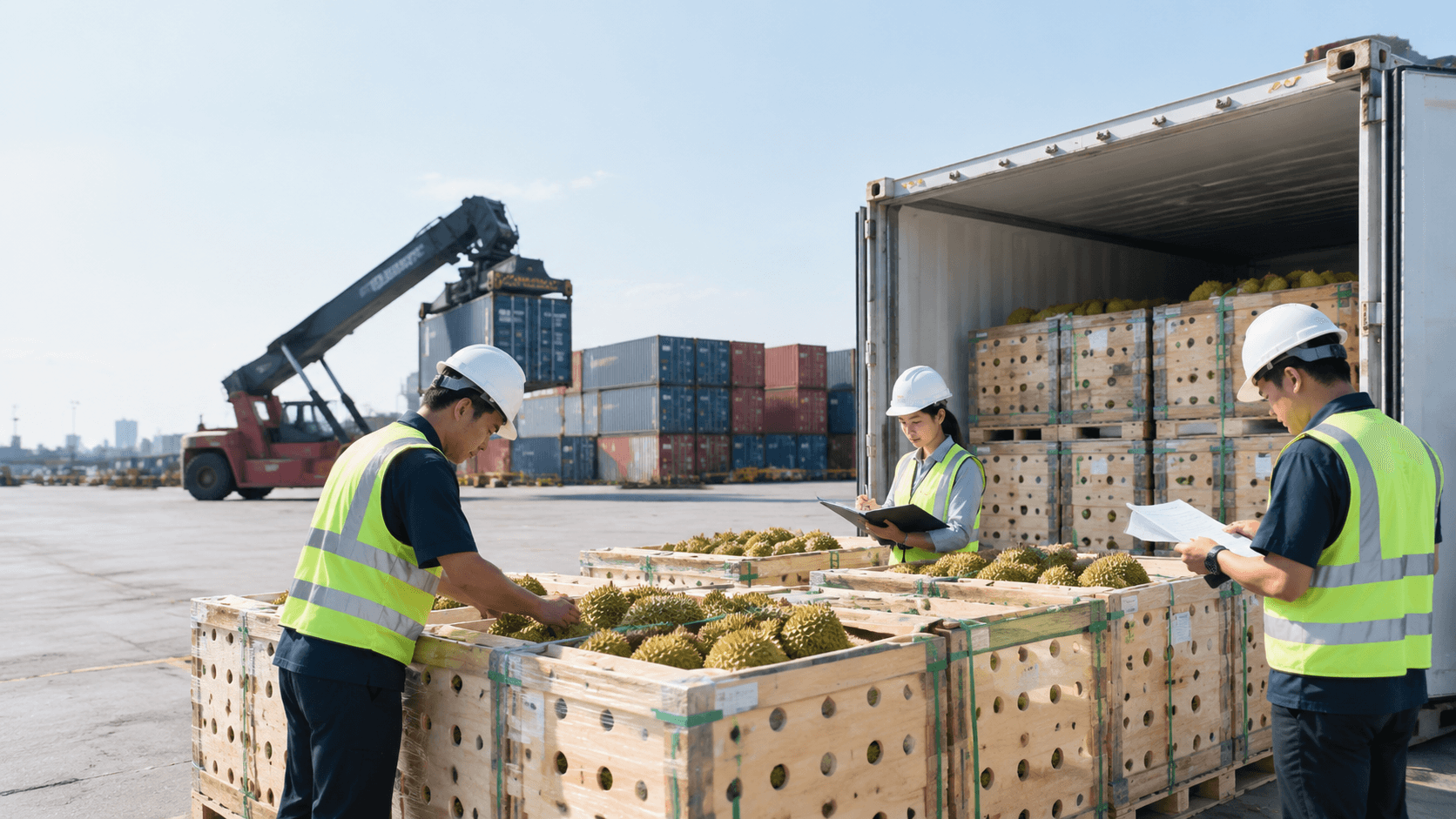
Identify the durian variety, whole-fruit specifications, commercial volume, and quality standards required by the Taiwanese importer
During transportation and customs clearance for shipping fresh durian to Taiwan, businesses should agree with the importer on the durian variety, average weight per fruit, acceptable size, defect rate, harvest maturity, and desired ripeness at the delivery point before booking transportation. Ri6, Monthong, and other commercial varieties differ in flesh, rind, stem characteristics, and ripening rates, so a single operating standard cannot be applied to every shipment.
To optimize the cost and schedule of shipping fresh durian to Taiwan, the assessment documents should specify the variety name, scientific name Durio zibethinus, production origin, total weight, estimated number of fruits, carton specifications, and grading proportions. For example, a 12,000 kg shipment with an average fruit weight of 3 kg corresponds to approximately 4,000 fruits, excluding cartons, pallets, and cushioning materials. Distinguishing net weight from gross weight is essential when calculating payload and freight charges.
Commercial standards must be specified in a contract appendix or confirmed in the buyer's technical requirements. If the Taiwanese buyer accepts only fruits with uncracked rinds, intact stems, and relatively uniform ripeness, the business must arrange grading at the packing facility rather than waiting until the export warehouse to remove defective goods. This approach reduces transportation costs for products that clearly fail to meet the required standards.
Analyze physiological maturity, respiration intensity, and quality changes to determine the viable transportation time limit for each shipment
Durian is a fruit that continues to ripen after harvest and may experience a significant increase in respiration activity and ethylene production during ripening. At high ambient temperatures, quality changes may accelerate, causing the fruit to soften quickly, develop a strong odor, crack, or have a shorter commercial shelf life. Therefore, the transportation schedule must be based on the fruit's actual condition rather than the harvest date alone.
Businesses should record the harvest time, fruit age based on cultivation records, physiological maturity, stem condition, signs of cracking, and flesh temperature or the measurement-zone temperature specified in the control procedures. Representative samples from each shipment can be monitored under the intended storage conditions to assess ripening progression. The number of days after fruit set must be adjusted according to variety, weather, and growing region; a single fixed figure should not be treated as a universal standard.
For sea freight, the actual transit timeline must include transportation from the warehouse to the port, waiting for container yard entry, time aboard the vessel, import customs clearance, and final delivery. A voyage with a short sailing time may still be unsuitable if the fruit is nearly ripe when the container is packed or must wait for specialized inspections at the destination port.
Compare Taiwan's fresh durian acceptance requirements with the supply source, packing facility capabilities, and exporter's ability to comply
Export feasibility depends on two distinct sets of conditions: the importing market's legal requirements and the customer's commercial requirements. A shipment that meets size, appearance, and sensory quality standards may still fail to clear customs if it violates phytosanitary requirements or pesticide residue limits.
Businesses must verify traceability capabilities, agricultural input usage records, pesticide application schedules, pre-harvest intervals, and the ability to provide laboratory samples. Packing facilities must have suitable areas for receiving, grading, sanitation, packing, storage, and pest control. Any requirements for growing area codes or packing facility codes must be determined according to the regulations actually applicable to the shipment; China's regulatory framework must not be automatically applied to other markets.
In particular, it is necessary to clarify which business will be named as the exporter, which party will be responsible for testing, and which importer will handle the receiving procedures in Taiwan. When these three parties do not use consistent shipment data, customs clearance delays often occur even when the transportation plan has been prepared relatively thoroughly.
Establish a backward schedule from the expected delivery date in Taiwan to determine the harvest date, preliminary processing, document completion, and transportation handover
The backward schedule starts from the time the importer needs to receive goods that meet the required standards, then subtracts the time required for domestic delivery in Taiwan, import inspections, port or airport handling, international transportation, and origin-side processing. This planning method helps businesses determine the latest feasible harvest date while allowing sufficient time for quarantine inspections and document processing.
For air freight, preliminary planning may allocate approximately 24–72 hours for the entire process after handover, provided flights, procedures, and customs clearance proceed smoothly. Sea freight requires a longer allowance, depending on the loading port, discharge port, shipping route, and transshipment arrangements. These are planning ranges only, not guarantees of transportation or customs clearance times.
Key control points include the cargo acceptance deadline at the warehouse, the documentation cut-off, the terminal cut-off, the deadline for completing quarantine inspections, the container delivery time, and the deadline for confirming the bill of lading. If the harvest schedule changes, the entire timeline must be updated accordingly to prevent fruit from being harvested before transportation or cargo space is ready.
Exporting Fresh Durian to Taiwan: Controlling Import Requirements and Risks During Shipment Approval
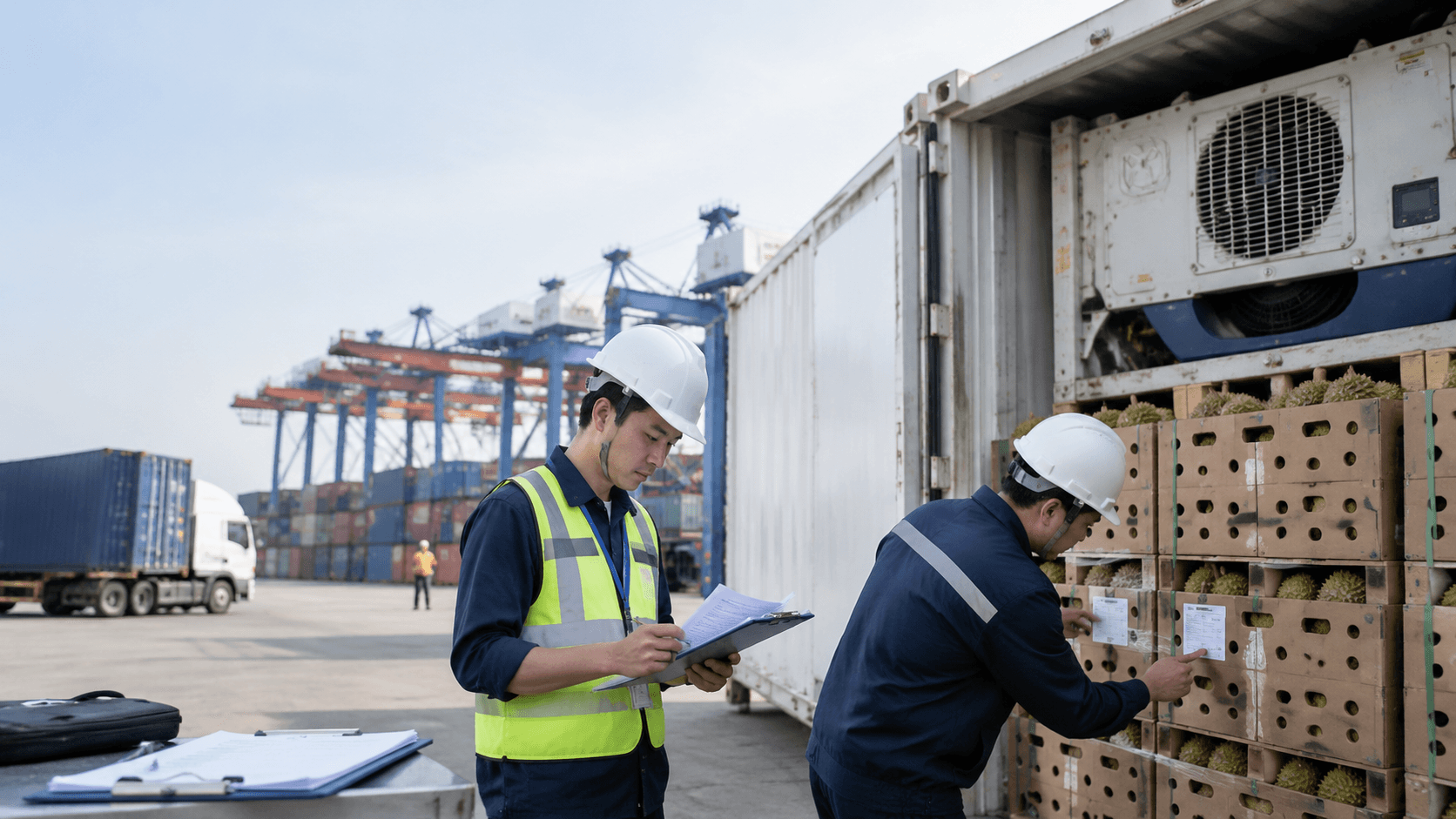
Verify whether fresh durian from Vietnam is permitted to enter Taiwan and confirm the phytosanitary requirements currently in force before purchasing the goods
Activities of exporting fresh durian to Taiwan must begin with checking the applicable import requirements for the specific country of origin, product type, and commercial import format. Taiwan's Animal and Plant Health Inspection Agency, abbreviated as APHIA, publishes a database for checking permitted plant imports and phytosanitary requirements at https://smartpq2.aphia.gov.tw/APP/APP01. Businesses should look up whole durian originating from Vietnam and confirm the conditions applicable to the intended import date.
Border inspection notices issued by Taiwan's Food and Drug Administration, or Taiwan FDA, in 2026 have recorded cases involving fresh durian shipments originating from Vietnam, including the Ri6 and Kanyao varieties, that were subject to enforcement due to non-compliant pesticide residues. This indicates that commercial imports have been recorded, but it does not mean that every shipment of Vietnamese durian automatically qualifies for import. Permitted import status, phytosanitary treatment requirements, and enhanced inspection measures must still be confirmed for the relevant period.
APHIA publishes lookup guidance and regulations at https://www.aphia.gov.tw/ws.php?id=14344. Businesses should also cross-check updated phytosanitary regulations effective April 1, 2026, and obtain written confirmation from the importer or agent in Taiwan. The prohibition on passengers carrying fresh fruit in their luggage must not be confused with the regulated commercial import process.
Approval principle: Do not purchase large quantities or make non-cancellable delivery commitments until the applicable import eligibility, phytosanitary, and food safety requirements have been verified for the specific shipment.
Verify requirements for growing areas, packing facilities, traceability, and pest control under the regulations applicable to the shipment
Traceability records must be connected from the harvesting orchard to the final shipment. Each lot should have an internal identification code, information about the farm or production area, harvest date, quantity received into storage, grading results, packing date, and carton code. When an issue is detected during inspection, this system makes it possible to isolate the affected portion of the shipment instead of impacting the company's entire output.
Regarding phytosanitary quarantine, pest control requirements must be based on the lists and measures prescribed by Taiwan for Vietnamese durians. Businesses should not independently determine quarantine treatment methods or treatment temperatures based on experience with other commodities. If mandatory treatment is required, the procedure must be confirmed in advance by the competent authority and the importer before implementation.
Alongside quarantine, pesticide residues are an independent risk that must be controlled. For example, on July 14, 2026, the Taiwan FDA announced that a shipment of Ri6 durians from Vietnam was non-compliant because acetamiprid was detected at 0.02 ppm, while the limit cited by the agency for that case was 0.01 ppm. Businesses must check the current limits for each active ingredient and product and must not use this example alone as a general limits table. Reference source: https://www.fda.gov.tw/UnsafeFood/UnsafeFoodContent.aspx?id=6071.
Prepare an export documentation package including the contract, commercial invoice, packing list, customs declaration, and specialized certificates as actually required
The documentation package must be checked for consistency in the seller's name, buyer's name, product variety, quantity, net weight, gross weight, place of origin, and delivery terms. The data on the phytosanitary certificate must match the actual goods and the commercial documents. Discrepancies in the scientific name, number of packages, container number, or consignee information may require the shipment to be explained or the documents to be amended.
- A confirmed foreign trade contract or purchase order specifying the Incoterms and the responsibilities of each party.
- A Commercial Invoice containing the full product name, unit price, total value, payment currency, and transaction information.
- A Packing List describing the number of cartons, number of pallets, net weight, gross weight, and packing specifications.
- An export customs declaration and data used for goods classification; HS code 0810.60 is a reference basis for fresh durians, but the detailed code must be verified in each country.
- A Phytosanitary Certificate issued by the competent phytosanitary authority of Vietnam in accordance with applicable regulations.
- A bill of lading or air waybill, together with booking confirmation and relevant transportation data.
- A certificate of origin if required to obtain preferential treatment or fulfill the contract; issuance and use depend on the rules of origin, agreements, and actual conditions.
- Pesticide residue test results, traceability records, specialized treatment documents, or supplementary import documents if required by the Taiwanese side.
For customs declaration, the correct HS code, customs value, export procedure type, and customs clearance location must be determined before the goods arrive at the port. If the business chooses refrigerated container transportation, the documentation must also accurately state the container number, seal number, and any changes made after loading. Old shipping documents should not be reused to declare a new shipment when the quantity or export facility has changed.
Establish a prior confirmation mechanism with the importer and the customs clearance contact in Taiwan to reduce the risk of import refusal, re-export, or destruction of goods
Before the harvest date, the importer must confirm the import commodity code, quarantine conditions, certificate requirements, food inspection procedures, and receiving capacity at the destination port or airport. Confirmation should be retained as a traceable email or written document, together with the verified version of the documentation. This provides a basis for handling regulatory changes or disputes over responsibilities.
Taiwan conducts phytosanitary inspections and food safety inspections through the relevant authorities. Non-compliant shipments may be subject to treatment, import refusal, re-export, or destruction, depending on the findings and applicable regulations. For fresh durians, waiting for corrective measures may also allow the fruit to continue ripening, significantly reducing the recoverable value after an incident.
HNT Logistics recommends that businesses establish a pre-shipment approval mechanism requiring three separate confirmations: commercial approval from the buyer, confirmation of import legality from the Taiwanese contact, and confirmation of operational feasibility from the transportation provider. If any of these three conditions is not met, shipment handover to the carrier should be suspended to avoid turning risks into actual costs.
Shipping Fresh Durian to Taiwan: Designing a Preservation Chain Based on the Fruit's Physiological Characteristics
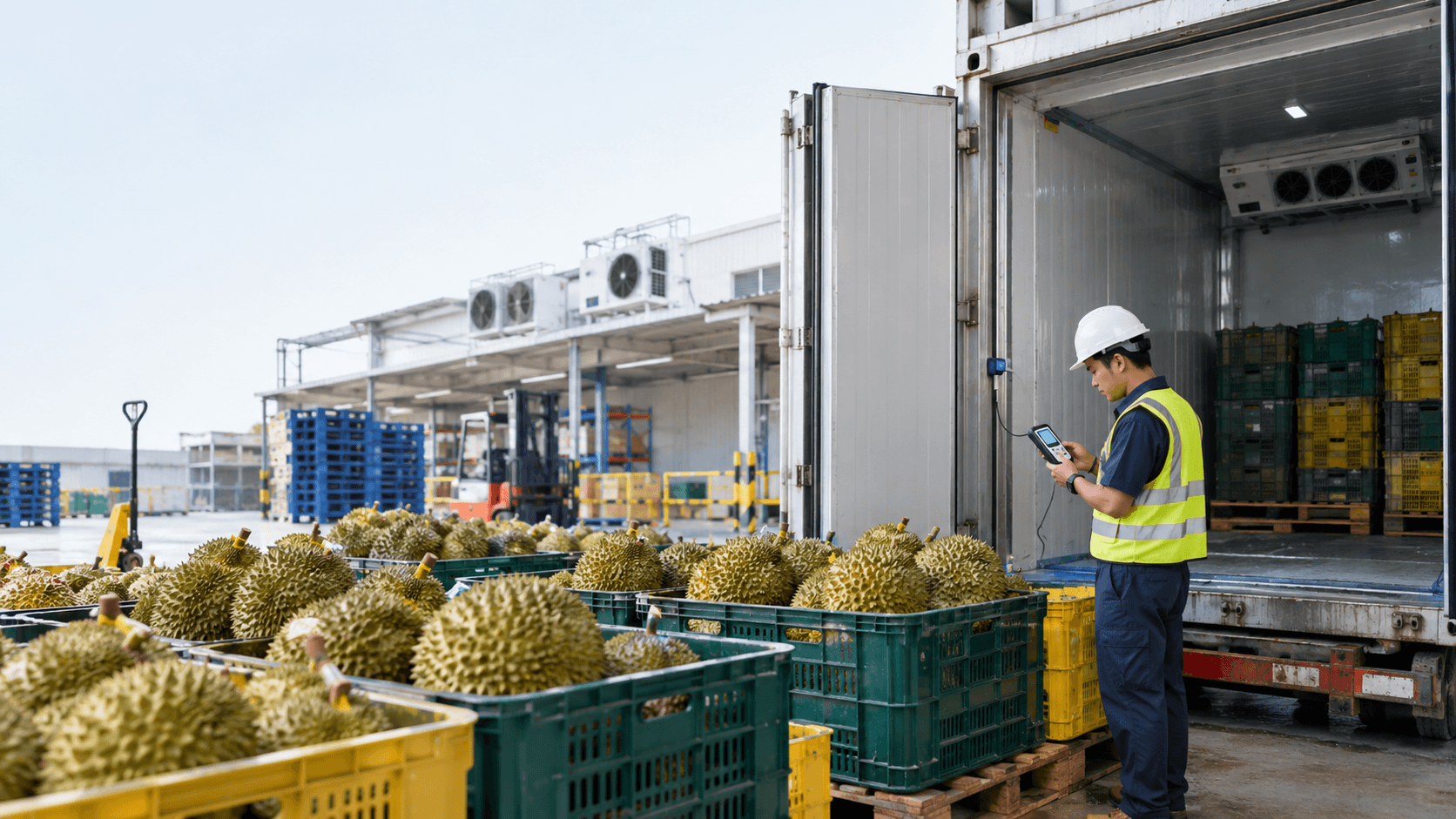
Classify durians by harvest maturity, stem condition, thorn integrity, and degree of uniformity to determine shipment packing standards
Whole durians have a hard, thorny rind, but this does not mean they can withstand strong impacts. Broken thorns, bruised stems, natural cracks, or damage to the rind can increase contamination risks and reduce quality. Businesses should grade the fruit upon receipt, separating fruit that shows signs of rapid ripening, fruit that is overripe, or fruit that does not meet export requirements.
Each packing group should be relatively uniform in variety, size, and maturity. If fruit at different stages of ripeness is mixed in the same carton or pallet, the heat generated during respiration and the required time to consumption will be difficult to control. For contracts requiring a high degree of uniformity, businesses should conduct sampling, record photographs, and prepare an acceptance inspection report before packing.
Develop a preliminary processing, cleaning, grading, and carton-packing procedure to minimize rind cracking, impact damage, contamination, and quality deterioration
The preliminary processing procedure should begin in a clean receiving area with a roof and separation from potential sources of contamination. The fruit should be inspected, foreign matter removed, graded, and cleaned according to an approved procedure. Do not arbitrarily soak the fruit in chemicals, spray preservatives, or apply post-harvest treatments without first verifying the legality of the substances used and their ability to meet Taiwan's residue standards.
Moisture-resistant cartons, specialized plastic crates, or packaging approved by the importer must have a load-bearing structure suitable for the fruit's thorny shape. Cushioning materials should minimize direct contact between individual fruits while ensuring adequate ventilation. For lots using cartons, stacking load tests should be conducted under the expected operating humidity conditions to minimize bottom-carton deformation during cold storage or long-distance transportation.
A packing specification of 10–20 kg net weight per carton can be used to simulate a commercial arrangement, but it is not a mandatory standard. The final weight depends on fruit size, packaging load capacity, and buyer requirements. Ventilation holes must be positioned so that they are not completely blocked when pallets are stacked, especially for refrigerated container shipments.
Determine suitable temperature, ventilation, and humidity settings based on the durian variety, cargo condition, and storage guidelines confirmed for the shipment
Temperature control is a decisive factor in determining the commercial shelf life of fresh durians, but the lowest possible temperature should not automatically be selected. Fruit may suffer chilling injury if stored below the chilling tolerance threshold for its variety and harvest maturity. Conversely, excessively high temperatures accelerate ripening, increase the risk of rind cracking, and reduce quality before delivery to the buyer.
A range of 12–15°C can be used as an initial assumption for evaluating a storage plan for certain shipments of whole durians, but it is not a standard temperature applicable to every variety. The setpoint should only be confirmed after reviewing post-harvest guidelines, storage trial results, maturity, transportation time, and customer requirements. Relative humidity of approximately 85–90% may serve as a starting point for technical evaluation, but water condensation, mold, and packaging moisture resistance must be controlled.
Refrigerated containers must be checked for machine condition, cleanliness, sensors, doors, and air circulation systems. The goods should be loaded into the container only after reaching an appropriate receiving temperature; a refrigerated transport container should not be used as a rapid-cooling device to replace a pre-cooling facility. If fresh-air ventilation is required, the airflow rate must be configured according to the cargo's physiological requirements and the equipment supplier's guidelines. A fixed ventilation opening should not be applied arbitrarily to every shipment.
Throughout the transportation process, temperature and sensor location data logs help distinguish between supply air temperature, return air temperature, and the actual temperature of the goods. When a claim arises, these logs are more valuable than simply presenting the set temperature on the control panel. For high-value cargo, independent data loggers can be placed at representative locations after agreement with the relevant parties.
Establish odor control, vehicle sanitation, and loading and unloading procedures to minimize the impact on other goods during transportation operations
The characteristic odor of durian may affect acceptance by airlines, cargo handling warehouses, and freight consolidation providers. Not all carriers accept fresh durian under the same packaging conditions. Businesses must accurately declare the commodity name, ripeness status, and odor control methods so that the carrier can confirm acceptance before the booking is issued.
Cargo vehicles must be clean, free of chemical residues and unusual odors, and must not carry mixed loads with products that could pose a food safety risk. During loading and unloading, pallets should be kept out of direct sunlight, cartons should not be dragged, and the time cold storage doors remain open should be controlled. For refrigerated containers, cargo must not obstruct the supply or return airflow and must not exceed the equipment's load line or cargo stacking height limit.
Before sealing, the person in charge must record the seal number, door condition, refrigeration unit status, cargo temperature, and the time container loading is completed. This is an important set of data for determining responsibility at each handover point during international transportation.
Comparison Table of Fresh Durian Shipping Options to Taiwan and Logistics Freight Cost Structure

Comparison of air and sea freight in terms of total transit time, suitable shipment volumes, storage requirements, and ability to meet delivery deadlines
The two transportation methods have different timeframes and risk profiles. Air freight reduces international transit time but is subject to capacity constraints, acceptance conditions for odorous cargo, and charges based on chargeable weight. Sea freight is more suitable for large commercial volumes, especially when using a full refrigerated container, but port waiting times, transshipment, and the fruit's remaining commercial shelf life must be carefully considered.
| Criteria | Air | Sea |
|---|---|---|
| Expected origin | Tan Son Nhat International Airport | Suitable ports in the Ho Chi Minh City and Cai Mep areas, depending on the route |
| Expected destination | An airport in Taiwan capable of accepting the cargo | Taiwanese port as confirmed in the booking |
| International transit time | Flight time measured in hours; excludes waiting for flights and cargo handling | Depends on direct shipping routes, transshipment, and carrier schedules |
| Estimated total transit time for preliminary planning | Approximately 1–3 days under favorable conditions | Approximately 5–12 days or longer, depending on the route and customs clearance |
| Suitable shipment size | Small shipments, high-value goods, and orders requiring fast delivery | Large shipments, full-container loads, or accepted refrigerated consolidation options |
| Consolidated (LTL) | Cool storage, suitable insulated packaging, and control of time spent outside storage | Refrigerated containers, pre-cooling, ventilation, and data monitoring |
| Main risks | Flight delays, rejection of strong-smelling cargo, and capacity limitations | Schedule changes, transshipment, port storage, power outages, or temperature deviations |
| Selection criteria | Carrier confirmation of cargo acceptance and a suitable delivery timeframe | The shipment's remaining commercial shelf life must be sufficient for the entire transit and contingency period |
The time ranges in the table are assumptions for comparison purposes and are not confirmed operating schedules for any specific carrier. Before booking, businesses must obtain the transportation schedule, port of departure, port of arrival, transshipment time, and delivery deadline from the transport provider. For durian that already shows signs of ripening quickly, prioritizing a safe total transit time may be more important than the difference in freight costs.
Fresh durian shipping cost calculation table for Taiwan, itemized by component, including pickup in Ho Chi Minh City, packaging, domestic transportation, port or airport handling, international freight, and documentation
To assess the shipping costs for fresh durians to Taiwan, cargo owners should request a quotation itemised by stage, together with the payment terms. A quotation showing only ocean freight or air freight does not fully reflect the actual costs if it excludes collection, loading and unloading, refrigerated transport, phytosanitary inspection, customs declarations, cold storage and delivery in Taiwan.
The table below is an illustrative budget calculation for a refrigerated container carrying 12,000 kg of net cargo. It is not a quotation from HNT Logistics, does not reflect market prices as at the publication date and must not be used to finalise a transaction.
| Category | Illustrative costs (VND) | Notes |
|---|---|---|
| Collection and transport from the collection point to the packing facility in Ho Chi Minh City | 6.000.000 | Depends on the distance, number of trips and storage requirements |
| Sorting, packaging materials and packing | 18.000.000 | Assumed rate of VND 1,500/kg |
| Inland transport to the port and container coordination | 8.000.000 | Depends on vehicle type, route and waiting time |
| Loading and unloading, port handling and origin-side refrigeration | 7.000.000 | Must be confirmed against the actual tariff |
| International ocean freight charges | 25.000.000 | Simulation assumptions, not a route quotation |
| Documentation, declarations, and phytosanitary coordination | 5.000.000 | Excludes any additional testing |
| Contingency for schedule changes and unexpected issues | 6.000.000 | Internal management budget |
| Simulated total budget | 75.000.000 | Equivalent to VND 6,250/kg of exported goods |
For an accurate comparison, businesses need to convert foreign currencies using a consistent exchange rate, determine whether quoted taxes and surcharges are included, and clearly identify which party bears the costs in Taiwan. If the delivery term is FOB, the seller's cost scope differs significantly from CPT, CIP, CFR, CIF, or DAP. The use of Incoterms 2026 must be appropriate for the mode of transport and the specific delivery location stated in the contract.
Comparison table of crating, palletising and refrigerated container options based on usable volume, payload limits, ventilation capacity and space utilisation efficiency
Optimizing space does not mean loading goods to the maximum nominal capacity. Durian has an irregular shape, protruding spikes, and requires adequate airflow, so the actual space utilization rate depends on carton construction and the loading arrangement. In particular, blocking the return airflow can cause uneven temperature distribution even when the refrigeration unit is operating at full capacity.
| Method | Reference specifications | Ventilation capacity | Load considerations |
|---|---|---|---|
| Carton or plastic crate | Example: 10–20 kg net weight per carton | Depends on the location and area of ventilation openings | Compression resistance and moisture resistance testing |
| Standard pallet | May use 1,000 x 1,200 mm dimensions or a type approved by the buyer | Adequate airflow channels must be maintained between cargo blocks | Do not exceed pallet load capacity or operational stacking height limits |
| 20-foot refrigerated container | Geometric internal volume is typically approximately 28 m³, depending on the model | Recirculating airflow and ventilation systems according to configuration | Payload must be verified against the CSC plate and equipment specifications |
| 40-foot High Cube refrigerated container | Geometric internal volume is typically approximately 67 m³, depending on the model | Proper clearance must be maintained for supply and return airflow | Limited by container payload, vehicle capacity, and road transport regulations |
The geometric volume shown in the table is not the usable volume permitted for cargo loading. When developing a shipping plan, businesses must deduct the space required for airflow, loading line restrictions, refrigeration systems, pallets, and operational clearances. If wooden pallets are used, imported wood packaging material requirements must be checked, including compliance with ISPM 15 where applicable.
Risk cost analysis table covering quality losses, warehousing, storage charges, specialist inspections, transport schedule changes and the handling of non-compliant goods
The biggest cost in durian transportation is not necessarily freight charges. One day of port storage can result in additional refrigeration electricity fees, container demurrage or storage charges, delivery schedule adjustments, and a decline in the proportion of goods meeting quality standards. If residue testing or phytosanitary inspections fail, businesses may also face handling, re-export, destruction, and contractual dispute costs.
| Risk category | Financial impact | Control measure |
|---|---|---|
| Quality deterioration | Reduced saleable volume and lower commercial value | Correct maturity classification and monitoring of temperature and transit time |
| Cold storage and port storage | Cold storage fees, refrigeration electricity, and container storage charges | Coordinate phytosanitary inspection, container yard entry, and vessel departure dates |
| Specialized inspection | Sampling, testing, and cargo detention fees | Pre-export testing and verification against import requirements |
| Transportation schedule changes | Booking amendment fees, extended storage, and vehicle changes | Select schedules with contingency arrangements |
| Non-compliant cargo | Re-export, destruction, detention, and cargo value losses | Obtain legal approval before procurement and arrange appropriate insurance |
To quantify risks, businesses can establish budgets based on the probability of occurrence and the expected level of loss. However, costs such as import rejection cannot be assessed solely using average expenses because the consequences may affect the entire shipment. Risks with severe impacts require independent preventive measures, even when their probability of occurrence is considered low.
Optimising Fresh Durian Shipping Rates to Taiwan Based on the Actual Cost per Kilogram of Compliant Goods
Developing a total logistics cost model based on volume, seasonality, transport mode, delivery terms and the selected scope of services
The cost model should begin with the expected commercial cargo volume and the freight calculation method. Air freight is generally calculated using chargeable weight, based on actual weight or volumetric weight according to the carrier's rules. For full-container shipments, businesses must allocate the total container cost across an appropriate cargo quantity based on payload limits and storage conditions, rather than overloading the container simply to reduce the unit cost.
Total logistics costs can be modeled using the following formula: C = C_pickup + C_packaging + C_domestic + C_origin + C_international + C_documentation + C_destination + C_contingency. Destination costs should only be included in the seller's responsibilities when required by the agreed delivery terms. Businesses should avoid double-counting surcharges already included in the carrier's or agent's all-inclusive quotation.
Seasonality can simultaneously affect purchase prices, packing warehouse capacity, refrigerated vehicle availability, vessel schedules, and booking demand. Therefore, comparisons between suppliers must be based on the same shipping date, container type, pickup and delivery points, and conditions for additional charges. A lower unit price that excludes refrigeration electricity fees or first-mile and last-mile transportation does not necessarily represent a more economical solution.
Calculating the cost of compliant goods at the destination by combining freight charges, packaging costs, loss rates and a contingency budget for unforeseen expenses
The most important indicator to monitor is not the freight cost per kilogram exported, but the logistics cost allocated to each kilogram accepted by the importer. This indicator helps identify the actual benefits of investing in better packaging, shortening delivery times, or selecting transportation solutions with lower risks.
Formula: Logistics cost per accepted kilogram = Total actual logistics costs / Quantity of goods accepted at the receiving point. If 12,000 kg are exported and the acceptance rate is 96%, the accepted quantity is equivalent to 11,520 kg. With a simulated total budget of VND 75,000,000, the allocated logistics cost is approximately VND 6,510 per accepted kilogram, instead of VND 6,250 per kilogram when divided by the initial cargo volume.
If the acceptance rate drops to 90%, the accepted quantity falls to 10,800 kg, and the allocated logistics cost increases to approximately VND 6,944 per kilogram. This difference does not include the value of rejected goods, recovery costs, or price reductions requested by the buyer. Therefore, saving several million VND in transportation costs may prove ineffective if it significantly increases the proportion of cargo that loses commercial value.
When preparing a budget, businesses should distinguish between physical losses, goods downgraded commercially, and goods that fail to meet import eligibility requirements. These three categories have different levels of recoverable value. For shipments rejected at import, businesses must also consider ownership rights, contractual responsibilities, re-export possibilities, and insurance limitations before deciding on a handling solution.
Optimising harvest schedules, collection times, crating specifications and booking plans to reduce waiting times without compromising fruit quality
Transportation optimization begins at the harvesting site, not when the container arrives at the warehouse. If harvesting is organized before booking confirmation, goods may need to remain in storage for an extended period, reducing their commercial shelf life. Conversely, waiting until just before the vessel's cargo cutoff to arrange phytosanitary inspections may leave insufficient time to resolve documentation discrepancies or conduct additional inspections.
An effective solution is to lock in the transportation schedule around clearly assigned milestones: completion of testing, shipment approval, vehicle confirmation, harvesting, preliminary processing, loading, certificate issuance, and handover. Each milestone should include a reasonable time buffer. This buffer does not necessarily require longer warehouse storage; priority should be given to maintaining flexibility before harvesting and preparing alternative transportation arrangements in advance.
Packaging specifications also affect efficiency. If cartons are too large, the fruit may be compressed or difficult to distribute at the destination. If cartons are too small, material costs, handling operations, and packaging volume may increase. Businesses should test actual loading arrangements, calculate the number of cartons per pallet, and check airflow before confirming the booking quantity.
Establishing a risk matrix based on financial impact, likelihood of occurrence and contingency measures for delayed departures, documentation discrepancies or disruptions to storage and preservation
The risk matrix should be assessed based on two factors: the likelihood of occurrence and the level of impact on the shipment's commercial value. An internal scale from 1 to 5 can be used for each factor, after which the two scores are multiplied to determine management priorities. This is an internal decision-making tool, not a phytosanitary inspection scoring system or an assessment standard issued by regulatory authorities.
For shipment delays, contingency measures include checking alternative schedules, reassessing the remaining storage life, and obtaining new acceptance confirmation from the customer. If documentation discrepancies occur, businesses must determine whether corrections can be made before the cargo leaves the port and avoid independently modifying data on certificates that have already been issued. When a refrigerated container malfunctions, maintaining the power supply, recording actual temperatures, and coordinating technical inspections with the carrier must take priority.
Risks involving residue violations or failure to meet phytosanitary requirements must be controlled before harvesting. Changing the transportation method cannot resolve the legal ineligibility of a shipment. Businesses should retain the right to suspend exports until testing documents and import approval have been completed.
HNT Logistics' End-to-End Fresh Durian Shipping Services to Taiwan: Integrated Transport, Documentation and Cost Control
Developing a service plan based on the collection point in HCM, shipment volume, delivery deadlines and the Taiwanese partner's storage requirements
For businesses that require fresh durian shipping to Taiwan, HNT Logistics can advise on logistics arrangements based on four groups of information: pickup location, shipment volume, delivery deadline, and storage conditions. Based on these details, the logistics provider can develop a plan covering domestic transportation, vehicle type, departure port or airport, and the scope of documentation requiring coordination.
Cargo owners should provide the specific pickup address in Ho Chi Minh City or nearby areas, volume per shipment, durian variety, carton specifications, expected temperature, destination port, and Incoterms. If the shipment is still at the planning stage, HNT Logistics can work with the business to review technical requirements before finalizing the transportation method. International service arrangements depend on operating schedules, cargo acceptance capacity, and confirmation from transportation partners.
Coordinating road transport, arranging suitable vehicles or containers, connecting international transport services and managing handover milestones according to plan
HNT Logistics has experience in container transportation, refrigerated transportation, and freight forwarding at major port clusters. When handling durian exports from Ho Chi Minh City, the road transportation stage must be coordinated with packing warehouse schedules, phytosanitary inspection timelines, and container delivery plans. Vehicles or containers must be inspected before accepting cargo, particularly in terms of cleanliness, temperature maintenance capabilities, and loading conditions.
If using multimodal transportation, the plan must clearly define the transfer of responsibilities between road transportation, warehouses, ports, and international carriers. Combining multiple transportation legs is only meaningful when waiting times, temperatures, and documentation are controlled throughout the entire journey. Each handover point should record cargo condition, package count, seal status, and relevant storage parameters.
When using refrigerated sea containers, HNT Logistics can help coordinate the operational stages covered by the agreed service scope. If switching to air freight, businesses must first verify the airline's capacity to accept whole fresh durians and its odor-control requirements. Businesses should not automatically assume that the two options can be substituted immediately when transportation schedule disruptions occur.
Supporting export customs declarations, reviewing documentation and coordinating phytosanitary procedures according to the actual requirements of the shipment
Customs customs declaration must be prepared in coordination with commercial documentation and the importing country's phytosanitary requirements. HNT Logistics can assist in reviewing information on invoices, packing lists, contracts, transport documents, and data required for export declarations within its operational scope. Specialized certificates must be issued by competent authorities, not by logistics companies.
For plant quarantine, exporters must coordinate with the relevant quarantine authorities in Vietnam to complete registration, inspection, and certificate issuance in accordance with applicable procedures. HNT Logistics can assist with transportation coordination and provide data for relevant procedures, while communicating documentation requirements to the importer. An export phytosanitary certificate does not replace the obligation to comply with phytosanitary and food safety regulations when the goods arrive in Taiwan.
When residue testing is required, businesses must select a laboratory with appropriate capabilities, determine the list of active substances to be analyzed according to the destination market's current standards, and agree on representative sampling procedures. Testing should not be limited to substances that were previously flagged, as permissible limits and risk lists may change over time.
HNT Logistics supports durian exporters with transparent logistics solutions, fresh cargo risk management and cost optimisation from Ho Chi Minh City to Taiwan, in accordance with the agreed scope of services.
The value of a solution end-to-end fresh durian shipping to Taiwan lies in the ability to connect multiple operational stages into a manageable plan. Businesses need to know when cargo will be received, who is responsible at each stage, when risks are transferred, and which costs are not included in the quotation. These details should be clearly stated in the service contract or transportation confirmation.
HNT Logistics aims to coordinate domestic transportation, connect international shipping services, review documentation, and assist with export procedure coordination on a case-by-case basis. Service arrangements must be based on confirmed import conditions, actual transportation capacity, and the shipment's storage requirements. No logistics solution can replace agricultural product quality control at the growing area or guarantee customs clearance when goods violate applicable regulations.
To manage budgets proactively, businesses should request quotations that separately itemize freight charges, port fees, packaging costs, refrigeration electricity, documentation, specialized inspections, and conditional additional charges. When two providers offer the same service scope, comparing costs per kilogram of accepted goods provides a more accurate picture of actual efficiency than simply looking at international freight rates.
Fresh durian shipping to Taiwan from Ho Chi Minh City is truly effective only when three conditions are met simultaneously: the shipment qualifies for import, the preservation chain is appropriate for the fruit's physiological characteristics, and total costs are controlled from pickup to delivery. Proper preparation from the moment the cargo source is approved helps businesses minimize customs clearance delays, quality deterioration, and commercial disputes.
Businesses planning to export fresh durians to Taiwan can contact HNT Logistics through the website https://hntshipping.com.vn or hotlines 0911.446.060 and 0949.393.300 to discuss freight forwarding arrangements, cold chain management, and logistics cost estimates based on actual shipment volumes. Providing information about the cargo source, delivery deadlines, confirmed import conditions, and partner requirements early will help develop a more transparent, feasible solution aligned with business objectives.