A container of frozen durian for export can incur significant costs if the factory has not been approved by China, phytosanitary documents are non-compliant, or storage temperatures are interrupted during transportation. For frozen food products, completing customs declarations in Vietnam does not mean that the shipment is guaranteed entry into China. Businesses must simultaneously control legal requirements, product documentation, cold chain capabilities, and inspection procedures at the port of entry.
When researching frozen durian exports, procedures for exporting frozen durian to China are implemented based on the Protocol on Inspection, Quarantine, and Food Safety Requirements signed on August 19, 2026, between Vietnam and the General Administration of Customs of China (GACC). In addition, businesses must update their knowledge of imported food manufacturer registration regulations under GACC Order No. 280, effective June 1, 2026. HNT Logistics analyzes the process, from verifying export eligibility and preparing documentation to selecting transportation routes and establishing cost and delivery risk control models.
Procedures for Exporting Frozen Durian to China: Verifying Legal Requirements and Eligibility for Acceptance at the Border Crossing

For frozen durian export solutions, market access eligibility is a step that must be completed before businesses commit to delivery or book refrigerated containers. The Vietnam–China Protocol allows the export of frozen durian products within the agreed scope. However, permission to import does not mean that every factory or every durian-based processed product automatically qualifies. Businesses must accurately verify the product, raw material sources, facility registration status, and quarantine requirements for each shipment.
Distinguish the regulatory requirements for frozen durian by product type, including whole durian segments, deseeded durian flesh, frozen fruit pulp and processed products, to accurately determine the product category, HS code and applicable import-export policies
During the transportation and customs clearance of frozen durian exports, Article I of the Protocol identifies three product forms within its scope: whole frozen durians with their shells, frozen peeled durian flesh or pulp, and frozen peeled durian puree. The raw materials must originate from ripe fresh durians grown in Vietnam. This is the first basis for assessing the eligibility of frozen durian exports to China under the market access mechanism agreed upon by both parties.
To optimize costs and schedules for frozen durian exports, commercial operations sometimes use terms such as frozen durian segments, deseeded durian pulp, and frozen fruit flesh interchangeably. However, businesses must clearly describe whether the product contains seeds, whether the seeds have been removed, whether the product has been pureed, and whether sugar or additives have been added. Durian ice cream, durian-filled cakes, fruit mixtures, and blended products must not automatically be considered goods covered by the Protocol for frozen durian.
Based on HNT Logistics' practical operating experience with frozen durian exports, for products consisting of frozen fruit that has not undergone extensive processing, HS heading 0811 is a classification basis that should be considered, with subheading 0811.90 relating to other frozen fruits. The eight-digit HS code must be determined according to Vietnam's currently applicable Export and Import Goods Nomenclature, the actual product characteristics, and technical documentation. Processed or blended products may fall under other headings, resulting in changes to regulatory policies and import tax calculations.
When researching frozen durian exports, the Protocol stipulates that products must be frozen at a temperature of minus 35°C or lower for at least one hour until the core temperature reaches minus 18°C or lower. The core temperature must then be maintained at no higher than minus 18°C during storage and transportation. This is a mandatory technical requirement that must be demonstrated through production records. Businesses must not confuse the rapid-freezing temperature at the factory with the refrigerated container's temperature setting during transportation.
Check the registration eligibility of the exporting company, processing plant and relevant facilities against the list of establishments approved by the competent Chinese authorities, and verify GACC registration requirements where applicable
For frozen durian export solutions, Article V of the Protocol stipulates that facilities producing, processing, and storing frozen durian must be inspected and evaluated by the Vietnamese authorities and recommended to China for registration in accordance with applicable requirements. Only after a facility has been registered can products within its registered scope be exported. Therefore, businesses should not simply check domestic business licenses or food safety certificates while overlooking the facility's approval status in China.
From June 1, 2026, GACC Order No. 280 replaces Order No. 248 on the registration management of overseas food manufacturers. Businesses must cross-check the list of products requiring registration under the competent-authority recommendation mechanism, the application status on the CIFER system, and the specialized requirements under the bilateral Protocol. They should not assume that frozen durian manufacturing facilities can independently register through the general procedure if specialized regulations require recommendations from Vietnamese authorities.
When inspecting a factory, businesses must confirm its legal name, production address, registration code in China, approved product scope, and registration validity. At the same time, the documentation must provide traceability to the raw material growing areas registered with the Vietnamese management authorities under Article IV of the Protocol. If a trading company purchases products from multiple factories, each facility that actually produces the shipment must be checked separately. The registration code of another factory must not be used.
The review process should be completed before scheduling cargo loading. If a facility changes its address, production process, or registration information, the business must verify its update obligations with the competent authorities. The GACC registration code and manufacturer information on labels, phytosanitary certificates, and import documentation must be consistent. Discrepancies between the exporter's trade name and the manufacturer's name may result in requests for clarification if they are not clearly explained in the documentation package.
Determine the food safety criteria for frozen products, including pesticide residues, heavy metals, microorganisms, food additives and applicable limits under current Chinese regulations
Frozen durian is a plant-based food product and must therefore comply with the food safety and quarantine requirements stipulated in the Protocol and corresponding Chinese standards. The groups of indicators to consider include pesticide residues, heavy metals, pathogenic microorganisms, food additives, and prohibited substances. Applicable limits must be determined based on the specific product type and the version of the standards in force at the time of importation.
For pesticide residues, the reference framework includes the GB 2763 standards system and relevant supplementary standards. For contaminants, businesses must update their knowledge of GB 2762-2026, effective September 2, 2026. Standards concerning pathogenic microorganisms, including GB 29921 where applicable, and food additive regulations must also be reviewed according to the product characteristics. A single general limit must not be applied to all types of frozen durian without first identifying the correct applicable category.
The Protocol specifically requires control of microbiological hazards such as norovirus, hepatitis A virus, and harmful substances that may arise from raw materials or processing. Factories must operate sanitation control programs, separate production areas to minimize cross-contamination, retain test results, and maintain raw material traceability records. Indicators such as cadmium and unauthorized colorants must be included in testing plans according to actual regulatory requirements and market alerts.
Test results should be linked to batch codes, production dates, processing facilities, and sampling methods. Businesses must verify the testing laboratory, analytical methods, validity period of the results, and any accreditation requirements imposed by China. A test report meeting a factory's internal quality standards does not automatically replace specialized inspection documents or testing requirements applied by the importing authorities to individual shipments.
Establish a pre-transaction verification process between the exporter, Chinese importer and logistics provider to confirm cargo acceptance conditions, Chinese-language labelling requirements, traceability records and customs clearance feasibility at the intended border crossing
Before signing a foreign trade contract, exporters should send their Chinese partners a product information package including the product name, processing form, packaging images, proposed HS code, factory registration code, production location, storage conditions, and test reports. Importers are responsible for coordinating verification of acceptance requirements at the intended port or border crossing, including import registration, quarantine, and food inspection requirements imposed by Chinese Customs.
Article VI of the Protocol stipulates that packaging must be clean, hygienic, and made from new materials that comply with food safety requirements. Each package must display mandatory information in Chinese or English, including the product name, country of origin, name of the manufacturing or processing facility, Chinese registration code, exporter name and address, production date, shelf life, and a statement confirming that the goods are exported to China. Chinese labeling requirements for imported food must also be checked according to the distribution format and packaging specifications.
For shipments passing through Lang Son, Quang Ninh, or Chinese seaports, businesses must verify whether the entry point can accept frozen food, its operating hours, specialized inspection facilities, power supply for refrigerated containers, and the capacity of cold storage facilities near the border. The fact that a border crossing handles agricultural products does not mean that every type of frozen durian can be processed there. Confirmation from the importer and the Chinese-side freight forwarder must be obtained for each transportation plan.
An effective verification mechanism should include a written agreement among all three parties covering legal documentation, sampling schedules, customs clearance responsibilities, temperature conditions at handover, container free-time allowances, and contingency plans if goods are held for inspection. This is an important step in reducing the risk of additional refrigerated transportation charges or disputes when goods have left the factory but do not yet meet all import requirements.
Frozen Durian for Export: Completing Specialist Documentation and Standardising Customs Declaration Data

The export documentation package must simultaneously satisfy the requirements of Vietnamese Customs, quarantine authorities, payment banks, and importing partners. For frozen durian exports, even minor differences in product names, factory codes, or weights can require document amendments after the container has entered the port. Therefore, businesses should establish a master data set for customs declarants, freight forwarders, and importers to use consistently.
Prepare a shipment-specific document checklist covering the international sales contract, Commercial Invoice, Packing List, customs declaration, bill of lading, Certificate of Origin (C/O) and food safety inspection certificates where required
The list of required documents should be developed according to the transportation method, trade terms, payment method, and import country requirements. Not every commercial document must be submitted in every case, but all relevant documents must be prepared and retained for explanation when requested by management authorities or business partners. In particular, the phytosanitary certificate required under the Protocol must be handled separately and should not be combined with the commercial quality certificate.
- Foreign trade contract: Specifies the buyer, seller, product description, quantity, unit price, Incoterms, payment terms, and responsibilities for handling losses.
- Commercial Invoice: Confirms the transaction value, payment currency, delivery terms, and information about the parties.
- Packing List: Specifies the number of packages, net weight, gross weight, packaging specifications, number of pallets, and batch codes.
- Export customs declaration: Submitted through the electronic system using the appropriate declaration type and product information.
- Bill of Lading or road transport document: Shows the transportation route, carrier, container number, and delivery information.
- Certificate of Origin (C/O): Prepared according to the applicable trade agreement and the importer's need to obtain tariff preferences.
- Phytosanitary Certificate: Issued in accordance with the requirements applicable to each shipment of frozen durian covered by the Protocol.
- Testing and food safety inspection documents: Prepared according to applicable regulatory requirements, product type, and risk assessment results.
- GACC facility registration records, raw material area traceability documents, freezing logs, and quality inspection reports: Retained for verification when necessary.
Under Article VIII of the Protocol, the competent Vietnamese authority issues a phytosanitary certificate for each shipment that meets the requirements. The certificate must state the name of the manufacturing or processing facility together with its Chinese registration code and include a supplementary declaration confirming compliance with the Protocol. Businesses must use the certificate content and format approved by the competent authorities of both countries. They must not independently translate or draft substitute certification statements.
A C/O is not an export license and does not replace a phytosanitary certificate. Applications for preferential C/O, such as under the ASEAN–China Agreement or RCEP, must be checked against rules of origin, applicable tariff schedules, and import conditions. For contracts using CIF or other terms requiring insurance, insurance documents must also be prepared according to the agreed responsibilities.
Analyse the basis for HS code classification according to product condition, composition, preservation method, degree of processing and commercial specifications to minimise discrepancies in tax rates or goods management policies
HS code classification must begin with the nature of the goods rather than relying solely on the product name stated in the contract. Whole frozen durians, frozen durian segments, and frozen fruit flesh without blending are generally considered under frozen fruit headings. However, products containing sugar, flavoring agents, other ingredients, or processing stages that change their commercial characteristics must be analyzed separately according to the HS Explanatory Notes and classification rules.
A common example is an exporter describing a product as Frozen Durian Pulp when the actual goods packed in cartons consist of pureed durian pulp with additional ingredients. During declaration, customs authorities may request clarification regarding the processing level and the basis for classification. Therefore, technical documentation should include the ingredient list, production process flowchart, raw material ratios, product images, and intended use. These details help minimize incorrect classification and the risk of additional tax assessments or administrative penalties.
Businesses should refer to the guidance issued by Vietnam Customs, the Export and Import Goods Nomenclature, and current regulations before opening a customs declaration. On the Chinese side, the importer must confirm the product code according to China's tariff schedule and inspection lists. Although both countries use the international HS system, national-level detailed codes may differ. Therefore, exporters must not simply copy the eight- or ten-digit Vietnamese code into Chinese import documentation.
Ensure consistency across all documents in the product name in Vietnamese, English and Chinese, product ingredients, net weight, gross weight, production batch number, manufacturing date and expiry date
Standardizing data is a low-cost preventive measure that can deliver significant benefits. Businesses should develop a unified product data sheet specifying the Vietnamese, English, and corresponding Chinese product names for the exact product form. For example, Frozen Durian Pulp and Frozen Durian Puree should be used according to the actual product structure, avoiding inconsistent translations across invoices, carton labels, and import documentation.
Net weight must reflect the weight of the goods excluding packaging, while gross weight includes the goods and corresponding packaging materials. For containers using pallets, businesses must distinguish between product weight, carton weight, pallet weight, and the total weight of the containerized cargo. Packing List figures must be reconcilable with weighing records, transportation documents, and data used to determine the verified container gross mass as required by the shipping line.
If one container contains multiple production batches, the documentation system must clearly identify the number of cartons, pallets, and loading positions for each batch code. Production dates, expiration dates, and storage periods must be consistent with the factory's quality declaration or technical documentation. Shelf life should not be adjusted solely to satisfy commercial conditions without supporting product stability and safety assessments.
Establish the sequence for electronic customs declarations, receipt of customs channel allocation results, handling requests for document checks or physical inspections, and completing customs clearance requirements before dispatching the goods on their international journey
The declaration process begins by checking export eligibility, HS codes, product management policies, and the status of quarantine documentation. Businesses then standardize the Invoice, Packing List, contract, and transportation information before submitting an electronic customs declaration through the system currently applied by Vietnamese Customs. During declaration, they must distinguish between mandatory information required at registration and information that may legally be supplemented later, avoiding premature declarations of unverified data.
For green-channel declarations, system acceptance does not exempt businesses from complying with specialized regulatory requirements. Yellow-channel declarations require document inspection, while red-channel declarations may involve physical cargo inspections. For refrigerated containers, businesses must coordinate inspections at appropriate locations to minimize exposure to the external environment and arrange power supply or transfer to cold storage when necessary.
After completing customs and specialized regulatory obligations, businesses coordinate with the carrier to confirm when the cargo is eligible to pass through the customs supervision area or exit Vietnam. Customs declarations, clearance results, phytosanitary documents, container numbers, seal numbers, and handover times must be retained. For sea freight, completion of procedures must be coordinated with the port's container receiving deadline, transportation data submission deadline, and actual vessel schedule.
Before the container leaves the Vietnamese port or border crossing, exporters must reconfirm that their Chinese partners have the corresponding import documentation in place. Export customs clearance and import customs clearance are two independent processes. If Chinese authorities discover that the facility does not meet registration requirements, label information is incorrect, or the appropriate phytosanitary certificate is missing, the shipment may still be detained for inspection, require corrective action, or be refused entry.
Frozen Durian Exports: Designing an Uninterrupted Cold Chain from the Factory to the Import Warehouse in China
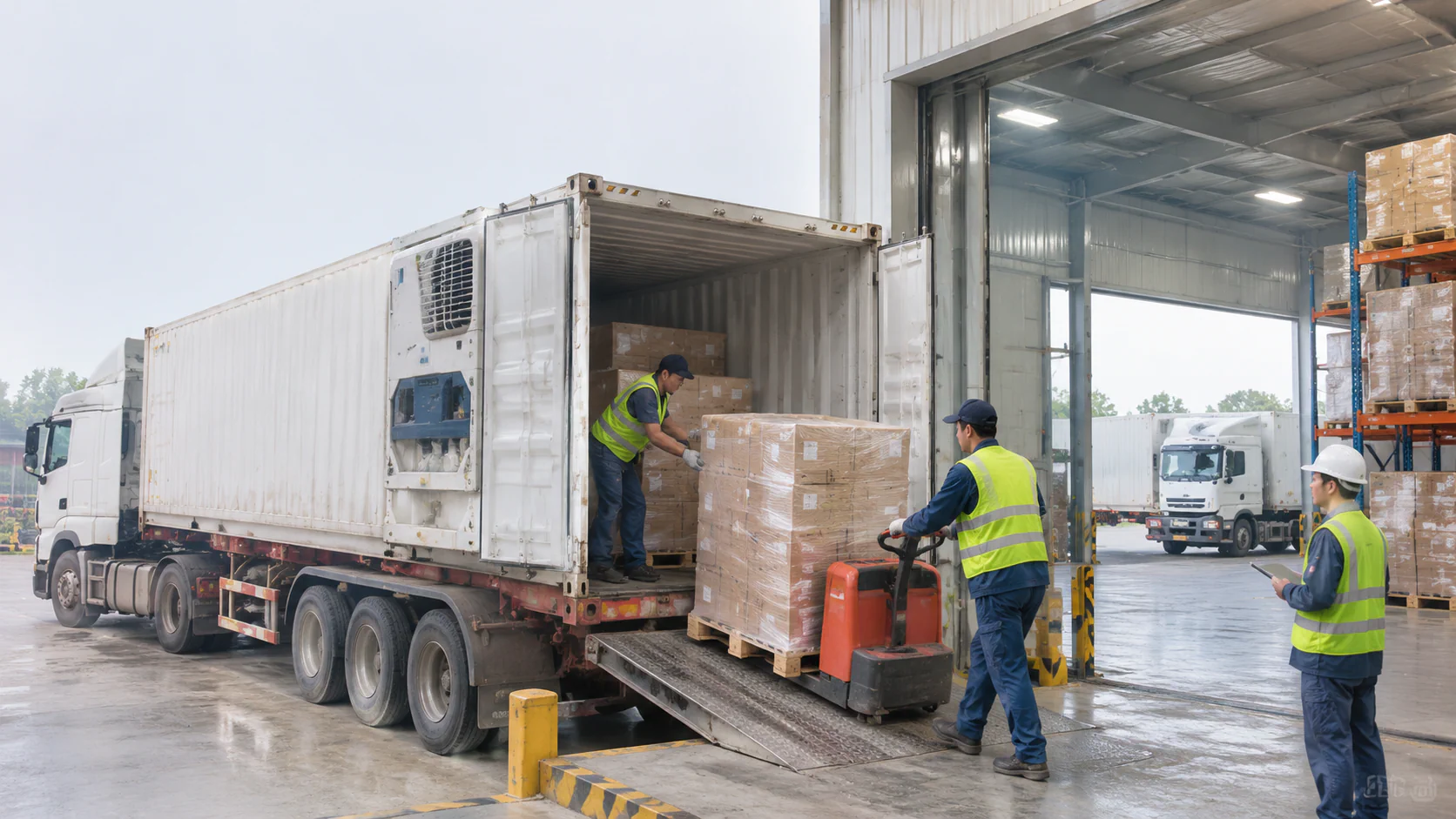
The cold chain determines whether the product's commercial quality can be preserved after production is completed. A standard refrigerated container is designed to maintain the temperature of goods that have already been properly frozen. It is not a replacement for the factory's rapid-freezing system. Therefore, frozen durian export plans must be designed from the finished-goods warehouse to the final receiving warehouse, including periods when containers are not connected to a fixed power source.
Develop a cold chain route covering the finished goods warehouse, container loading point, domestic transport, export port or border crossing, and destination cold storage facility in China, defining responsibility for maintaining storage conditions at each handover point
A standard transportation chain can be organized in the following sequence: the factory's finished-goods warehouse, refrigerated container loading area, domestic transportation, seaport or export border crossing, international transportation leg, Chinese import inspection point, and the recipient's cold storage facility. At every handover point, a responsible party must be assigned for temperature control, seal integrity, cargo quantity, and handover time. Gaps in responsibility between two carriers are among the greatest risks for cross-border frozen cargo.
Before loading, businesses must inspect the refrigerated container's pre-trip inspection report, commonly known as PTI, compressor condition, sensors, door gaskets, ventilation floor, and ability to maintain the set temperature. The cargo must meet freezing requirements before loading. Under normal transportation conditions, a setting of minus 18°C or lower is selected according to product characteristics, contractual requirements, and the factory's technical instructions. The setting must not be changed without confirmation.
Container loading should take place in a temperature-controlled area or follow a rapid-loading procedure to minimize heat absorption. Cartons must be arranged without blocking cold air circulation channels, exceeding the maximum loading height line, or obstructing return airflow. After loading, operating personnel must recheck the setpoint, seal number, refrigeration unit status, and initial recorded data.
For road transportation, containers must have an appropriate power supply from a genset mounted on the trailer or an equivalent power supply arrangement throughout the journey. When entering ports, inspection yards, or transshipment warehouses, the times when power is disconnected and reconnected must be recorded. Handover documents should clearly state the time, displayed temperature, and equipment condition to establish responsibility if quality fluctuations occur later.
Assess refrigerated container transport options by sea and cross-border road according to the receiving region, shipment volume, delivery time, cold storage connectivity and actual operating conditions
Sea freight is suitable for full-container-load shipments with relatively stable delivery schedules and the ability to connect seaports with cold storage facilities at the destination. Factories in the Southeast region or Mekong Delta may consider transporting containers to Cat Lai Port or other suitable ports in Ho Chi Minh City. Depending on the Chinese destination port, shipping lines may operate direct services or transshipment routes, affecting total transportation time.
Refrigerated road transportation is suitable when cargo must be delivered to distribution centers in Guangxi or areas with convenient connections from northern Vietnamese border crossings. The solution may combine northbound refrigerated transportation, consolidation at a cold storage facility near the border, and onward transportation using vehicles that meet operating requirements in China. Businesses must clearly determine whether the delivery method involves a container crossing the border directly or cargo transshipment at the border area, as each method involves different temperature risks and costs.
For businesses needing to combine sea freight, road transportation, and intermediate warehouses, multimodal transportation solutions allow routes to be allocated according to factory location, cold storage capacity, and delivery deadlines. However, adding a transportation leg is only worthwhile when the time or cost benefits outweigh the risks at handover points. Before selecting a solution, businesses must confirm schedules, actual operating conditions, and receiving capacity at the destination.
Establish a temperature monitoring system using independent data loggers, container sensors and handover records, and define alert thresholds for temperatures exceeding the agreed storage limits
The monitoring system should combine data from the refrigeration controller, supply-air and return-air sensors, and an independent temperature data logger placed within the cargo area. These two data sources allow businesses to compare the unit's operating status with actual temperature conditions. Container air temperature is not entirely equivalent to product core temperature. Therefore, records of product temperature measurements at warehouse dispatch and acceptance must be maintained using appropriate methods.
For shipments requiring the core temperature to remain no higher than minus 18°C, businesses can establish more conservative operational warning thresholds, such as issuing an alert when the air temperature at the sensor location exceeds minus 16°C for an agreed period. This is only an example of an internal warning threshold, not a legal limit permitting the product core temperature to exceed minus 18°C. Official thresholds must be based on factory validation, sensor locations, and contractual conditions.
Data loggers should have identification codes, calibration information, sampling intervals, and the ability to export raw data. For routes involving multiple transshipment points, a recording interval of 5 to 15 minutes may be considered according to risk management requirements. At delivery, the receiving party must confirm the seal number, displayed temperature, power supply status, and handover time to avoid data gaps between transportation legs.
Develop contingency plans for power outages, refrigeration unit failures, border congestion, vessel delays, or extended storage requirements to maintain cold chain continuity.
For frozen cargo, contingency plans must be prepared before the container leaves the factory. In the event of a power outage, the carrier needs an alternative power supply arrangement, the nearest available electrical connection point, and the technical support contact number of the container supplier. When the refrigeration unit generates an alarm, the cause must be verified through the error code, temperature data, and downtime before deciding whether to repair the unit on-site or transfer the cargo to compliant equipment.
In the event of border congestion, the operating plan must identify the availability of powered storage yards, backup cold storage facilities, and daily additional costs. If the route requires transshipment, receiving vehicles must be scheduled at the correct time, with appropriate handling areas and a rapid cargo counting procedure. Containers should not be opened repeatedly for visual inspections without a professional requirement, as opening the doors increases heat exchange and affects the ability to maintain storage conditions.
For sea freight, risks often arise when vessels change schedules, containers are transshipped, or port storage periods are extended. Cargo owners should require freight forwarders to check container free-time allowances, refrigerated electricity charges at ports, and the contact points responsible for handling equipment incidents. These items should be included in quotations from the beginning rather than calculating only the basic freight rate and dealing with additional charges after the cargo arrives.
Frozen Durian Exports: Logistics Options Comparison Table and Cost Calculation Model per Kilogram

Logistics costs are an important component of frozen durian export prices, particularly when goods must continuously maintain sub-zero temperatures. To evaluate efficiency, businesses should not simply compare transportation costs per container. They must calculate total costs from the factory to the delivery point and divide them by the actual quantity accepted by the buyer. This model clearly shows the impact of shipment volume, loading utilization, transportation time, and additional expenses.
Prepare a comparison table of 20-foot and 40-foot refrigerated sea containers and refrigerated road transportation to China, covering total transit time, costs, carrying capacity, transshipment points, and suitability for different import regions.
Total transit time must be calculated from the moment the container receives the cargo at the factory until the importer accepts the goods at the agreed delivery point, rather than considering only vessel sailing time or vehicle travel time. For shipments to China, differences in distance, shipping routes, border crossings, quarantine procedures, and receiving warehouse addresses can significantly affect the efficiency of each option.
| Criteria | Refrigerated sea container | Refrigerated road transportation |
|---|---|---|
| Estimated total transit time | Approximately 5–12 days or longer, depending on the destination port and transshipment requirements | Approximately 3–8 days or longer, depending on the receiving location, border crossing, and congestion |
| Cost structure | Container drayage, port charges, ocean freight, refrigerated electricity, and destination charges | Tractor-trailer transportation, fuel, refrigeration, road tolls, border charges, and transshipment |
| Carrying capacity | Suitable for transporting multiple containers according to vessel schedules | Flexible according to vehicle availability and customs clearance capacity at border crossings |
| Transfer points | Factory, export port, transshipment port if applicable, import port, receiving warehouse | Factory, consolidation warehouse, border crossing, intermediate warehouse if applicable, receiving warehouse |
| Specific risks | Vessel schedule changes, port storage, power disconnection, and import inspections | Congestion, vehicle restrictions, transshipment, and insufficient backup power supply |
| Suitable regions | Cities and distribution centers with convenient seaport connections | Guangxi and regions with suitable road routes and border crossings |
| Control measures | Book refrigerated containers, monitor vessel schedules, and confirm power connection points | Coordinate refrigerated trucks, monitor border conditions, and prepare backup cold storage |
The timeframes above are hypothetical ranges for comparing planning options. They are not transportation commitments or confirmed schedules. Actual transit times must be quoted for specific routes based on operating schedules at the time of booking and import-side procedural conditions. In some cases, sea freight may offer lower total costs for large shipments. Conversely, road transportation may be more efficient for destinations near the border and flexible delivery schedules.
Prepare a comparison table of 20-foot and 40-foot refrigerated container specifications, including usable dimensions, estimated volume, cargo payload, refrigeration capacity, pallet loading capacity, and carrier operating limits.
Container selection must be based on cargo weight, carton dimensions, pallet configuration, permissible payload, and temperature maintenance capabilities. Refrigerated containers have insulation layers and refrigeration units, meaning their usable internal space is smaller than that of dry containers with the same nominal dimensions. The following table uses sample specifications from Ocean Network Express (ONE) refrigerated container documentation. Actual equipment supplied may differ in dimensions and weight.
| Parameters | 20-foot refrigerated container | 40-foot High Cube refrigerated container |
|---|---|---|
| External dimensions (length × width × height) | 6,058 × 2,438 × 2,591 mm | 12,192 × 2,438 × 2,896 mm |
| Internal dimensions: length × width × height | 5,456 × 2,288 × 2,263 mm | 11,590 × 2,284 × 2,544 mm |
| Approximate internal volume | 28.2 m³ | 67.5 m³ |
| Container tare weight | 2,910 kg | 4,520 kg |
| Maximum technical cargo payload according to the sample specifications | 27,570 kg | 29,480 kg |
| Maximum gross weight according to model | 30,480 kg | 34,000 kg |
| Estimated pallet capacity | Approximately 9–10 standard pallets measuring 1,200 × 1,000 mm | Approximately 20 standard pallets measuring 1,200 × 1,000 mm |
| Reference equipment temperature range | Approximately minus 30°C to plus 30°C; some specialized equipment can reach minus 35°C | Approximately minus 30°C to plus 30°C; some specialized equipment can reach minus 35°C |
| Refrigeration capacity | Depends on the model, ambient conditions, and operating point | Depends on the model, heat load, and operating conditions |
| Limits requiring verification | Road payload, load distribution, ventilation floor, and power supply | Road payload, shipping line limits, loading height, and power supply |
The number of pallets in the table is an estimated single-tier arrangement, not a capacity guaranteed by the carrier. Actual quantities depend on pallet dimensions, loading arrangements, airflow clearance, carton height, and weight limits. Regarding refrigeration capacity, a single fixed kW value should not be applied to all containers because usable capacity varies according to outdoor temperature, internal container temperature, and refrigeration unit model. Businesses should request the technical specifications of the equipment assigned when preparing an operating plan.
Although 40-foot containers have significantly greater capacity, their maximum cargo payload does not increase at the same rate. This gives 40-foot containers an advantage for carton-packed or palletized goods that occupy considerable volume, while 20-foot containers may be more suitable for heavy shipments with relatively small volumes. A container's technical payload is also not equivalent to the legally permitted payload on every road route in Vietnam or China.
Develop a cost analysis table for frozen durian exports, breaking down the cost components into factory product cost, domestic refrigerated transportation, container charges, international freight, customs declarations, specialized inspections, and destination-side handling costs.
Export costs should be divided between product costs and logistics costs. If businesses only add production costs and international freight, they may overlook freezing costs, cold storage, transportation from the factory to the port, container electricity, quarantine, and cargo handling in China. Cost components also vary according to Incoterms because the responsibility for paying expenses and bearing risks between the seller and buyer does not always coincide.
| Item | Cost calculation basis | Reference Unit | Fluctuation factors |
|---|---|---|---|
| Factory product cost | Raw materials, processing, freezing, packaging, and production expenses | VND/kg of finished product | Seasonality, durian pulp recovery rate, and raw material quality |
| Pre-export cold storage | Storage duration, pallet location, and cargo volume | VND/pallet/day or VND/ton/day | Waiting time for documents and delivery schedules |
| Domestic refrigerated transportation | Distance, vehicle type, number of trips, and operating time | VND/trip | Fuel, road tolls, and waiting time |
| Container and port charges | Lifting, equipment usage, power supply, and terminal services | VND per container | Operating port, storage duration, and tariff schedule |
| International freight | Transportation route, container type, and schedule | USD/container or VND/trip | Peak season, transportation capacity, and exchange rates |
| Customs and documents | Scope of declaration and documentation handling services | VND/declaration or documentation package | Number of product lines and processing requirements |
| Quarantine and inspection | Testing indicators, sample quantities, testing laboratories, and applicable procedures | VND/shipment | Specialized requirements and number of inspections |
| Chinese destination-side costs | Customs clearance, port charges, cold storage, delivery, and applicable taxes | CNY/shipment or CNY/container | Receiving location, HS code, and trade terms |
| Risk contingency | Container detention, port storage, additional inspections, and operational expenses | VND/shipment | Processing time and level of risk |
The table above is a cost calculation structure, not a market quotation or a commitment from HNT Logistics. Fees must be updated according to the route, carrier, shipment date, and actual scope of work. Under FOB, CIF, DAP, or DDP terms, businesses must correctly allocate costs that fall under each party's responsibility according to the selected Incoterms. Import obligations and tax payments in China must be verified with a qualified importer.
Develop a model for calculating logistics costs per kilogram of actual delivered cargo, simulating different container volumes, payload utilization rates, transportation durations, and scenarios involving additional warehouse storage, container detention, or supplementary inspections.
The basic model is calculated as follows: logistics cost per kilogram equals total logistics costs within the calculation scope divided by the actual delivered quantity accepted. The actual delivered quantity may be lower than the quantity loaded into the container if shortages, rejected goods, or quality losses occur. To avoid double counting, product costs must be separated clearly from logistics costs, and the calculation scope must be defined as port-to-port, warehouse delivery, or final delivery according to the contract.
Assume a shipment uses a 40-foot container with a loaded cargo weight of 20,000 kg. The business establishes a hypothetical base logistics budget of VND 80,000,000, including domestic transportation, container charges, international freight, and documentation services under the seller's responsibility. If all 20,000 kg are accepted, logistics costs amount to VND 4,000/kg. The values in this simulation are intended solely to explain the calculation method and do not represent actual transportation quotations.
| Scenario | Actual delivered quantity | Estimated total logistics cost | Logistics cost/kg | Impact |
|---|---|---|---|---|
| Base case | 20,000 kg | VND 80,000,000 | VND 4,000 | No expenses beyond the budget |
| Only 75% of the base quantity is utilized | 15,000 kg | VND 80,000,000 | VND 5,333 | Fixed costs allocated across a smaller quantity |
| Additional container detention charges | 20,000 kg | VND 86,000,000 | VND 4,300 | Increase of VND 300/kg |
| Additional inspection and storage charges | 20,000 kg | VND 92,000,000 | VND 4,600 | Increase of VND 600/kg |
| 5% loss of accepted cargo weight | 19,000 kg | VND 80,000,000 | VND 4,211 | Cost per accepted kilogram increases |
When comparing payload utilization rates, businesses must distinguish between utilization of planned shipment volume and utilization of the container's maximum technical payload. For example, 20,000 kg represents only approximately 67.8% of the sample technical payload of 29,480 kg for a 40-foot High Cube container in the specifications table. However, the cargo may already have reached its loading limits in terms of volume, pallets, or cold air circulation. Businesses should not increase cargo weight to reduce costs per kilogram if doing so exceeds technical loading limits.
Transportation time should be incorporated into the model through variables such as vehicle rental days, refrigerated power supply days, cold storage days, and inventory financing costs. When delivery schedules are extended, direct costs may increase alongside quality risks. The model should include at least three budget scenarios: normal operations, schedule delays, and additional inspections, thereby determining an appropriate contingency budget before the sales price is finalized.
Frozen Durian Exports to China: Managing Temperature Risks, Traceability, and Quality Disputes
Quality disputes involving frozen goods are often complicated because losses may originate from raw materials, freezing processes, factory storage, or interruptions at any point during transportation. When buyers discover changes in the structure of durian pulp, container temperature data alone are insufficient to establish the cause without production records and initial acceptance documentation. Therefore, risk management must be established as an end-to-end process rather than handled only after complaints arise.
Establish a set of acceptance criteria for cargo handover, including packaging condition, carton integrity, product temperature, package quantity, batch codes, and container seal records.
The acceptance report must document the cargo condition before responsibility is transferred to the carrier. The factory must check that packaging is not torn, unusually wet, showing signs of thawing or refreezing, or contaminated with unsuitable materials. Carton quantities, batch codes, weights, and pallet positions must be checked against the Packing List. Any discrepancies must be resolved and recorded before the container is sealed.
Product temperature at the time of warehouse dispatch should be checked according to a sampling procedure validated by the factory, using equipment suitable for measuring frozen food temperatures. Simply taking a screenshot showing a container temperature of minus 18°C does not prove that all products have reached the corresponding core temperature. The report must retain both product inspection results and equipment parameters, while recording the start and completion times of loading.
After container loading is completed, responsible personnel must check the container number, seal number, temperature setting, refrigeration unit status, and door condition. Seal photographs must be sufficiently clear for verification during handover. If the transportation route involves mandatory inspections or transshipment, the seal replacement procedure must be specified and supported by documents proving that the container was opened by an authorized party or under a valid agreement.
Analyze specific types of frozen cargo damage, including temperature fluctuations, partial thawing, refreezing, freezer burn, changes in durian pulp texture, and deterioration in sensory quality.
Prolonged temperature fluctuations may cause some products to warm up, changing the state of ice crystals and affecting the texture after thawing. In durian pulp, these changes may appear as water separation, reduced smoothness, altered stickiness, or loss of consistency. The extent of damage depends on heat exposure duration, actual temperature, packaging specifications, and the initial characteristics of each shipment.
Refreezing occurs when a product has partially thawed and is subsequently frozen again. In some cases, packaging may show signs of large ice crystals, refrozen water, or product deformation. However, the entire shipment cannot be determined to have undergone refreezing based solely on external appearance. Identifying the cause requires combining temperature records, quality inspections, and expert assessment results when disputes arise.
Freezer burn may occur when the surface of food loses moisture during frozen storage, particularly when packaging does not provide adequate sealing or the product is exposed to cold air for an extended period. The consequences are generally associated with surface dryness, changes in color, flavor, and sensory texture. Therefore, moisture-resistant packaging and sealing inspection procedures are important alongside temperature control.
Not every change in the smell, color, and softness of durian pulp is caused by transportation. Raw material ripeness, durian variety, the time between harvesting and freezing, and processing conditions also affect finished product quality. Businesses should retain reference samples for each batch, initial testing results, and production parameters to distinguish pre-delivery product defects from losses occurring during transportation.
Develop a procedure for retaining transportation data, temperature logs, loading photographs, seal numbers, handover records, and cold storage documents as evidence for identifying the cause, timing, and responsibility for any loss.
Traceability records should begin with the growing area, raw material supplier, factory receiving time, production line, and freezing stage. Each batch code must be linked to finished product data, quality inspection results, and storage location. When loading the container, the records should be supplemented with the container number, seal number, photographs taken before and after loading, operating logs, and handover documents for the carrier.
During transportation, temperature recording data must be retained in a format that allows time-based traceability rather than relying solely on screenshots captured at a few isolated moments. If independent data loggers are used, the sensor location, device code, battery status, and time synchronization method must be recorded. This information helps expert assessors distinguish actual incidents from measurement equipment errors or data collection timing discrepancies.
Whenever a container passes through a port, transshipment yard, or another transportation vehicle, each handover must include information about the time, power supply status, and receiving party. For sea freight, businesses should request access to container operating data within the scope supported by the shipping line. For road transportation, GPS data and refrigerated genset logs may provide additional evidence for determining vehicle downtime or technical incidents.
Record retention periods must comply with relevant legal regulations, inspection requirements, and contractual claim limitation periods. Businesses should establish a centralized storage system organized by container code and batch code to prevent data loss between the import-export department, factory, and logistics provider. Records are valuable when data are consistent, have clear origins, and have not been altered in ways that undermine verification.
Establish a coordination plan for expert inspections, loss notifications, preservation of evidence, claim handling, and the allocation of responsibilities among exporters, carriers, shipping lines, insurers, and importers under the contract.
When signs of damage are discovered, the receiving party must document the actual condition before proceeding with commercial handling. Loss notifications must be submitted within the time limits and in the format required by the contract, transportation documents, and insurance conditions. Unauthorized destruction, discounted sales, or recycling of goods before establishing supporting evidence may reduce the ability to determine the cause and claim compensation.
Independent inspections should be considered when losses are substantial or the parties cannot agree on the cause. Inspection content may include packaging condition, product temperature, cargo structure, degree of quality deterioration, and transportation data. Sampling methods must be clearly documented to avoid disputes about whether inspection results are representative of the entire container.
Compensation liability cannot be determined solely because goods arrive at their destination in an unacceptable condition. Businesses must examine the Incoterms, sales contract, transportation contract, insurance conditions, risk transfer point, and evidence regarding the cause of the loss. For multimodal transportation, businesses must also distinguish the responsibilities of the multimodal transport operator from those of individual carriers handling each leg, according to the applicable contract and law.
If goods are held for inspection in China, businesses must determine whether the cause relates to legal documentation, quarantine, product quality, or transportation conditions. If the cause is an incorrect factory registration or non-compliance with food safety regulations, requiring the carrier to bear all losses generally has no basis if the carrier has fulfilled its contractual obligations. The allocation of responsibilities should be agreed upon before the first shipment is dispatched.
HNT Logistics Supports Frozen Durian Export Procedures with Cross-Border Logistics Solutions
For exporters, an effective logistics plan must combine document compliance, acceptance capabilities in China, and the ability to maintain the cold chain. HNT Logistics provides solutions connecting container transportation, coordinating customs procedures, and arranging cargo delivery according to the agreed service scope. The objective is to help businesses forecast costs clearly, determine responsibilities for each transportation leg, and minimize risks throughout the journey.
Receive product documentation, proposed HS codes, factory information, storage conditions, shipment volume, delivery locations, and import requirements to assess the feasibility of the export plan.
To assess a frozen durian export shipment, HNT Logistics needs to receive the product name and processing form, weight, carton specifications, pallet quantity, package dimensions, proposed HS code, and storage temperature. Businesses should also provide factory information, Chinese registration code, dispatch warehouse address, receiving address, delivery deadline, and trade terms to determine a suitable transportation plan.
Based on the input data, HNT Logistics can coordinate reviews of issues requiring verification concerning documentation, quarantine, refrigerated container capabilities, and delivery conditions. For requirements falling under the licensing or approval authority of management agencies, businesses must obtain decisions from the relevant competent authorities. An initial assessment does not replace the issuance of a GACC registration code, quarantine results, or customs clearance decisions by the authorities of either country.
Coordinate refrigerated container transportation, tractor-trailer services, sea or road freight connections, and handover point arrangements to maintain the cold chain throughout the journey to China.
HNT Logistics can coordinate FCL container transportation, arrange tractor-trailer services at port clusters, and select international transportation routes according to the cargo's receiving location. For businesses in southern Vietnam, the plan may include transportation from the factory to Cat Lai Port or another suitable operating location. For road shipments, the plan may connect domestic refrigerated transportation, intermediate cold storage, and Chinese-side delivery partners.
When implementing multimodal transportation, coordination must focus on loading schedules, vehicles with refrigerated power supply capabilities, delivery times, and the transfer of responsibility at each handover point. HNT Logistics can work with operating partners to determine container requirements, contingency arrangements, and data reporting mechanisms. Operational capabilities, available routes, and responsibilities for maintaining transportation conditions must be specifically confirmed in quotations and service contracts.
Support businesses in reviewing commercial documents, coordinating customs declarations, verifying specialized inspection requirements, and connecting relevant parties at the import destination within the agreed service scope.
For export documentation, HNT Logistics supports the reconciliation of information across contracts, Invoices, Packing Lists, transportation documents, and other data required for customs declarations. Checking the consistency of product names, package quantities, weights, container numbers, and seal numbers helps reduce the risk of document amendments after cargo has entered the port. Businesses must also prepare quarantine documentation and other documents related to China's import requirements in advance.
During implementation, HNT Logistics can coordinate with customs declaration service providers, specialized inspection authorities, and destination-side partners within the authorized scope. Additional requirements such as physical inspections, document amendments, or cold storage arrangements must be promptly communicated to cargo owners. Each expense outside the initial quotation should have a valid basis and be agreed upon before implementation whenever actual conditions allow.
HNT Logistics accompanies businesses in implementing frozen durian exports through integrated transportation, customs procedures, and cross-border cold chain control solutions, aiming to minimize quality risks, improve logistics cost transparency, and enhance delivery efficiency to the Chinese market.
The effectiveness of frozen durian exports to China does not depend solely on low purchasing prices or transportation costs. A feasible plan must begin with an eligible factory, traceable raw material sources, compliant specialized documentation, and a cold chain capable of maintaining the required temperature throughout the entire journey. When these factors are controlled in a coordinated manner, businesses are better positioned to forecast costs, protect cargo quality, and fulfill customer commitments.
HNT Logistics accompanies businesses by connecting refrigerated container transportation, coordinating export procedures, and organizing cross-border delivery according to the actual conditions of each shipment. Businesses seeking to develop transportation plans, review documentation, and estimate logistics costs for frozen durian exports can contact HNT Logistics via hotline 096 309 78 19, email marketing@hntshipping.com or its headquarters at 8A Hoang Minh Giam, Ho Chi Minh City, for consultation and quotation requests.