A frozen durian shipment may meet high quality standards at the processing plant but still suffer losses during export if the product's core temperature is not maintained, the refrigerated container is unsuitable or the documentation fails to meet the importing market's requirements. For high-value frozen goods, logistics costs involve more than just freight charges. They also include preservation, warehousing, electricity supply, specialised inspections and contingency provisions for potential disruptions during handling and delivery.
In particular, the export of frozen durian to China now has its own legal framework under the Protocol on Inspection, Plant Quarantine and Food Safety Requirements, signed by Vietnam and China on 19 August 2026. This document specifies requirements for freezing conditions, product core temperature, raw material sources, registration of processing facilities, packaging, product labelling and quarantine inspections before export. Businesses need to understand these requirements correctly to develop appropriate production and logistics plans from the outset.
This article examines the entire process, from product selection and quality control to finished-product handover, refrigerated container arrangements, customs procedures and cost management. The information is updated to reflect legal and technical references available as of November 2026. China's specific requirements are distinguished from standard frozen cargo transportation practices and the conditions of other markets, enabling businesses to develop appropriate implementation plans.
Frozen Durian for Export: Identifying Product Segments and Commercial Requirements Before Organising a Shipment
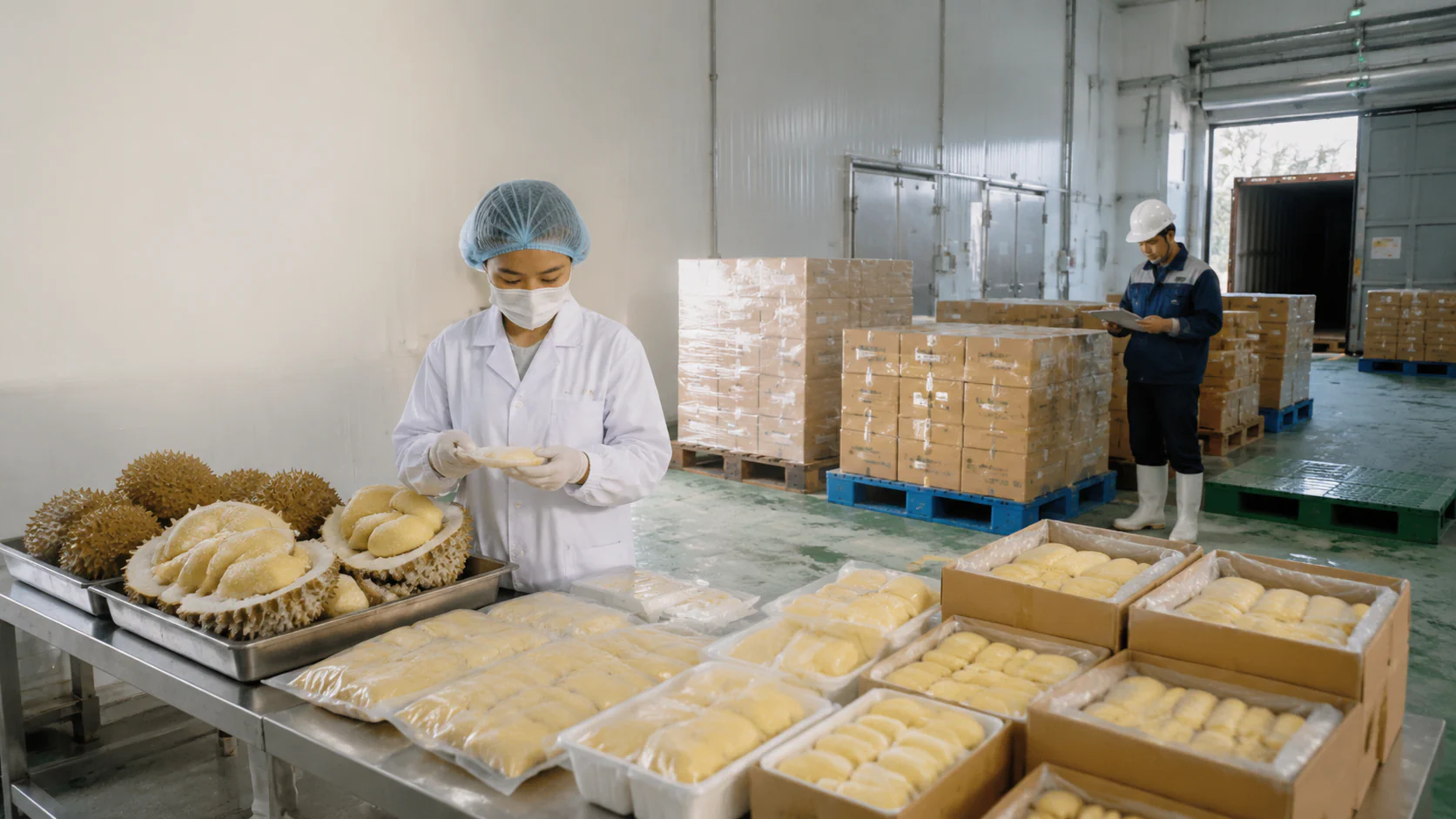
Distinguish between whole frozen durian, deseeded durian, durian flesh segments and puree based on processing characteristics, storage requirements, commercial specifications and the acceptance criteria of individual importing markets.
Frozen durian is a product processed using rapid temperature reduction to bring the edible portion or whole fruit into a frozen state, followed by maintaining an appropriate temperature throughout storage and transportation. The aim is to minimise changes in texture, colour and flavour, as well as microbial activity. However, freezing cannot restore the quality of spoiled raw materials or remedy the problem of durians harvested before they are fully mature.
From a commercial perspective, whole frozen durian retains its original shell and is suitable for customers who wish to preserve the fruit's appearance and carry out preliminary processing in the importing market. This product is large, has substantial packaging weight and occupies considerable container space. Businesses must carefully calculate space utilisation, loading methods and transportation costs per kilogram of actual durian flesh obtained.
Whole-segment frozen durian is typically peeled while retaining the flesh and seeds intact. This product can be supplied directly to retail chains, restaurants and food processing businesses. Key considerations include the integrity of each segment, flesh-to-seed ratio, colour and ability to retain its texture after thawing. Packaging generally consists of specialised food-grade bags combined with outer boxes or cartons to minimise impact damage.
For deseeded durian, the flesh is separated from the seeds before freezing. This product offers greater convenience, is easy to portion and is suitable for manufacturers of ice cream, cakes, beverages and processed foods. However, deseeding increases the number of direct food-contact stages. Businesses must therefore maintain strict hygiene controls for personnel, utensils and contact surfaces, while minimising the risk of foreign matter contamination along the production line.
Durian puree consists of flesh that has been crushed or blended into a smooth, uniform consistency. It is generally packed in bags or specialised packaging according to commercial weight specifications for the industrial food sector. As blending eliminates the original structure of individual durian segments, key acceptance criteria include smoothness, dry matter content, consistency, colour and flavour. If sugar or additives are included, these ingredients must be accurately declared when determining the HS code and import requirements.
In terms of market access, the Protocol between Vietnam and China on frozen durian covers three product categories: whole durian fruit with its shell, peeled and pureed durian, and peeled durian flesh. Businesses must accurately match their actual products to the descriptions covered by the document, while also checking registration requirements for production and processing facilities and any conditions imposed by importers. They should not assume that a product specification accepted in one market will automatically be accepted in another.
Product selection should be driven by commercial demand rather than solely by existing processing capabilities. For example, businesses supplying supermarket chains should prioritise packaging specifications, the appearance of durian segments and retail labelling. Meanwhile, businesses supplying raw materials to food manufacturers should focus on the consistency of dry matter content and flavour, as well as the ability to supply large volumes. These factors also play a decisive role in planning refrigerated container transportation and calculating the cost per unit of product.
Assessing raw material quality by Ri6, Monthong and Chanee varieties, using criteria such as physiological maturity, dry matter content, flesh yield, colour, flavour and finished product consistency
The quality of frozen durian depends primarily on the variety, physiological maturity and harvesting conditions. Ri6, Monthong and Chanee have different sensory characteristics, so factories should not apply a single set of acceptance criteria to all raw materials. Separate incoming material standards should be established for each variety, processing purpose and customer segment to minimise quality variations between production batches.
Ri6 is typically characterised by deep yellow flesh, a relatively smooth texture, a rich, creamy taste and a distinctive aroma. When used to produce frozen whole durian segments, factories need to check the integrity, elasticity, colour and recoverable flesh yield. If the raw material has uneven maturity, the finished product may show variations in softness, sweetness and colour, even within the same carton.
Monthong is characterised by relatively large segments, pale yellow to creamy yellow flesh, a generally firm texture and a milder aroma than some popular durian varieties in Vietnam. This variety is suitable for orders requiring uniform segment sizes and consistent appearance. However, maturity must be closely controlled, as fruit harvested before reaching sufficient maturity may lack the sweetness, aroma and dry matter content required.
Chanee typically has a strong aroma, soft flesh and a distinctive rich, creamy taste. When processed into purée or ingredients for the food industry, these sensory characteristics can provide a commercial advantage. Conversely, if customers require a firm texture, intact segments and a high degree of uniformity, businesses should conduct practical trials before confirming production volumes.
Physiological maturity should be assessed by combining the fruit development period with characteristics of the stem, spines, segment lines, colour and analytical measurements of the flesh. Raw material should not be deemed compliant based solely on external appearance or the fact that the fruit has naturally split along its segments. Research on the Ri6 variety in Vietnam indicates that harvesting approximately 95–100 days after flowering may produce suitable quality under the specific research conditions. However, this timeframe is not a universal standard applicable to all growing regions and seasons.
Dry matter content is a valuable indicator for assessing maturity and flesh quality. For Monthong, a study published in the journal Horticulturae in 2026 reported that dry matter content varied across development stages, reaching approximately 37.13% at the study's 120-day-after-flowering assessment point. This is research data for one variety under specific conditions, not a mandatory threshold for every export batch of durian. Acceptance thresholds must be agreed upon in accordance with raw material specifications and the contract.
Recoverable flesh yield directly affects a factory's financial performance. If one tonne of raw material has a low flesh yield, the procurement cost allocated to each kilogram of finished product will increase. Businesses should weigh representative samples from each batch and record the proportions of husk, seeds, flesh and discarded material to forecast finished product output. In parallel, checking colour, flavour, softness, creaminess and signs of fermentation helps identify unsuitable raw materials at an early stage.
For frozen finished products, factories should establish sensory and physicochemical specifications for each product code. Parameters should be tested using standardised methods, with clearly defined acceptance limits and sampling procedures. If buyers and sellers describe a product merely as premium-quality durian flesh without providing a specific definition, the risk of quality disputes when the goods arrive at the destination port will be very high.
Determining compatibility between finished product specifications, net weight, packaging materials, product labels, batch codes and traceability requirements under the international trade contract
Packaging specifications must be determined alongside sales specifications. A product sold in 400-gram bags for the retail channel has very different requirements from one packed in 1-kilogram, 5-kilogram or 10-kilogram bags for industrial customers. Before signing the contract, exporters should agree on the net weight per unit, number of bags per carton, carton dimensions, gross weight and permitted weighing tolerances.
Materials in direct contact with durian flesh must be suitable for food use in the importing market. PE, PA or multilayer laminated bags may be selected based on their barrier properties, resistance to low temperatures, sealing performance and ability to minimise odour absorption. Packaging must withstand frozen storage conditions without cracking, delaminating or leaking during transportation.
For exports to China, the requirements under the Protocol stipulate that packaging materials must be clean, hygienic, unused and compliant with food safety and phytosanitary conditions. Each package must bear a label in Chinese or English showing the product name, country of origin, name and registration number of the production or processing facility, name and address of the exporter, production date, expiry date and the mandatory statement: This product is being exported to the People’s Republic of China.
Product labels should be checked before mass printing. A common mistake is a mismatch between the label information and the facility registration documents, the product name in the contract or the goods description on the Commercial Invoice. If discrepancies are discovered at the destination port, businesses may have to submit supplementary documents, provide explanations, relabel the goods or incur container storage charges while awaiting resolution.
The batch code is the foundation for tracing the entire production process. A good batch code must link the raw material growing area, harvest date, supplier, durian variety, production shift, processing line, freezing time, inspection results, storage facility and export container. If a container holds multiple finished-product batches, the Packing List and traceability records must clearly show the relationship between each batch code and the actual number of cartons.
Businesses must also standardise how net weight and gross weight are recorded in contracts, Packing Lists and bills of lading. The sale weight must accurately reflect the product delivered, without incorrectly including packaging or pallets in the net weight. For goods sold by the kilogram, the weighing tolerance and the method for handling any shortages must be clearly specified to avoid payment disputes.
Analyse the trading terms between the processing plant, exporting company and importer regarding committed quantities, weight tolerances, delivery deadlines, acceptance conditions and quality responsibilities.
The frozen durian trading chain typically involves at least three parties: the processing plant, the company named as the exporter and the importer. Under some business models, the exporting company owns the raw materials and outsources processing, while under others, the processing plant both manufactures and exports the products directly. Regardless of the model chosen, responsibilities for quality, documentation, handover timing and additional costs must be clearly allocated.
Committed quantities must be based on raw material supply capacity and actual processing yields. For example, a sales contract for 20 tonnes of durian flesh does not mean that the factory only needs to prepare 20 tonnes of whole durian fruit. Businesses must estimate the flesh recovery rate according to variety, season, incoming raw material quality and rejection rate to determine the quantity of raw materials to procure. Committing to quantities beyond production capacity may result in short deliveries or missed vessel schedules.
Weight tolerances should be specified for both individual packaging units and the total delivery quantity. The contract must clearly state the tolerance as a percentage, the weighing method, the location where the weight is determined and the party responsible if the weighing results at the port of departure differ from those at the port of arrival. For frozen products packed in bags, it is necessary to clarify whether net weight is determined before or after packaging and how torn packaging or products rejected during inspection will be handled.
The delivery terms under Incoterms 2026 should be selected according to the business's ability to manage and control logistics operations. Under FOB, the seller is generally responsible for delivering the goods on board the vessel and fulfilling the obligations agreed upon under the specified terms at the port of departure. Under CIF, the seller must also arrange sea freight and insurance within the scope of the CIF terms. For containerised cargo, the actual nature of cargo handover at the port terminal should be considered when selecting the appropriate delivery term, rather than mechanically applying a particular term simply out of commercial habit.
The delivery deadline must be calculated backwards from the time the goods are required to arrive at the destination port, taking into account production, inspection, document preparation, inland transportation, cut-off times and vessel schedules. For frozen cargo, businesses should not calculate only the sailing time while overlooking the time needed to await document confirmation, quarantine clearance or the release of empty containers. A reasonable time buffer helps businesses avoid last-minute booking changes.
Acceptance conditions must specify the core temperature, packaging appearance, weight, sensory characteristics, defective product ratio and sampling method. Both parties should agree on which data will serve as the final basis for acceptance, such as pre-loading inspection reports, container temperature records, independent laboratory test results or inspection reports issued at the destination port. Quality responsibilities must also distinguish between defects originating at the factory and losses caused by transportation or storage after the handover.
Frozen Durian Processing Procedure: Controlling the Handover Point from Factory-Finished Products to the Logistics System
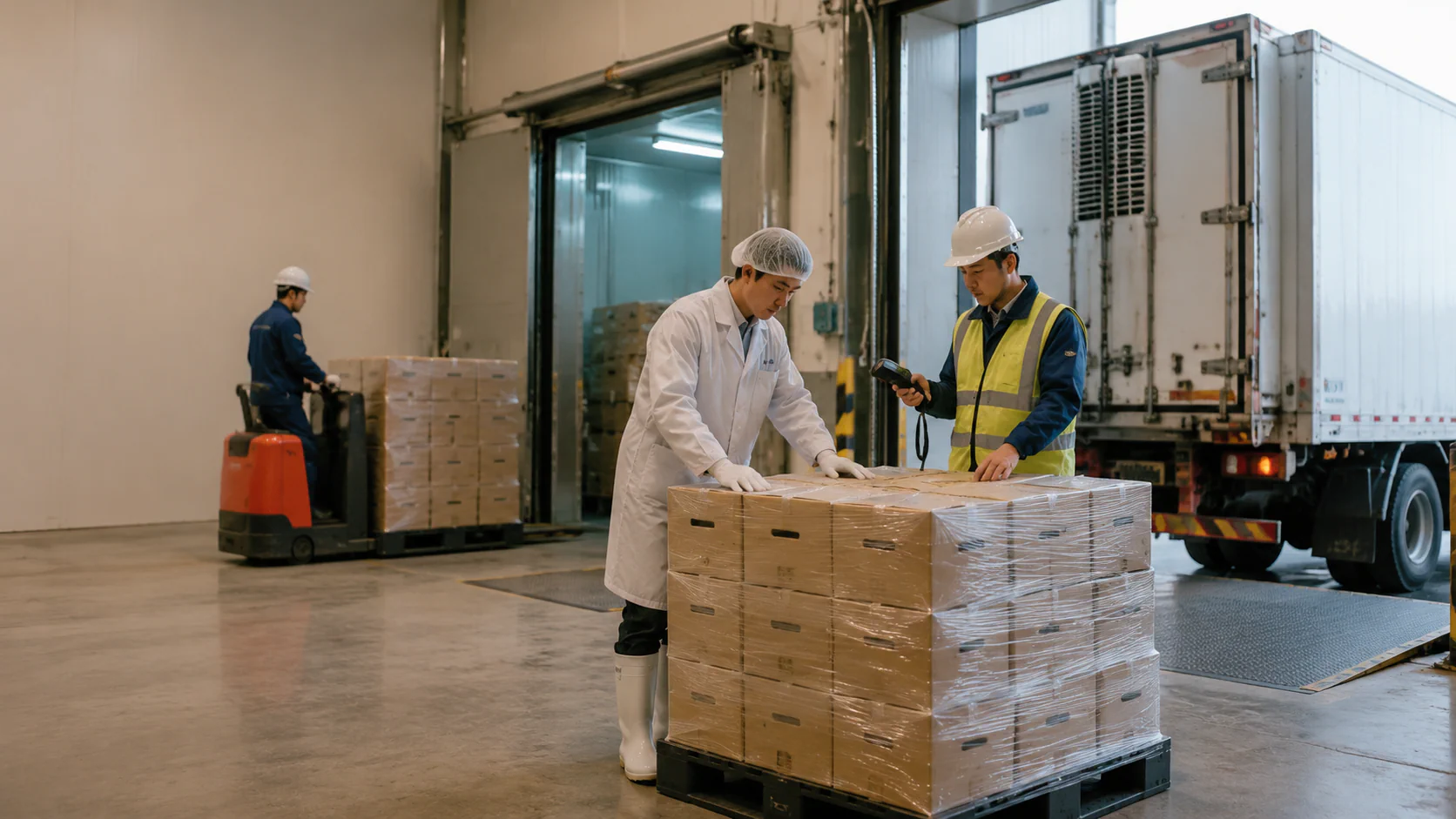
Establish a finished-product handover record after processing, including batch codes, carton quantities, net weight, freezing completion time, product temperature and packaging condition before the goods are transferred to the warehouse awaiting export.
The handover point between the factory and the logistics provider is one of the most critical stages in the cold chain. If the handover records are incomplete, businesses will find it difficult to determine responsibility when temperature deviations, missing goods or packaging damage occur. Therefore, preparing a handover report must be treated as an independent quality control step, rather than merely an administrative procedure for confirming cargo quantities.
The records must include the product name, finished-product form, durian variety, batch code, number of cartons, number of bags, net weight, gross weight and packaging condition. For goods containing multiple batch codes, a carton reconciliation table must be prepared for each batch to support traceability. The figures in the handover report must be consistent with the warehouse release note and the proposed Packing List.
The freezing completion time must be recorded together with the product temperature data. For products exported to China, businesses must demonstrate that the products were frozen at -35°C or below for at least one hour, until the core temperature reached -18°C or below. After this stage, the core temperature must continue to be maintained at -18°C or below throughout storage and transportation.
Temperature recording must follow a clearly defined measurement method. Warehouse air temperature, packaging surface temperature and product core temperature are three different parameters and cannot be used interchangeably. The factory should retain measurement results obtained using appropriate equipment, recording the sampling location, measurement time and corresponding batch code. When necessary, a penetration probe can be used on a representative sample to verify the core temperature.
Packaging condition must be checked before the goods are received into the warehouse pending shipment. Cartons that are dented, torn, wet, have unsealed edges or show signs of leakage must be isolated for assessment. Goods should be stored in an area capable of maintaining a stable temperature, with systems in place to monitor and record data. Goods that meet quality requirements should not be moved into the dispatch area until batch codes and quantities have been fully reconciled.
The final handover report must be acknowledged by representatives of the factory, the transport provider and the exporting company. If the goods are stored in a third-party cold storage facility, the records should also include the time of warehouse receipt, the time of release, the actual quantity received and temperature data throughout the storage period. This evidence is essential when resolving quality complaints or disputes over storage responsibilities.
Analyse the compatibility requirements between the finished product's storage temperature, the reefer container's set temperature and the equipment's operating conditions, in accordance with the manufacturer's instructions, product standards and buyer requirements.
Businesses must clearly distinguish between freezing temperature, finished product core temperature, cold storage temperature and the reefer container's set temperature. These four parameters are related but not interchangeable. The rapid freezing process establishes the initial frozen state; cold storage preserves product quality before export; and the reefer container maintains the agreed conditions during transportation.
For frozen durian exported to China, the Protocol requires freezing at -35°C or below for at least one hour until the core temperature reaches -18°C or below. The core temperature must then be maintained at -18°C or below throughout storage and transportation. This is a specific requirement of the Chinese market and should not automatically be treated as a general legal requirement for all importing markets.
During transportation, reefer containers are generally set at -18°C or below, depending on product requirements and the contract. Some buyers may require -20°C or another temperature in accordance with their storage standards. Businesses must cross-check the set temperature against the product's actual core temperature, the equipment's operating instructions and the shipping line's operating conditions. Setting the temperature lower without authorisation does not necessarily improve product quality.
One particularly important point to note is that a reefer container is not a rapid-freezing unit. The refrigeration system in a container is designed primarily to maintain the temperature of goods that have already been properly chilled or frozen. If warm products are loaded into a container in the expectation that the equipment will cool the entire cargo, the cooling process may take longer, temperatures may become uneven and other packages may be adversely affected.
For frozen goods that have already reached the required temperature, the ventilation setting is generally kept closed, while humidity is controlled in accordance with the shipping line's or equipment manufacturer's instructions. Cargo must be stowed appropriately in relation to the T-shaped floor structure, must not exceed the red cargo load limit line and must not obstruct the circulation of cold air. MSC and other refrigerated transport providers emphasise that frozen goods must be frozen before being loaded into containers and arranged in a way that allows the refrigeration system to maintain an even temperature.
In addition to the set temperature, the refrigeration unit's operating capability, supply and return air sensors, data recording equipment, door condition, door seals and power supply must also be checked. For road transportation, the operating time of the container's independent generator must be taken into account if the tractor unit uses a genset. At ports and on vessels, the electrical connection points and reefer container monitoring procedures must be confirmed to minimise interruptions to the power supply.
Develop a coordinated export dispatch plan covering the freezing warehouse, bonded warehouse if applicable, container stuffing location and export port to minimise the time goods spend outside temperature-controlled environments.
The dispatch plan should be designed as a continuous timeline from the finished goods warehouse to the port. Businesses must determine the production completion time, cargo collection time, container stuffing duration, truck arrival time at the port and the shipping line's final cut-off for accepting reefer containers. Delays at any stage may result in additional storage, truck detention or refrigeration electricity charges, or the risk of missing the scheduled vessel.
The freezing warehouse must be capable of maintaining a stable temperature and organising dispatch by individual batch codes. If a bonded warehouse or intermediate cold storage facility is used, storage responsibilities, power supply arrangements, storage duration and inbound and outbound records must be clearly established. A bonded warehouse may only be used when legal requirements are met and its use is consistent with the shipment's customs clearance arrangements; not every export consignment needs to pass through this type of facility.
The container stuffing location should be selected based on its distance from the cold storage facility, accessibility for tractor units, availability of lifting equipment and power supply capacity. If loading takes place directly at the factory, the business should arrange a covered dispatch area or an enclosed loading bay to minimise exposure to ambient temperatures. If stuffing takes place at the port or a container freight station, the operating hours, vehicle registration requirements and handling conditions of the terminal operator must be confirmed in advance.
For cargo sourced from the southern region, Cat Lai Port may be a suitable option when vessel schedules, transport routes and handling arrangements meet the delivery plan. For cargo sourced from the north, businesses may consider ports in Hai Phong, such as Dinh Vu, Lach Huyen or Tan Vu, depending on the actual shipping routes. Port selection should not be based solely on geographical distance, but should also take into account transit time, vessel schedules, power supply availability and terminal costs.
Domestic transportation using refrigerated containers requires contingency time to be factored in for traffic congestion, weight inspections, waiting times at the port and delivery and collection arrangements. For long journeys or where waiting times are uncertain, businesses should consider using tractor units equipped with suitable generators to keep the refrigeration equipment running. In particular, backup power supplies and contingency arrangements in the event of a vehicle breakdown en route must be confirmed.
Coordination between the factory, cold storage facility, transport provider and port should be managed by a single designated coordinator. This coordinator is responsible for updating production schedules, confirming cargo quantities, checking bookings, monitoring vehicle status and handling changes to vessel schedules. When all parties use the same timeline and consignment data set, discrepancies and additional costs can be significantly reduced.
Establish a procedure for confirming product temperatures before container loading, checking packaging conditions and cross-checking consignment data to minimise quality disputes at the receiving point.
Before loading, businesses should carry out an independent check comparing production records with the actual condition of the finished products. This is the final verification step to ensure that the goods are loaded into the container in accordance with the correct specifications, batch codes and storage conditions. Warehouse temperature records should not be used as a substitute for checking product temperatures at the time of dispatch.
Temperature measurements should be taken from representative samples in accordance with an agreed sampling plan. The core temperature, measurement time, batch code, sample location and equipment used should all be recorded. If any sample is found to have a temperature above the acceptance limit, loading must be suspended, the affected batch isolated and the factory asked to identify the cause. The issue should not be addressed simply by lowering the container's temperature setting.
Alongside temperature checks, loading personnel should inspect the condition of the cardboard cartons, inner bags, bag seals, labels and batch codes. Packaging must be dry and clean, free from unusual odours and not seriously deformed. Any non-compliant cartons must be replaced or dealt with in accordance with quality procedures before being loaded onto the vehicle.
Before closing the container doors, the total number of cartons, net weight, number of pallets and loading plan must be checked against the Packing List. If multiple batch codes are used, the location of each batch must be recorded to facilitate traceability. Taking photographs of the empty container, floor, walls, doors, cargo during loading and the seal after completion provides valuable practical evidence.
The container must be inspected to ensure that it is clean and dry, free from residual odours, with no signs of water leakage or foreign objects. When loading cargo onto the floor, ensure that the payload limit is not exceeded, the return airflow is not obstructed and the cartons are not deformed. Once the doors are closed, the container number, seal number, completion time and details of the person verifying the loading must be recorded.
All handover data should be retained together with the export documentation. In the event of a dispute, businesses can use temperature records, loading photographs, temperature logger data, warehouse dispatch notes and bills of lading to establish when and why the issue occurred. This is a far more effective approach to risk management than relying solely on verbal confirmations between parties.
Exporting Frozen Durian: Designing a Reefer Container Transport Plan Based on Shipping Routes and Operating Conditions
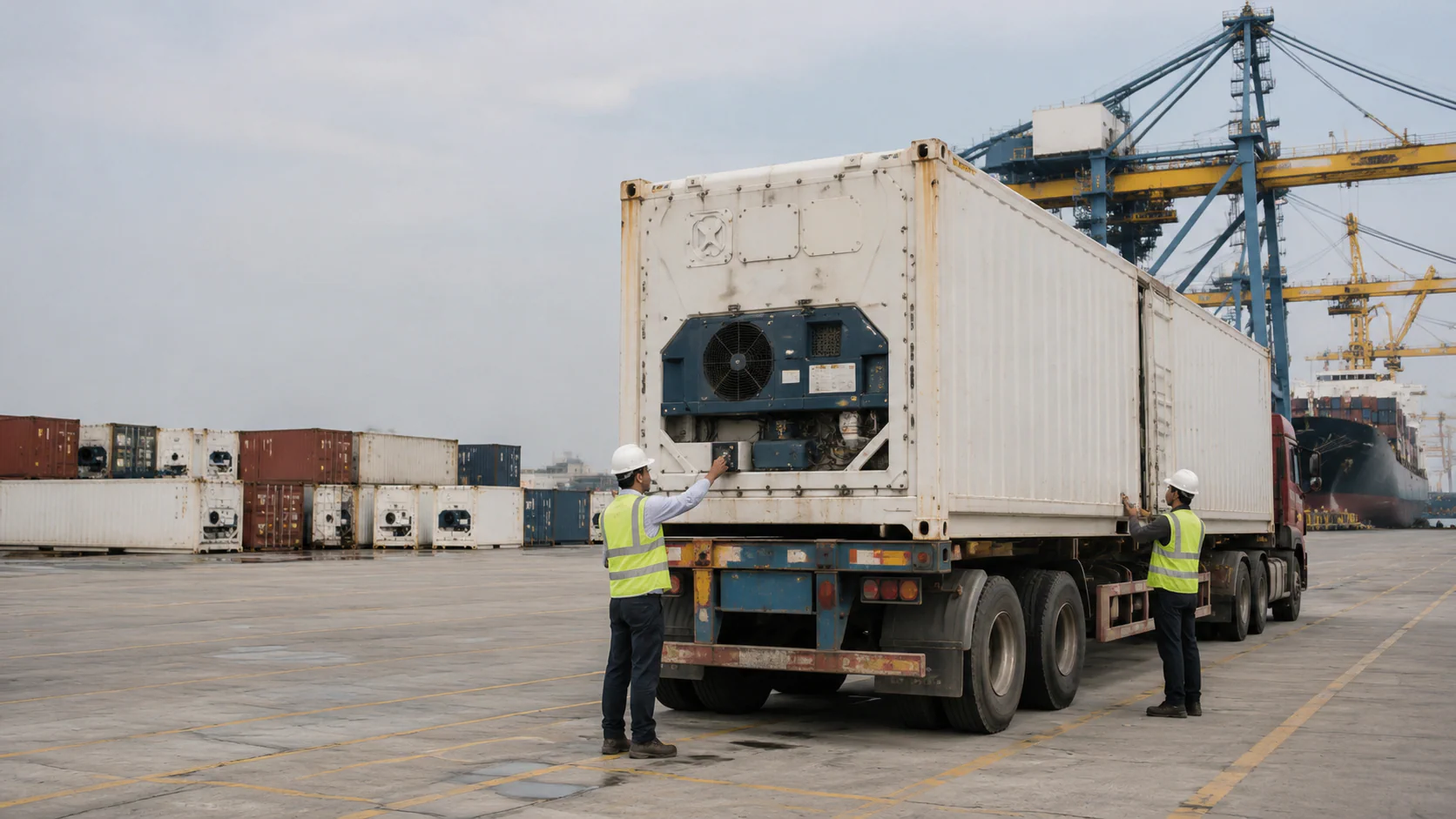
Assessing the suitability of 20-foot and 40-foot refrigerated containers for transporting frozen durian based on actual production volumes, cargo payload, loading volume and the operating limits of each transport route.
20-foot and 40-foot reefer containers are two common options for exporting frozen goods. However, the choice should not be based on the assumption that a 40-foot container can always carry twice as much as a 20-foot container. For refrigerated equipment, usable volume, cargo payload, floor structure, door dimensions and maximum permissible operating gross weight directly affect the actual quantity of cargo that can be loaded.
20-foot refrigerated containers are generally suitable for medium-sized consignments that require flexibility in cargo consolidation or are subject to road transport weight restrictions. 40-foot High Cube refrigerated containers offer greater volume and are suitable for larger consignments with compact packaging that can make effective use of the available internal space. However, the maximum payload of a 40-foot container does not increase in proportion to its volume.
Businesses need to distinguish between the maximum payload specified in the container's technical specifications and the cargo weight permitted on the actual transport route. For domestic transportation, the combined weight of the vehicle, tractor unit, chassis, container and cargo must comply with the applicable gross vehicle weight and axle load limits. A container's high technical load capacity does not mean that a tractor unit is legally permitted to carry that entire weight on every road.
For whole durians with their husks intact, the large volume they occupy means that space utilisation may be lower than for bagged durian flesh. For puree or standard carton-packed durian segments, businesses can achieve a higher packing density while still maintaining adequate cold-air circulation. Therefore, the container configuration should be based on a loading plan and the actual packaging dimensions rather than relying solely on total weight.
Before confirming the container type, businesses should provide the transport operator with the number of cartons, the dimensions of each carton, gross weight, pallet specifications and expected total shipment volume. This information can then be used to determine the number of containers required, volume utilisation and operational payload. Calculating these figures in advance helps prevent insufficient loading space, overloading or last-minute adjustments to the loading plan.
Assess tractor unit transport options from the factory or cold storage facility to Cat Lai Port, Hai Phong Port and other suitable export ports, taking into account the location of the cargo source, vessel schedules and container receiving times.
Transporting frozen durians from the factory to the port should be organised through a temperature-controlled collection and delivery model. The tractor unit must not only be suitable for the required payload but also meet the operating requirements of refrigerated containers. For long journeys or situations where containers may have to wait at the port gate, businesses should consider using a genset to maintain the required temperature throughout the journey.
For cargo originating from Ho Chi Minh City, Binh Duong, Dong Nai and the provinces of the Mekong Delta, connections to Cat Lai Port can be considered based on warehouse location, road routes and vessel schedules. Businesses should account for vehicle travel times through heavily congested areas, truck operating-hour restrictions and the port's receiving hours for refrigerated containers. Scheduling trucks too close to the cut-off time may cause shipments to miss their sailing if traffic congestion occurs or collection and delivery procedures take longer than expected.
For cargo originating in northern Vietnam, Hai Phong Port has several operational areas, including Dinh Vu, Lach Huyen and Tan Vu. Each area has its own operational characteristics, shipping routes and receiving procedures. Businesses must confirm the exact terminal specified in the booking to avoid dispatching trucks to the wrong location, which could result in additional transfer costs or missed container delivery deadlines.
The choice of export port must be aligned with vessel schedules and the destination market. If a port offers convenient sailing schedules but requires a long domestic journey, businesses should compare the total costs and risks rather than focusing solely on ocean freight rates. Conversely, a port close to the factory may not be the optimal choice for a frozen shipment if it has few suitable sailings or requires multiple transshipments.
Domestic transport quotations should clearly specify container haulage charges, chassis usage fees, genset charges, free waiting time, additional waiting charges beyond the allowance and lifting costs. For tractor units transporting refrigerated containers, businesses should also clarify responsibility for supplying fuel to the generator, fuel checks and procedures for handling genset failures during transit.
HNT Logistics can coordinate FCL container transport and container haulage within the Cat Lai port complex and at Hai Phong's ports, according to arrangements suited to the cargo source location. Confirming the route, collection and delivery times, and power supply requirements before dispatching vehicles helps minimise additional costs and ensure that export schedules are maintained.
Develop a refrigerated container booking plan, confirm equipment condition, carry out PTI checks, verify power supply capabilities and confirm empty container availability times to reduce the risk of disruptions before loading.
Refrigerated container bookings should be made earlier than bookings for conventional transport vehicles alone. Businesses must specify the container type, quantity, required temperature, empty container collection time, loading location, container drop-off port and expected vessel schedule. For goods manufactured in batches, bookings should be divided according to finished product completion schedules to avoid unnecessarily prolonged cold storage.
PTI (Pre-Trip Inspection) is the process of checking the technical condition of refrigeration equipment before it is put into service. The inspection typically covers the operating performance of the compressor, fans, condenser, evaporator, temperature sensors and control system, as well as the condition of the doors and any technical warning indicators. The equipment must pass the inspection in accordance with the procedures established by the container operator.
In addition to the PTI, businesses should physically inspect the container before accepting it. Key items to check include interior cleanliness, residual odours, the T-shaped floor, door seals, signs of water ingress, drainage holes, walls and the condition of the electrical system. If the container does not meet the required standards, businesses should request a replacement before loading rather than accepting equipment with potential technical risks.
The empty container availability time must be confirmed with the shipping line or equipment provider. If the goods are ready early but the container has not yet been released, businesses may have to extend the cold storage period. Conversely, if the container is released too early before the factory is ready, additional container detention, vehicle waiting or equipment usage charges may arise.
The availability of power supply at the port is a mandatory factor that must be confirmed in the planning process. It is necessary to check the container discharge time, the availability of reefer plugs, the temperature monitoring procedures and the power supply arrangements on board the vessel. If the cargo has to wait in the container yard, the business must confirm the refrigeration electricity charges, the charging period and responsibility for monitoring the equipment.
Before the loading date, a final confirmation should be carried out between the shipping line, factory, transport provider and exporting company. The confirmation should cover the container quantity, PTI status, set temperature, empty container release time, container collection location, loading time, container yard gate-in time and cut-off time. A clear booking plan helps minimise the risk of equipment shortages or missing the vessel schedule.
Assess direct sea freight and transhipment options based on transit time, the number of transhipments, the ability to maintain refrigerated power supply and their suitability for the delivery deadlines specified in the contract
Both direct sea freight and transport via transhipment ports can be used for frozen durian. The differences lie in the number of transhipments, transit time, the reliability of vessel schedules and the ability to maintain storage conditions. For frozen cargo, route selection should not be based solely on the lowest ocean freight rate; the overall risks throughout the journey must also be assessed.
Direct routes generally have the advantage of requiring fewer container handling operations. The cargo is loaded onto a vessel at the port of origin and transported to the destination port without changing vessels at an intermediate port. Reducing the number of transhipments can minimise the risk of missed connections, document discrepancies, schedule changes and additional handling operations at the transhipment terminal.
Transhipment routes may offer advantages in terms of freight rates or connectivity to markets without direct services. However, businesses must also factor in waiting time for connecting vessels, the possibility of insufficient space on the next sailing and the risk of schedule changes. For refrigerated containers, it is essential to confirm whether the containers will remain plugged into the power supply throughout their stay at the transhipment port and whether there is a system for monitoring equipment conditions.
Transit time must be calculated from the vessel's departure from the port of origin to its expected arrival at the destination port, with additional time allowed for import customs clearance and delivery. If the contract specifies a particular delivery deadline, businesses should use a vessel schedule with an appropriate time buffer. Relying solely on the shipping line's advertised transit time may lead to discrepancies when the actual vessel schedule changes.
For products requiring a core temperature of -18°C or below, businesses must maintain temperature records throughout the journey. Container monitoring data may include supply air temperature, return air temperature and equipment alarm information. These records should be cross-checked against the pre-loading inspection report to determine whether any incidents occurred during transport.
Before confirming a booking, businesses should request a detailed schedule from the shipping line or freight forwarder, including the number of transhipments, expected waiting times, power supply policy and any associated surcharges. When comparing two routes, the total delivery time and overall logistics costs should be assessed on the same basis. A route with a lower freight rate but a longer transit time and a higher risk of storage charges may not necessarily offer better economic efficiency.
Exporting Frozen Durian: Comparison Table of Container Specifications and a Model for Calculating Total Logistics Costs

Prepare a comparison table of 20-foot and 40-foot refrigerated containers covering usable dimensions, indicative capacity, cargo payload, pallet-stacking capacity and suitability for different volumes of frozen durian
Refrigerated container specifications may vary depending on the shipping line, manufacturer and equipment generation. The table below uses indicative specifications from publicly available technical documentation published by DHL Global Forwarding and Hapag-Lloyd. When planning container loading, businesses should reconfirm the specifications of the actual container supplied, particularly the door dimensions, maximum payload and usable capacity.
| Parameters | 20-foot refrigerated container | 40-foot High Cube refrigerated container |
|---|---|---|
| Internal length | Approximately 5.456 m | Approximately 11.599 m |
| Internal width | Approximately 2.294 m | Approximately 2.290 m |
| Internal height | Approximately 2.160 m | Approximately 2.425 m |
| Reference volume | Approximately 28.4 m³ | Approximately 67.7 m³ |
| Indicative maximum cargo payload | Approximately 27,540 kg | Approximately 29,580 kg |
| Operating characteristics | Compact and flexible, suitable for medium-sized consignments | Larger capacity, suitable for consignments with many packages |
| Limiting factors | Payload, volume and loading arrangement | Payload, volume, axle load and route restrictions |
Please note that the maximum payload shown in the table is an indicative technical specification of the equipment, not the actual cargo weight that businesses are guaranteed to be permitted to transport. The total weight of a container transported by road must comply with applicable load regulations. In addition, pallets, dunnage materials, package dimensions and cold-air circulation requirements may reduce the amount of cargo that can be loaded compared with the theoretical limit.
Pallet capacity is not a fixed figure for every container. The number of pallets depends on pallet dimensions, loading orientation, carton dimensions, package height and the floor design of each container type. Businesses should prepare a loading plan before stuffing to ensure that weight is evenly distributed, the red line is not exceeded and the flow of cold air is not obstructed. If the cargo does not fully occupy the floor space, suitable securing and cushioning measures should be used to prevent movement.
For whole durians, businesses should prioritise calculating volume and ensuring that the cargo is protected against impact. For boxed durian flesh or puree, palletised or block stacking can be optimised in accordance with the shipping line's guidelines. However, loading density should not be increased by obstructing airflow or exceeding the cargo weight limit. The objective is to maintain stable temperature conditions, not simply to achieve the highest possible load weight.
The final container selection should be based on three parameters: finished product volume, packaging volume and the weight limit on the transport route. If production volume is insufficient to fully utilise a 40-foot container, businesses should compare the cost of using a 20-foot container with consolidation options or adjustments to the export schedule. Decisions should not be based solely on the freight rate per container while overlooking the cost per kilogram of finished product.
Prepare a cost breakdown covering domestic transportation, container release charges, PTI inspection, port handling charges, ocean freight, shipping line surcharges, refrigerated container electricity charges and handling costs at the destination port.
The total logistics cost of a frozen durian shipment should be calculated from the moment the cargo leaves the factory warehouse until delivery is completed under the agreed trade terms. Businesses should request quotations with each cost component itemised rather than accepting a single all-inclusive price. This approach helps identify which costs are included, which may vary and which party is responsible for payment.
| Cost component | Charge Item | Factors to check |
|---|---|---|
| Domestic shipping | Tractor unit transporting the container from the warehouse to the port | Distance, vehicle type, waiting time and road tolls |
| Generator set (genset) | Power supply for refrigerated containers during road transport | Operating time, fuel and contingency arrangements |
| Empty container release | Equipment release or repositioning charges, if applicable | Empty container collection location, container type and equipment condition |
| PTI | Technical inspection of the container before use | Inspection scope, party responsible for the charges, equipment replacement conditions |
| Port handling charges | Container reception, lifting and handling at the port | Terminal tariff, time of charge accrual |
| Sea freight | Container transportation from the port of loading to the destination port | Shipping line, route, container type, rate validity period |
| Carrier surcharges | Route-specific surcharges and surcharges based on operating periods | Fuel surcharges, peak season surcharges, equipment imbalance surcharges and other surcharges |
| Reefer electricity charges | Power supply and monitoring of refrigerated containers at the port | Chargeable period, port or shipping line tariff |
| Documentation fee | Bill of lading issuance, document processing and related charges | Documentation fees, bill of lading amendment fees, if applicable |
| Destination port charges | Lifting, reefer electricity, document processing and delivery | Contract terms, agency tariff rates, terminal charges |
| Warehousing, yard storage and container storage | Charges incurred when cargo or equipment exceeds the free time allowance | Free time, demurrage, detention and storage |
Domestic transport costs typically vary depending on distance, collection point, chassis type, waiting time and traffic conditions. For refrigerated containers, it is essential to clarify whether the genset charge is included in the container haulage rate or billed separately. If a quotation only lists transport charges without specifying the power supply arrangements, businesses may face significant additional costs when vehicles have to wait for extended periods at warehouses or ports.
Port charges comprise various items, each calculated differently. Handling charges generally depend on the terminal's tariff and the type of service; reefer electricity charges may be calculated based on the duration of the power connection; and yard and container storage charges apply when the free time allowance is exceeded. These charges should not be combined into a single port charges line if a business needs to monitor the cost of goods sold for each shipment.
For ocean freight, the container type, port of loading, port of discharge, direct or transhipment route, quotation validity period and applicable surcharges must be confirmed. Businesses should also clarify which charges relate to the port of origin and which apply at the destination port. Freight quotations from two shipping lines must be compared on an equivalent basis to avoid confusing the basic freight rate with the total transportation cost.
Destination port handling costs should be taken into account from the outset when quoting prices to buyers. If the trading terms require the seller to bear freight or other costs up to the destination port, the business must obtain the agency tariff, reefer electricity charges, handling charges and documentation fees. Under FOB, CIF or other terms, the scope of costs and responsibilities must be checked carefully against the applicable Incoterms and contract.
Design a logistics cost model per kilogram of frozen durian for export based on three volume scenarios, container utilisation rates, cargo loss ratios and storage periods before shipment.
Logistics cost per kilogram is an essential metric for businesses to assess export performance. However, the denominator used in the calculation must be the actual weight of finished products delivered or the commercial weight agreed by both parties, rather than automatically assuming the weight of the incoming raw materials. If a business calculates costs based on the total weight loaded into the container but some goods are subsequently rejected during acceptance inspection, the logistics cost per kilogram of compliant goods will be higher than expected.
The basic formula can be expressed as follows: Logistics cost per kilogram = Total logistics costs for the shipment / Total net weight of finished products delivered. Total costs include domestic transport, containers, PTI, port charges, ocean freight, surcharges, reefer electricity, warehousing, yard storage, documentation and destination port handling costs in accordance with the delivery terms.
To assess the impact of shipment volume, businesses can develop three illustrative scenarios. Scenario A uses 8,000 kg of finished products, Scenario B uses 16,000 kg and Scenario C uses 24,000 kg. These are assumed volumes for designing a financial model, not standard payload capacities for 20-foot or 40-foot containers. The number of containers required must be determined based on the actual payload capacity and loading volume.
| Criteria | Scenario A | Scenario B | Scenario C |
|---|---|---|---|
| Sản lượng thành phẩm dự kiến | 8.000 kg | 16,000 kg | 24,000 kg |
| Hệ số sử dụng container | Thấp hoặc trung bình | Medium to high | Cần tối ưu theo tải trọng và thể tích |
| Tỷ lệ hao hụt giả định | 0,5% | 0,5% | 0,5% |
| Khối lượng giao thực tế | 7.960 kg | 15.920 kg | 23.880 kg |
| Tổng chi phí logistics | C1 | C2 | C3 |
| Giá logistics/kg | C1 / 7.960 | C2 / 15.920 | C3 / 23.880 |
Trong bảng, C1, C2 và C3 là tổng chi phí logistics thực tế của từng phương án, được xác định từ báo giá hãng tàu, đơn vị vận tải và các khoản phí tại cảng. Doanh nghiệp không nên sử dụng một mức chi phí cố định cho cả ba kịch bản vì số lượng container, mức sử dụng thiết bị và chi phí vận chuyển có thể thay đổi theo sản lượng.
Tỷ lệ hao hụt cần được phân biệt giữa hao hụt chế biến, hàng loại do không đạt tiêu chuẩn, hàng hư hỏng bao bì và tổn thất phát sinh trong vận chuyển. Đối với mô hình tính giá logistics, chỉ nên đưa những khoản hao hụt có liên quan trực tiếp đến lượng hàng giao nhận vào mẫu số. Hao hụt nguyên liệu trong chế biến cần được đưa vào mô hình giá thành sản xuất để tránh tính trùng chi phí.
Hệ số sử dụng container được tính dựa trên tỷ lệ giữa thể tích hoặc tải trọng hàng thực tế và khả năng khai thác phù hợp của thiết bị. Nếu hàng xếp đầy thể tích nhưng chưa đạt tải trọng tối đa, doanh nghiệp vẫn có thể đã sử dụng hết công suất thương mại của container. Ngược lại, nếu đạt tải trọng nhưng còn nhiều khoảng trống không thể xếp thêm vì yêu cầu luồng khí lạnh, không nên coi đó là cơ hội để tăng hàng vượt giới hạn kỹ thuật.
Thời gian lưu kho trước xuất khẩu cũng ảnh hưởng trực tiếp đến giá logistics. Nếu sản xuất xong nhưng chưa có booking phù hợp, hàng phải tiếp tục lưu kho đông lạnh và phát sinh phí lưu trữ, điện năng, quản lý kho. Doanh nghiệp nên tính thời gian lưu kho theo ngày, xác định mức phí cho mỗi pallet hoặc kilogram và đưa khoản này vào mô hình giá thành trước khi chốt giá bán.
Để đánh giá hiệu quả giữa ba kịch bản, doanh nghiệp nên so sánh giá logistics trên kilogram, số container sử dụng, thời gian lưu kho và mức dự phòng chi phí. Kịch bản có tổng chi phí thấp nhất chưa chắc tối ưu nếu làm tăng rủi ro giao hàng trễ hoặc không bảo đảm điều kiện nhiệt độ. Phương án phù hợp là phương án cân bằng giữa chi phí, khả năng khai thác và mức độ an toàn của hàng hóa.
Phân tích tác động tài chính của thời gian lưu container, lưu bãi, lưu xe, thay đổi lịch tàu và thời gian chờ cấp điện đến tổng giá vốn giao hàng, từ đó xác định các khoản chi phí cần dự phòng trong báo giá xuất khẩu
Thời gian chờ là một trong những yếu tố khiến giá vốn giao hàng của sầu riêng cấp đông tăng nhanh mà doanh nghiệp khó nhận diện nếu chỉ theo dõi cước vận chuyển cơ bản. Một container đã hoàn thành đóng hàng nhưng chưa được hạ bãi đúng lịch có thể phát sinh chi phí lưu xe, genset và điều chỉnh lịch giao nhận. Nếu lỡ chuyến tàu, doanh nghiệp còn phải tính đến thời gian lưu container và lưu kho kéo dài.
Demurrage là khoản phí lưu container tại cảng vượt thời gian miễn phí theo điều kiện hãng tàu; detention là khoản phí giữ container bên ngoài cảng vượt thời gian miễn phí; storage là phí lưu bãi tại cảng theo biểu phí đơn vị khai thác. Ba khoản phí này có bản chất khác nhau, có thể được tính đồng thời tùy tình huống. Doanh nghiệp cần kiểm tra rõ free time trong booking và không nên mặc định rằng thời gian miễn phí tại cảng đi và cảng đến giống nhau.
Đối với container lạnh, phí điện lạnh có thể tiếp tục phát sinh trong thời gian chờ tại bãi. Khi lịch tàu thay đổi, container có thể phải nằm lại cảng lâu hơn kế hoạch. Vì vậy, doanh nghiệp cần xác định thời gian cắm điện, phí theo ngày, phương thức giám sát nhiệt độ và trách nhiệm thanh toán nếu lịch tàu bị hãng tàu điều chỉnh.
Thời gian chờ cấp điện cũng là một rủi ro cần kiểm soát. Container lạnh cần được kết nối nguồn điện theo quy trình khai thác tại cảng. Nếu việc hạ bãi, tiếp nhận hoặc cấp điện bị chậm, doanh nghiệp cần có đầu mối theo dõi và xác nhận tình trạng thiết bị. Trường hợp xảy ra gián đoạn, cần yêu cầu đơn vị khai thác ghi nhận thời gian, nguyên nhân và dữ liệu nhiệt độ để phục vụ đánh giá tổn thất.
Khi xây dựng báo giá xuất khẩu, doanh nghiệp nên dự phòng một khoản chi phí cho biến động lịch tàu, lưu kho bổ sung, lưu bãi, lưu container và chi phí xử lý chứng từ. Mức dự phòng cần dựa trên dữ liệu khai thác của tuyến, thời gian giao hàng và điều khoản hợp đồng. Không nên sử dụng một tỷ lệ dự phòng tùy ý mà không có cơ sở từ lịch sử phát sinh hoặc điều kiện thực tế.
Một phương pháp quản trị hiệu quả là lập bảng chi phí theo ba trạng thái: vận hành đúng kế hoạch, chậm một ngày và chậm từ ba ngày trở lên. Mỗi trạng thái cần tính lại phí kho lạnh, phí điện, lưu bãi, lưu container và khả năng phát sinh booking mới. Khi đã biết mức độ nhạy cảm của giá vốn với thời gian chờ, doanh nghiệp có thể xác định ngưỡng chi phí cần phê duyệt và điều kiện thương mại cần đàm phán với người mua.
Trong trường hợp báo giá theo CIF hoặc điều kiện người bán chịu trách nhiệm về cước biển, doanh nghiệp cần tính đầy đủ chi phí vận tải và bảo hiểm theo hợp đồng. Với các điều kiện khác, cần phân định rõ khoản phí nào được chuyển cho người mua. Cách phân bổ minh bạch giúp doanh nghiệp tránh tình trạng chào giá thấp để giành đơn hàng nhưng lợi nhuận thực tế bị bào mòn bởi các khoản phí ngoài dự kiến.
Sầu Riêng Cấp Đông Xuất Khẩu: Kiểm Soát Rủi Ro Chất Lượng, Chứng Từ Và Điều Kiện Thông Quan
Rà soát bộ hồ sơ thương mại gồm hợp đồng ngoại thương, Commercial Invoice, Packing List, thông tin người xuất khẩu, người nhập khẩu, mô tả sản phẩm, mã HS tham khảo và vận đơn theo từng lô hàng
Hồ sơ thương mại phải được xây dựng thống nhất ngay từ khi ký hợp đồng. Tên sản phẩm, dạng thành phẩm, giống sầu riêng, quy cách đóng gói, số lượng, trọng lượng tịnh, xuất xứ và điều kiện giao hàng cần được thể hiện nhất quán giữa hợp đồng, hóa đơn, phiếu đóng gói và vận đơn. Một sai lệch nhỏ trong mô tả sản phẩm cũng có thể khiến doanh nghiệp phải sửa chứng từ hoặc giải trình với cơ quan hải quan và người nhập khẩu.
Hợp đồng ngoại thương là căn cứ xác định quyền và nghĩa vụ của người bán, người mua. Nội dung cần làm rõ sản phẩm, tiêu chuẩn chất lượng, số lượng, đơn giá, tổng trị giá, phương thức thanh toán, thời hạn giao hàng, điều kiện giao hàng, phương thức giải quyết tranh chấp và trách nhiệm khi hàng không đạt tiêu chuẩn. Đối với hàng đông lạnh, nên bổ sung điều kiện nhiệt độ bảo quản, thời điểm đo nhiệt độ và phương pháp xử lý khi phát hiện sai lệch.
Commercial Invoice thể hiện thông tin người bán, người mua, mô tả hàng hóa, số lượng, đơn giá, tổng trị giá, điều kiện giao hàng và đồng tiền thanh toán. Packing List cần thể hiện số kiện, số thùng, trọng lượng tịnh, trọng lượng cả bì, quy cách đóng gói và thông tin container nếu đã xác định. Các thông tin này phải phù hợp với thực tế đóng hàng và dữ liệu khai báo hải quan.
Về mã HS, sầu riêng tươi thuộc nhóm 0810.60 theo hệ thống phân loại hàng hóa. Đối với quả và phần quả đông lạnh, nhóm 0811 là hướng phân loại cần được xem xét, trong đó phân nhóm 0811.90 có thể là mã tham khảo cho các loại quả đông lạnh khác. Tuy nhiên, doanh nghiệp không nên mặc định mọi sản phẩm sầu riêng cấp đông đều sử dụng một mã duy nhất.
Việc xác định mã HS phải dựa trên trạng thái sản phẩm, thành phần, phương pháp chế biến và mức độ xử lý. Cơm sầu riêng đông lạnh nguyên trạng có đặc điểm khác với sản phẩm puree đã bổ sung đường, phụ gia hoặc trải qua công đoạn chế biến sâu. Nếu bản chất hàng hóa thay đổi, phân loại có thể chuyển sang nhóm hàng khác. Doanh nghiệp nên đối chiếu Biểu thuế xuất nhập khẩu hiện hành, chú giải phân loại và hồ sơ kỹ thuật sản phẩm trước khi khai báo.
Vận đơn là chứng từ vận tải thể hiện thông tin người gửi, người nhận, cảng xếp, cảng dỡ, tên tàu, số chuyến, số container, số seal và mô tả hàng hóa. Trước khi phát hành vận đơn chính thức, doanh nghiệp cần kiểm tra Shipping Instruction và đối chiếu thông tin với Commercial Invoice, Packing List. Sai sót về tên người nhận, cảng đích hoặc mô tả hàng có thể ảnh hưởng đến quá trình nhận hàng tại nước nhập khẩu.
Hồ sơ khai báo hải quan cần được chuẩn bị theo quy định hiện hành và đặc điểm của từng lô hàng. Ngoài tờ khai xuất khẩu, hóa đơn thương mại và các chứng từ liên quan, doanh nghiệp cần bổ sung chứng từ chuyên ngành nếu hàng thuộc diện kiểm tra hoặc phải đáp ứng điều kiện quản lý riêng. Đối với xuất khẩu sang Trung Quốc, cần đặc biệt chú ý chứng thư kiểm dịch thực vật theo Nghị định thư áp dụng cho sầu riêng đông lạnh.
Đối chiếu yêu cầu đăng ký doanh nghiệp, cơ sở sản xuất, cơ sở chế biến, mã số liên quan và điều kiện tiếp cận thị trường nhập khẩu theo quy định hiện hành của cơ quan có thẩm quyền
Điều kiện xuất khẩu không chỉ phụ thuộc vào doanh nghiệp đứng tên trên tờ khai hải quan mà còn liên quan đến cơ sở sản xuất, cơ sở chế biến, cơ sở bảo quản và nguồn nguyên liệu. Đối với một số thị trường, đặc biệt là thị trường có cơ chế quản lý thực phẩm nhập khẩu chặt chẽ, doanh nghiệp phải đáp ứng yêu cầu đăng ký hoặc được cơ quan có thẩm quyền của nước nhập khẩu chấp thuận trước khi xuất hàng.
Đối với sầu riêng đông lạnh xuất khẩu sang Trung Quốc, Nghị định thư quy định nguyên liệu phải có nguồn gốc từ các vườn sầu riêng đăng ký với phía Việt Nam. Các cơ sở sản xuất, chế biến và bảo quản phải được phía Việt Nam kiểm tra, giám sát và giới thiệu cho phía Trung Quốc. Doanh nghiệp đủ điều kiện phải được đăng ký với cơ quan có thẩm quyền của Trung Quốc trước khi thực hiện xuất khẩu sản phẩm.
Điều này có nghĩa là doanh nghiệp không thể chỉ mua sầu riêng từ bất kỳ nguồn cung nào rồi đưa vào một nhà máy có dây chuyền cấp đông để xuất khẩu sang Trung Quốc. Cần kiểm tra khả năng truy xuất nguồn nguyên liệu, tình trạng đăng ký của vườn cung cấp và tư cách của cơ sở sản xuất, chế biến, bảo quản. Tên doanh nghiệp và mã số đăng ký phải được sử dụng thống nhất trong hồ sơ xuất khẩu và nhãn hàng hóa.
Doanh nghiệp cũng cần phân biệt mã số cơ sở sản xuất, chế biến sầu riêng đông lạnh với mã số vùng trồng và cơ sở đóng gói phục vụ xuất khẩu quả tươi. Hai nhóm sản phẩm có cơ chế quản lý và điều kiện tiếp cận thị trường khác nhau. Việc một cơ sở có mã số phục vụ xuất khẩu sầu riêng tươi không tự động chứng minh rằng cơ sở đó đã đáp ứng toàn bộ yêu cầu đăng ký đối với sản phẩm đông lạnh.
Đối với thị trường khác, yêu cầu đăng ký cơ sở và chứng nhận có thể được quy định riêng. Doanh nghiệp phải kiểm tra điều kiện nhập khẩu của nước đến, yêu cầu của cơ quan quản lý thực phẩm, danh sách cơ sở được phép xuất khẩu và các quy định về thành phần sản phẩm. Không nên lấy bộ hồ sơ đã sử dụng cho Trung Quốc để áp dụng nguyên trạng cho Nhật Bản, Hàn Quốc, Hoa Kỳ hoặc thị trường châu Âu.
Việc tra cứu thông tin cần thực hiện qua nguồn chính thức của Bộ Nông nghiệp và Môi trường, cơ quan chuyên ngành về trồng trọt, bảo vệ thực vật và an toàn thực phẩm. Đồng thời, doanh nghiệp cần kiểm tra các yêu cầu do Tổng cục Hải quan Trung Quốc công bố và cập nhật tình trạng đăng ký cơ sở trước từng lô hàng. Đây là bước cần hoàn tất trước khi chốt ngày đóng container để tránh trường hợp hàng đã sản xuất nhưng chưa đủ điều kiện xuất khẩu.
Xác định yêu cầu kiểm dịch thực vật, an toàn thực phẩm, chứng nhận xuất xứ và chứng từ chuyên ngành theo bản chất sản phẩm, quy trình chế biến, mã HS và quy định của nước nhập khẩu
Kiểm dịch thực vật và an toàn thực phẩm là hai nhóm yêu cầu cần được đánh giá riêng. Kiểm dịch thực vật tập trung vào các đối tượng dịch hại và điều kiện kiểm dịch theo quy định của nước nhập khẩu. An toàn thực phẩm tập trung vào nguy cơ vi sinh vật, dư lượng thuốc bảo vệ thực vật, kim loại nặng, chất ô nhiễm và những yếu tố có thể ảnh hưởng đến sức khỏe người tiêu dùng.
Đối với sầu riêng đông lạnh xuất khẩu sang Trung Quốc, Nghị định thư yêu cầu cơ quan chức năng Việt Nam kiểm tra, kiểm dịch trước khi xuất khẩu. Lô hàng đạt yêu cầu sẽ được cấp Giấy chứng nhận kiểm dịch thực vật. Chứng thư phải thể hiện tên doanh nghiệp sản xuất hoặc chế biến và mã số đăng ký của doanh nghiệp tại Trung Quốc, đồng thời có nội dung xác nhận tuân thủ Nghị định thư trong phần khai báo bổ sung.
Về an toàn thực phẩm, quy trình kiểm soát phải bao phủ từ vùng nguyên liệu đến thành phẩm. Nguyên liệu cần được lựa chọn để loại bỏ quả thối, hỏng và bảo đảm không có tạp chất kim loại lạ. Các công đoạn tách, bóc vỏ, tách múi và chế biến phải được thực hiện bởi nhân viên được chỉ định theo yêu cầu của Nghị định thư, nhằm hạn chế nguy cơ lây nhiễm chéo trong khu vực sản xuất.
Ngoài ra, doanh nghiệp cần xây dựng chương trình giám sát các mối nguy vi sinh và hóa học. Những nguy cơ được nêu trong Nghị định thư bao gồm norovirus, virus viêm gan A, dư lượng thuốc bảo vệ thực vật và kim loại nặng. Việc kiểm nghiệm phải căn cứ vào chỉ tiêu áp dụng, tần suất lấy mẫu và phương pháp được chấp nhận. Kết quả kiểm nghiệm cần gắn với mã lô để có thể truy xuất khi cơ quan nhập khẩu yêu cầu.
Chứng nhận xuất xứ C/O không phải là chứng từ bắt buộc giống nhau cho mọi lô hàng. Doanh nghiệp cần xác định người mua có yêu cầu C/O hay không, thị trường nhập khẩu có hiệp định thương mại ưu đãi liên quan hay không và hàng hóa có đáp ứng quy tắc xuất xứ tương ứng hay không. C/O chỉ có giá trị khi được cấp đúng mẫu, đúng thẩm quyền và dựa trên hồ sơ chứng minh xuất xứ phù hợp.
Quy trình cấp C/O hiện được điều chỉnh theo các văn bản của Ministry of Industry and Trade, trong đó có Thông tư 40/2026/TT-BCT và các văn bản sửa đổi, bổ sung có hiệu lực tại thời điểm thực hiện. Doanh nghiệp có thể sử dụng hệ thống eCoSys để thực hiện các thủ tục theo phạm vi áp dụng. Hồ sơ đề nghị cấp C/O cần chuẩn bị thông tin về nhà sản xuất, nguyên liệu, quy trình sản xuất và chứng từ chứng minh xuất xứ theo quy tắc của từng hiệp định.
Đối với mã HS, doanh nghiệp cần xác định chính xác bản chất sản phẩm trước khi xem xét yêu cầu kiểm tra chuyên ngành. Cơm sầu riêng đông lạnh nguyên trạng, puree có bổ sung đường và sản phẩm đã chế biến sâu có thể chịu cách phân loại khác nhau. Khi mã HS thay đổi, nghĩa vụ khai báo, thuế và yêu cầu chuyên ngành cũng có thể thay đổi. Vì vậy, không nên sử dụng mã HS từ một lô hàng cũ nếu thành phần hoặc quy trình sản xuất đã thay đổi.
Bộ hồ sơ chuyên ngành có thể bao gồm chứng thư kiểm dịch thực vật, kết quả kiểm nghiệm, chứng nhận hệ thống quản lý an toàn thực phẩm, hồ sơ đăng ký cơ sở và C/O nếu được yêu cầu. Các chứng từ phải được kiểm tra về tên doanh nghiệp, mã số cơ sở, tên sản phẩm, xuất xứ, số lượng và mã lô. Đối với những thị trường có yêu cầu chứng nhận sức khỏe hoặc chứng nhận an toàn thực phẩm riêng, cần xác nhận đúng cơ quan cấp và mẫu chứng từ được chấp nhận trước khi xuất hàng.
Xây dựng ma trận xử lý tình huống khi container mất điện, nhiệt độ sai lệch, seal bất thường, chứng từ không khớp, lịch tàu thay đổi hoặc lô hàng bị yêu cầu kiểm tra bổ sung tại cửa khẩu
Rủi ro đối với sầu riêng cấp đông có thể phát sinh tại nhà máy, trên đường vận chuyển, trong thời gian lưu tại cảng hoặc tại cửa khẩu nhập khẩu. Doanh nghiệp cần có ma trận xử lý sự cố với ba nội dung chính: phát hiện, khoanh vùng và xác định trách nhiệm. Việc xử lý phải dựa trên dữ liệu thực tế, không nên tự ý thay đổi nhiệt độ, mở container hoặc can thiệp seal khi chưa có sự thống nhất với các bên liên quan.
Trường hợp container mất điện, đơn vị vận tải hoặc đơn vị khai thác cần xác định thời điểm mất điện, thời gian gián đoạn và tình trạng máy lạnh. Nếu container đang vận chuyển bằng xe đầu kéo, cần kiểm tra genset, nguồn nhiên liệu và kết nối điện. Nếu sự cố xảy ra tại cảng, cần yêu cầu đơn vị khai thác xác nhận thời gian phát sinh, tình trạng cắm điện và dữ liệu giám sát nhiệt độ.
Đối với trường hợp nhiệt độ sai lệch, cần kiểm tra dữ liệu cấp gió, hồi gió, cảnh báo thiết bị và nhiệt độ lõi sản phẩm khi có điều kiện kiểm tra phù hợp. Không nên kết luận hàng hóa hư hỏng chỉ dựa trên một lần ghi nhận nhiệt độ không khí. Ngược lại, cũng không nên bỏ qua cảnh báo kéo dài chỉ vì nhiệt độ sản phẩm đo tại một vị trí vẫn đạt yêu cầu.
Seal bất thường cần được xử lý như một sự cố an ninh hàng hóa. Nếu số seal không trùng với chứng từ, seal bị mất hoặc có dấu hiệu can thiệp, cần lập biên bản, chụp ảnh và thông báo ngay cho hãng tàu, đơn vị vận tải, doanh nghiệp xuất khẩu và các bên liên quan. Việc mở container phải tuân thủ quy trình của cơ quan có thẩm quyền và được ghi nhận đầy đủ để bảo vệ quyền lợi của doanh nghiệp.
Trường hợp chứng từ không khớp, doanh nghiệp cần xác định tài liệu sai lệch và thời điểm phát hiện. Nếu sai ở Commercial Invoice hoặc Packing List, cần đối chiếu lại số liệu thực tế và quy trình sửa chứng từ. Nếu sai ở vận đơn, phải thực hiện yêu cầu sửa đổi theo quy định của hãng tàu và xem xét ảnh hưởng đến thủ tục nhập khẩu. Việc sửa chứng từ không được làm thay đổi bản chất giao dịch hoặc tạo ra thông tin không đúng với thực tế hàng hóa.
Khi lịch tàu thay đổi, doanh nghiệp cần đánh giá ngay ảnh hưởng đến thời hạn giao hàng, thời gian lưu kho, phí điện lạnh và điều kiện hợp đồng. Nếu tàu bị hoãn, cần xác nhận khả năng giữ container tại cảng, phương án cắm điện và lịch tàu thay thế. Nếu cần chuyển booking, phải kiểm tra khả năng chuyển đổi cảng, thay đổi vận đơn và các khoản phụ phí liên quan.
Trường hợp lô hàng bị yêu cầu kiểm tra bổ sung tại cửa khẩu, doanh nghiệp cần phối hợp với người nhập khẩu và đại lý tại nước đến để xác định lý do, phạm vi kiểm tra và thời gian dự kiến. Hồ sơ truy xuất, kết quả kiểm nghiệm, chứng thư kiểm dịch và dữ liệu nhiệt độ cần được cung cấp kịp thời. Nếu có nguy cơ hàng bị giữ lâu, cần đánh giá phương án bảo quản, chi phí phát sinh và trách nhiệm của từng bên theo hợp đồng.
Ma trận xử lý có thể được thiết lập như sau:
| Situation | Hành động ban đầu | Hồ sơ cần lưu |
|---|---|---|
| Container mất điện | Xác nhận thời điểm, khôi phục nguồn điện và kiểm tra thiết bị | Biên bản sự cố, dữ liệu điện, dữ liệu nhiệt độ |
| Nhiệt độ sai lệch | Kiểm tra cảm biến, thiết bị và nhiệt độ sản phẩm | Biểu đồ nhiệt độ, biên bản đo lõi, kết quả đánh giá |
| Seal bất thường | Niêm phong hiện trạng, thông báo các bên và lập biên bản | Ảnh seal, số seal, biên bản giao nhận |
| Inconsistent documents | Đối chiếu dữ liệu gốc và thực hiện sửa đổi hợp lệ | Chứng từ cũ, chứng từ sửa đổi, xác nhận hãng tàu |
| Vessel schedule changes | Xác nhận lịch mới và phương án duy trì điện lạnh | Thông báo hãng tàu, booking mới, chi phí phát sinh |
| Kiểm tra bổ sung tại cửa khẩu | Phối hợp đại lý nhập khẩu và cơ quan kiểm tra | Chứng thư, hồ sơ truy xuất, kết quả kiểm nghiệm |
Doanh nghiệp nên quy định rõ thời gian thông báo sự cố, người có quyền phê duyệt phương án xử lý và nguyên tắc phân bổ chi phí. Một quy trình xử lý sự cố được chuẩn bị trước sẽ giúp giảm thời gian phản ứng, hạn chế tranh chấp và bảo vệ giá trị lô hàng khi phát sinh tình huống ngoài kế hoạch.
HNT Logistics Đồng Hành Xuất Khẩu Sầu Riêng Cấp Đông Với Giải Pháp Vận Tải Và Logistics Tích Hợp
Tiếp nhận dữ liệu lô hàng gồm dạng thành phẩm, sản lượng, quy cách đóng gói, nhiệt độ bảo quản, địa điểm lấy hàng, cảng xuất và thị trường nhập khẩu để đánh giá phương án vận chuyển phù hợp
Đối với mỗi lô sầu riêng cấp đông, HNT Logistics tiếp nhận thông tin hàng hóa trước khi xây dựng phương án vận chuyển. Việc khảo sát không chỉ dừng ở sản lượng mà còn phải xác định dạng thành phẩm, quy cách bao bì, nhiệt độ bảo quản, thời điểm hoàn tất cấp đông, địa điểm lấy hàng và cảng xuất dự kiến. Đây là cơ sở để đánh giá loại container, phương tiện kéo và lịch tàu phù hợp.
Thông tin về thị trường nhập khẩu cũng có ý nghĩa quyết định. Một lô hàng đi Trung Quốc cần được kiểm tra các yêu cầu liên quan đến đăng ký cơ sở, chứng thư kiểm dịch, nhãn hàng hóa và điều kiện nhiệt độ theo Nghị định thư. Với thị trường khác, cần rà soát yêu cầu nhập khẩu tương ứng. HNT Logistics phối hợp với doanh nghiệp để xác định phạm vi dịch vụ vận tải, chứng từ và các công việc cần thực hiện với đối tác chuyên ngành.
Trên cơ sở dữ liệu đầu vào, phương án có thể bao gồm container lạnh 20 feet hoặc 40 feet, xe đầu kéo có genset, vận chuyển từ nhà máy đến cảng và vận tải biển theo tuyến trực tiếp hoặc trung chuyển. Việc lựa chọn được cân nhắc theo sản lượng, thời gian giao hàng, khả năng khai thác thiết bị và tổng chi phí logistics. Doanh nghiệp sẽ có cơ sở so sánh các phương án trước khi quyết định.
HNT Logistics cũng cần xác định rõ những thông tin còn thiếu trước khi báo giá chính thức, chẳng hạn kích thước thùng, trọng lượng mỗi kiện, yêu cầu nhiệt độ, lịch sản xuất và điều kiện giao hàng. Nếu dữ liệu đầu vào chưa đầy đủ, báo giá chỉ nên được xem là dự toán ban đầu và cần xác nhận lại khi có thông tin thực tế. Cách tiếp cận này giúp hạn chế chênh lệch giữa giá dự toán và chi phí thực tế.
Phối hợp bố trí container lạnh, xe đầu kéo, vận tải nội địa và booking tàu theo kế hoạch sản xuất, thời hạn giao hàng và điều kiện tiếp nhận của cảng
Việc bố trí container lạnh cần được thực hiện đồng bộ với kế hoạch sản xuất và lịch giao hàng. HNT Logistics phối hợp với doanh nghiệp xác định thời điểm lấy container rỗng, kiểm tra tình trạng thiết bị, sắp xếp xe đầu kéo và đăng ký hạ bãi theo booking. Mục tiêu là hạn chế thời gian chờ giữa các công đoạn và bảo đảm thành phẩm luôn được duy trì trong điều kiện nhiệt độ phù hợp.
Với các lô hàng từ khu vực phía Nam, HNT Logistics có thể phối hợp phương án kéo container tại cảng Cát Lái và các điểm khai thác phù hợp theo lịch tàu. Đối với hàng từ miền Bắc, doanh nghiệp có thể tổ chức vận chuyển đến khu vực cảng Hải Phòng, bao gồm Đình Vũ, Lạch Huyện và Tân Vũ. Tuyến cụ thể được xác định theo địa điểm kho, cảng tiếp nhận và khả năng khai thác của hãng tàu.
Trong quá trình vận chuyển, điều kiện cấp điện cho container lạnh phải được xác nhận theo từng chặng. Nếu sử dụng xe đầu kéo có genset, cần xác định thời gian hoạt động và phương án xử lý khi phát sinh sự cố. Khi container vào cảng, phải kiểm tra tình trạng tiếp nhận và kết nối nguồn điện theo quy trình của terminal. Các thông tin này cần được theo dõi để bảo đảm chuỗi lạnh không bị gián đoạn.
Đối với vận tải biển, HNT Logistics hỗ trợ phối hợp booking theo thời hạn giao hàng và yêu cầu của người mua. Việc lựa chọn lịch tàu cần tính đến số lần chuyển tải, thời gian hành trình, khả năng cấp điện tại cảng trung chuyển và điều kiện tiếp nhận container lạnh tại cảng đích. Nếu lịch tàu thay đổi, cần có phương án cập nhật và đánh giá tác động chi phí trước khi xác nhận với khách hàng.
Through the service Refrigerated container transportation, doanh nghiệp có thể tổ chức vận tải nội địa và vận tải biển theo một kế hoạch thống nhất. HNT Logistics tập trung vào khả năng điều phối phương tiện, thiết bị và lịch giao nhận để giảm thời gian chờ, hạn chế phát sinh và nâng cao tính chủ động trong xuất khẩu hàng đông lạnh.
Hỗ trợ rà soát chứng từ thương mại, phối hợp khai báo hải quan và xử lý các yêu cầu kiểm tra chuyên ngành theo phạm vi dịch vụ được thống nhất với khách hàng
Chứng từ là một trong những yếu tố quyết định khả năng thông quan đúng tiến độ. HNT Logistics có thể phối hợp rà soát bộ hồ sơ thương mại gồm hợp đồng, Commercial Invoice, Packing List, thông tin người xuất khẩu, người nhập khẩu, mô tả hàng hóa, mã HS tham khảo và thông tin vận đơn. Việc rà soát tập trung vào tính thống nhất của dữ liệu và những điểm có thể ảnh hưởng đến khai báo hải quan.
Đối với hàng sầu riêng cấp đông, doanh nghiệp cần cung cấp đầy đủ thông tin về dạng sản phẩm, thành phần, quy trình chế biến và quy cách đóng gói để hỗ trợ xác định mã HS phù hợp. Nếu sản phẩm có bổ sung đường hoặc phụ gia, thông tin này phải được thể hiện chính xác. HNT Logistics phối hợp với khách hàng rà soát hồ sơ và đề xuất hướng xử lý nghiệp vụ theo phạm vi dịch vụ đã thống nhất, không thay thế trách nhiệm xác nhận bản chất sản phẩm của nhà sản xuất.
Với lô hàng đi Trung Quốc, hồ sơ cần đặc biệt chú ý đến mã số đăng ký cơ sở, nguồn nguyên liệu, nhãn hàng hóa và Giấy chứng nhận kiểm dịch thực vật. Những thông tin trên chứng thư phải phù hợp với đăng ký của doanh nghiệp tại Trung Quốc. Nếu phát hiện sai lệch trước khi xuất hàng, doanh nghiệp cần điều chỉnh kịp thời thay vì chờ đến khi hàng đến cửa khẩu nhập khẩu mới xử lý.
HNT Logistics có thể phối hợp khai báo hải quan và hỗ trợ khách hàng chuẩn bị các thông tin cần thiết cho thủ tục xuất khẩu. Đối với C/O, kiểm dịch thực vật và các chứng từ chuyên ngành, việc thực hiện phải theo đúng thẩm quyền của cơ quan cấp và phạm vi dịch vụ đã thống nhất. Doanh nghiệp cần chuẩn bị hồ sơ sản xuất, chứng từ nguồn gốc và kết quả kiểm nghiệm để phục vụ các bước xác minh khi được yêu cầu.
Việc phân định trách nhiệm cần được thể hiện rõ trong thỏa thuận dịch vụ. HNT Logistics phụ trách các công việc logistics và nghiệp vụ được giao; nhà máy chịu trách nhiệm về chất lượng, an toàn thực phẩm và tính chính xác của hồ sơ sản xuất; doanh nghiệp xuất khẩu chịu trách nhiệm về giao dịch thương mại và thông tin khai báo thuộc phạm vi của mình. Cách phân định này giúp quá trình phối hợp minh bạch và hạn chế tranh chấp khi phát sinh vấn đề.
HNT Logistics đồng hành cùng doanh nghiệp xuất khẩu sầu riêng cấp đông trong việc kết nối vận tải đa phương thức, kiểm soát điều kiện bảo quản xuyên suốt hành trình và tối ưu tổng chi phí logistics, hướng đến nâng cao tính chủ động và an toàn cho từng lô hàng xuất khẩu
Xuất khẩu sầu riêng cấp đông là hoạt động đòi hỏi sự phối hợp giữa nhà máy chế biến, kho lạnh, doanh nghiệp xuất khẩu, đơn vị vận tải, hãng tàu và đại lý tại thị trường nhập khẩu. Chỉ một điểm chuyển giao thiếu kiểm soát cũng có thể ảnh hưởng đến chất lượng thành phẩm, thời gian giao hàng và hiệu quả tài chính của cả lô hàng. Vì vậy, doanh nghiệp cần một phương án logistics được thiết kế dựa trên đặc điểm sản phẩm và điều kiện thương mại cụ thể.
Với kinh nghiệm trong lĩnh vực vận chuyển container FCL đường biển, đường bộ, vận tải hàng lạnh chuyên dụng Bắc Nam và vận tải đa phương thức, HNT Logistics hướng đến việc kết nối các công đoạn vận chuyển thành một kế hoạch thống nhất. Phương án được xây dựng theo sản lượng, địa điểm lấy hàng, cảng xuất, lịch tàu và yêu cầu bảo quản của từng thị trường.
Through the service Refrigerated container transportation, HNT Logistics hỗ trợ doanh nghiệp tổ chức phương tiện vận tải, bố trí thiết bị phù hợp, phối hợp giao nhận tại cảng và theo dõi các điều kiện khai thác liên quan. Đồng thời, việc rà soát chứng từ và phối hợp khai báo hải quan giúp doanh nghiệp chủ động hơn trong công tác chuẩn bị hồ sơ trước khi xuất hàng.
Giải pháp logistics hiệu quả không chỉ nằm ở việc tìm được mức cước thấp nhất. Giá trị thực tế đến từ khả năng duy trì nhiệt độ, giảm thời gian chờ, hạn chế phát sinh phí lưu kho và lưu container, lựa chọn tuyến vận chuyển phù hợp và kiểm soát trách nhiệm tại từng điểm giao nhận. Khi những yếu tố này được tính toán ngay từ đầu, doanh nghiệp có thể chủ động hơn trong việc lập giá bán, kiểm soát giá vốn và thực hiện cam kết với đối tác nhập khẩu.
HNT Logistics sẵn sàng tiếp nhận thông tin lô hàng để tư vấn phương án vận chuyển và báo giá theo nhu cầu thực tế. Doanh nghiệp có thể cung cấp dạng thành phẩm, sản lượng dự kiến, quy cách đóng gói, nhiệt độ bảo quản, địa điểm lấy hàng, cảng xuất và thị trường nhập khẩu để được đánh giá phương án phù hợp.
Liên hệ HNT Logistics để được tư vấn phương án vận chuyển và báo giá xuất khẩu sầu riêng cấp đông:
Hotline: 096 309 78 19
Email: marketing@hntshipping.com
Địa chỉ: Số 8A Hoàng Minh Giám, Thành phố Hồ Chí Minh, Việt Nam
Website: https://hntshipping.com.vn
Với từng lô hàng, lựa chọn đúng quy trình bảo quản, thiết bị container và phương án vận chuyển ngay từ đầu sẽ giúp doanh nghiệp giảm thiểu rủi ro chất lượng, kiểm soát chi phí và nâng cao độ tin cậy trong giao dịch xuất nhập khẩu. HNT Logistics đồng hành cùng doanh nghiệp trong việc kết nối vận tải và logistics, hướng đến hành trình xuất khẩu an toàn, minh bạch và hiệu quả.