A Fruit Consignment May Have Reached the Border Gate, but an Incorrect Origin Criterion on the C/O Could Cause the Buyer to Lose Preferential Tariff Treatment. Understand the Correct procedure for applying for a C/O Form E help businesses avoid this bottleneck before the goods are shipped.
In the first two months of 2026, Vietnam exported more than USD 11.02 billion worth of goods to China, an increase of 39.9% compared with the same period last year. In the first four months of the year, fruit and vegetable exports reached nearly USD 2.06 billion, with China accounting for approximately 54%. This is why certificates of origin continue to have a direct impact on exporters' competitiveness.
The pressure on C/O processing has also increased significantly. From the beginning of the year to 17 August 2026, the system had received more than 1.6 million C/O applications. In Lang Son, approximately 99% of issued C/Os were Form E, mainly serving agricultural produce and fruit exports to China. This article focuses on how to prepare the correct documentation, establish the correct origin and submit applications at the right time.
When Is a C/O Form E Required and What Benefits Does It Offer Businesses?
Form E is a certificate of origin used under the ASEAN–China Trade in Goods Agreement (ACFTA). Vietnamese businesses use this document when exported goods meet the corresponding rules of origin for shipments to China. Its commercial purpose is to enable importers to apply for preferential tariff rates in accordance with the regulations of the importing country.

ACFTA Rules of Origin: Requirements to Check in Advance
Not all goods manufactured in Vietnam automatically qualify. According to Circular 12/2019/TT-BCT, goods may qualify as wholly obtained or produced, be entirely produced from originating materials, or satisfy the rules applicable to non-originating materials. Where the general criterion applies, the regional value content (RVC) may need to reach at least 40% of the FOB value.
- Check the HS code of the finished product before determining the applicable origin criterion.
- Determine whether the goods qualify as wholly obtained or produced, particularly for agricultural products grown and harvested in Vietnam.
- Check the product-specific rules if the product contains imported materials or has undergone processing.
- Calculate the RVC when the applicable criterion requires a minimum regional value content under ACFTA.
- Check the change in tariff classification if the product-specific rule uses the CTC or CTH criterion.
- Exclude simple processing operations that are insufficient to confer origin under current regulations.
| Situation | Criteria to consider | Key documents | Main risks |
|---|---|---|---|
| Fruit grown in Vietnam | Wholly obtained origin | Growing areas, procurement, and traceability | Unable to prove the origin of goods |
| Aquatic products farmed in Vietnam | Wholly obtained origin | Farming, procurement, and processing records | Broken traceability chain |
| Processed food | RVC or product-specific rules | Material consumption norms and raw material invoices | Incorrect calculation of non-originating materials |
| Industrial goods | RVC or CTH | Raw material HS codes and production processes | Inconsistent HS classification |
For example, Minh Qua Company in Tien Giang exports fresh mangoes to Guangxi. Growing area and procurement records are organized by individual shipment lots. As a result, the company can prove wholly obtained origin more quickly and avoid unnecessary RVC calculations.
By contrast, a hypothetical food factory in Binh Duong uses imported additives to manufacture biscuits. The company checks the product-specific rules before signing the contract. This reveals that the proportion of non-originating materials is too high, allowing the company to adjust its supply sources before submitting the application. procedure for applying for a C/O Form E.
Practical summary: Do not start with the C/O form. Start with the HS Code, rules of origin, and material evidence. If these three elements are incorrect, accurately completing the form still will not save the application.
What Documents Are Required to Apply for a C/O Form E?
A complete set of C/O Form E application documents must establish a continuous chain of evidence. The issuing authority needs to cross-check the information on the application, C/O, and accompanying documents. Circular 12/2019/TT-BCT requires the goods description, quantity, weight, number of packages, and origin information to be consistent with the export documentation.

How Closely Must Documents Proving Origin Match?
Businesses should organize their documentation according to the principle of one set of data used across multiple documents without inconsistencies. Product names, HS Codes, weights, package counts, invoices, and transport details must be cross-checked. For goods containing imported materials, consumption norms and raw material import documents determine whether the company can provide explanations when requested by the issuing authority.
- The application for a C/O must be completed using actual shipment data and valid trader registration records.
- The Form E C/O must contain accurate information about the exporter, consignee, and goods.
- The export customs declaration must be cross-checked against the commercial invoice and packing list.
- The commercial invoice must accurately reflect the buyer, value, and agreed delivery terms.
- The bill of lading or transport document must be consistent in terms of route, means of transport, and cargo quantity.
- Material records, consumption norms, or procurement documents must be sufficient to prove the origin criterion.
- Quarantine and traceability documents must be prepared separately when the goods are subject to specialized regulatory requirements.
| Documentation | Data Must Match | Pre-submission checks | Common mistakes |
|---|---|---|---|
| Export declaration | HS Code, quantity, value | Invoice cross-check | Inconsistent goods description |
| Commercial invoice | Buyer and invoice number | C/O cross-check | Incorrect figures or dates |
| Bill of lading | Consignee and route | Shipping schedule cross-check | Different destination port |
| Material list | Origin and consumption norms | Production cross-check | Missing input documents |
| Procurement documents | Supplier and quantity | Production lot cross-check | Untraceable source |
For example, Bien Xanh Ca Mau Company exports frozen shrimp to Shenzhen. The documentation team discovers that the net weight on the invoice differs from the packing list. They correct the discrepancy before submission, avoiding an additional request for documents and keeping the schedule for delivering documents to the buyer on track.
In another case, a cashew nut company in Binh Phuoc imports part of its raw materials. The company maintains separate tracking records for each material source. When asked to explain its RVC calculation, the data is already available. Internal review time is reduced from nearly one day to approximately two hours.
Businesses can further standardize their procedures through the import-export documentation services page to centralize forms, inspection responsibilities, and completion deadlines for each type of document.
Practical summary: Before submission, select one document as the data reference and cross-check the entire application against it. This approach identifies discrepancies faster than checking each document individually.
Step-by-Step Guide to Applying for a C/O Form E on eCoSys
The most important part of the Form E C/O application guide is the submission and processing procedure through eCoSys. According to the National Public Service Portal, complete and valid online Form E applications are notified of the review result within 6 working hours. Direct paper applications have a processing deadline of 8 working hours.

- Register the trader profile and ensure that signature, representative, and production facility information remains valid.
- Log in to eCoSys, select the preferential C/O issuance procedure for Form E, and create a new application.
- Enter the exporter, consignee, transport, invoice, and individual product details.
- Select the appropriate origin criterion after checking the ACFTA rules applicable to the HS Code.
- Attach the customs declaration, invoice, transport documents, and other necessary documents proving origin.
- Cross-check the information displayed on the screen against the document set before signing and submitting the application.
- Monitor feedback, provide the requested supplementary information, and retain all versions of the application.
How to Complete the Commonly Misreported Fields on C/O Form E
Form E C/O is prescribed to be printed on blank A4 paper, consisting of one original and two copies, and completed in English according to the ACFTA form. When preparing the application, businesses should pay particular attention to the invoice number, invoice date, origin criterion, number of packages, weight, and special indicators in Box 13.
| Content | Inspection source | Common mistakes | Control method |
|---|---|---|---|
| Exporter | Trader profile | Different registered address | Use standardized data |
| Consignee | Invoice and bill of lading | Different legal entity names | Cross-check before declaration |
| Cargo description | Export declaration | Too general or inconsistent with HS | Standardize the description |
| Origin criteria | ACFTA rules | Incorrect selection of WO, RVC, or CTH | Prepare a determination table in advance |
| Box 13 | Shipment status | Missing required indicators | Check special circumstances |
For example, An Phu Wood Company in Dong Nai prepares a shipment of furniture for Guangzhou. An employee mistakenly selects an origin criterion based on experience with an older product code. Cross-checking the HS Code before submission identifies the error, helping the company avoid canceling and reapplying for the C/O.
A dragon fruit company in Long An submits its application at the beginning of a working day. It prepares growing area documents, invoices, and customs declarations in advance. Since no supplementary documents are required, processing remains within the officially published timeframe. HNT LOGISTICS recommends complete the C/O information before cargo loading rather than waiting until the transport vehicle leaves the border gate.
In 2026, C/O issuance authority continues to be decentralized to local authorities and operated through eCoSys. The Ministry of Industry and Trade states that C/O issuance infrastructure must maintain a stable connection with this system to transmit data and process electronic procedures.
Practical summary: Treat the electronic application as the final version of an internal review process, not as a place to complete declarations while still determining the origin of goods.
Regulations on C/O Form E for Exports to China: Issuance and Shipping Timelines
Regulations on C/O Form E for exports to China do not concern origin criteria alone. The issuance date and transportation route also affect eligibility for preferential treatment. Circular 12/2019/TT-BCT stipulates that goods must satisfy the direct consignment requirement, including cases involving permitted transit under specified conditions.
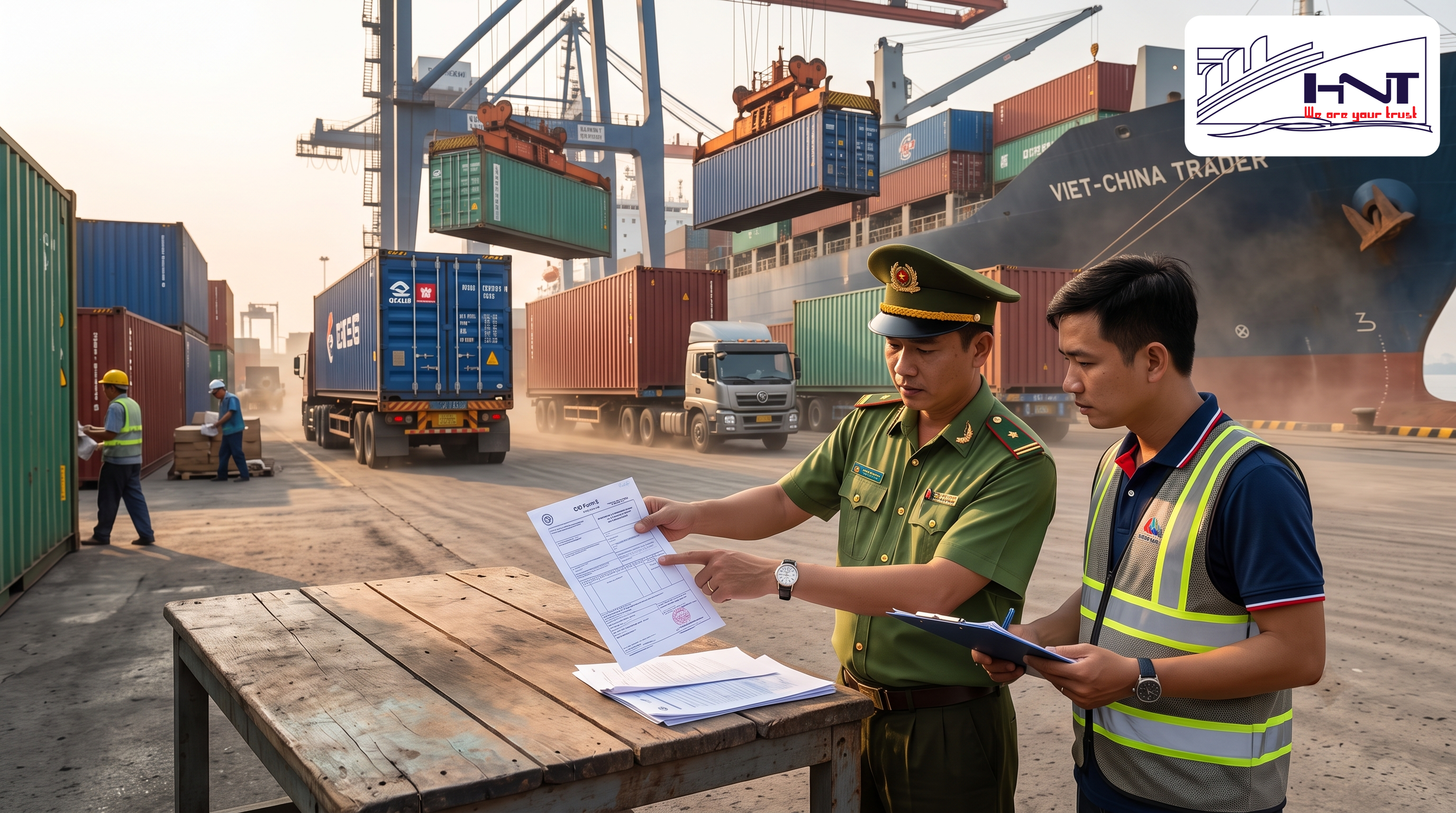
Retrospective Issuance of C/O, Third-Party Invoicing and Transhipment
Form E C/O may be issued before or at the time of shipment. If it is not issued at the appropriate time or within the prescribed period, it may be issued retrospectively within 12 months from the shipment date and must bear the retrospective issuance indication in Box 13. This is a requirement that businesses often overlook when handling urgent shipments.
- Determine the shipment date as soon as the plan is prepared to control the C/O issuance deadline and retrospective issuance documentation.
- If the invoice is issued by a third party, declare the correct circumstances and information about the invoice-issuing company.
- When transshipping, retain documents proving that the goods did not enter into commercial transactions at the transit location.
- Do not allow goods to undergo processing beyond operations necessary for their preservation during permitted transit.
- If the destination changes, immediately review whether a new C/O is required before delivering documents to the buyer.
- Keep the through transport document to prove the route if the importing authority requests verification.
| Situation | Main requirement | Documents to retain | Risk |
|---|---|---|---|
| Timely issuance | Declare before or at shipment | Invoice and transport documents | Incorrect final data |
| Retrospective issuance | Comply with the 12-month deadline | Shipment date | Missing Box 13 indication |
| Third-party invoice | Declare the correct circumstances | Related invoices | Inconsistent parties |
| Transit | Meet direct consignment requirements | Through bill of lading | Unable to prove the transportation route |
| Change of destination | Review the need for reissuance | Old C/O and new transport documents | Documents showing an incorrect destination |
For example, a coffee company in Dak Lak exports a container through a transshipment port before it reaches Shanghai. The documentation set includes the complete through bill of lading and evidence that the goods were only transshipped. This provides the company with grounds to explain compliance with transportation requirements when the importer requests verification.
A fruit company in Can Tho, however, has to change the delivery destination from Shenzhen to Guangzhou after the goods have left Vietnam. The documentation team immediately reviews the C/O and transport documents instead of simply changing the invoice. Early action prevents the buyer from receiving a document set with inconsistent destination information.
For refrigerated goods, businesses should also synchronize origin documentation with refrigerated container transportation standards. Based on HNT LOGISTICS' experience, finalizing the C/O before the goods arrive at the border gate helps reduce the risk of document delays consuming the safety buffer of the cold chain.
Specialized regulatory requirements must still be checked separately for each product. For example, China has established phytosanitary requirements for fresh jackfruit imported from Vietnam, effective from June 1, 2026. A C/O does not replace phytosanitary certificates, growing area codes, or food safety requirements.
Practical summary: C/O procedures and logistics must follow the same schedule. Any changes to the vessel, route, consignee, or destination must be immediately communicated to the documentation team.
Checking ACFTA Preferential Tariff Rates for C/O Form E and Managing the Risk of C/O Rejection
The ACFTA preferential tariff schedule for C/O Form E must be checked against the product code and regulations of the importing country. Decree 118/2026/ND-CP is Vietnam's ACFTA tariff schedule for the 2026-2027 period applicable to imports into Vietnam; it is not a tariff table that can be used to independently determine the tax rates China applies to Vietnamese goods.
Therefore, before promising Chinese buyers a specific tax saving, businesses should ask them or their customs agents in China to confirm the HS Code and applicable ACFTA tariff rate at the time of importation. A C/O only establishes the right to request preferential treatment when all conditions are satisfied. It does not guarantee a fixed tariff rate for every product.

Checklist Before Submitting Documents and Handing the C/O to the Buyer
- Confirm the HS Code with the importer before calculating tax benefits and determining the applicable origin rules.
- Check the WO, RVC, CTH, or product-specific criteria before submitting the application.
- Cross-check the C/O against the customs declaration, invoice, bill of lading, packing list, and raw material origin documents.
- Confirm the shipment date and indicate retrospective issuance if the shipment falls under the relevant circumstances.
- Check third-party invoices, transshipment, destination changes, and special circumstances before issuance.
- Retain supporting documents for at least the statutory retention period and in accordance with the company's control procedures.
- Send the checked document set to the buyer before they complete customs procedures so that discrepancies can still be corrected.
| Risk | Warning signs | Consequences | Measures |
|---|---|---|---|
| Wrong HS Code | The two parties use different codes | Incorrect rules and incorrect tariffs | Confirm before signing the contract |
| Incorrect origin criteria | No calculation worksheet | C/O questioned | Retain calculation records |
| Inconsistent documents | Different quantity or description | Verification required | Cross-check |
| Incorrect retrospective issuance | Missing Box 13 information | C/O may be rejected | Check the shipment date |
| Insufficient transit evidence | No through bill of lading | Loss of incentives | Retain route documentation |
For example, Viet May Machinery Company in Binh Duong informs its Chinese customer of a preferential tariff rate before both parties agree on the HS Code. After the import agent reclassifies the goods, the origin rules also change. The company has to recalculate the RVC, delaying the document set by nearly one day.
On the positive side, a fresh coconut company in Ben Tre prepares a six-point checklist before each shipment. It cross-checks growing areas, invoices, customs declarations, transport documents, C/O, and quarantine requirements. After three months, the number of applications requiring supplementary documents decreases significantly compared with the period when employees checked each document manually and separately.
C/O issuance fees must also be updated at the appropriate time. Under the regulations implemented in 2026, the new issuance fee is reduced to VND 30,000 per set until December 31, 2026; from January 1, 2027, the standard fee will be VND 60,000 per set.
Fluctuations in transportation costs make early document completion even more important. The Freightos Baltic Index, a global container freight rate index, has recently stood at approximately USD 3,570.80 per 40-foot container, while many Asian routes continue to experience significant fluctuations and congestion. Therefore, businesses should not allow C/O errors to create another variable in addition to freight costs and shipping schedules.
Businesses that export goods regularly can integrate customs declaration services with an origin control process. According to experts at HNT LOGISTICS, the most effective control point is to review the HS Code, origin criteria, and transportation route before making the final shipping reservation.
Practical summary: The true value of a C/O does not lie in the document itself, but in the amount of tax the buyer can legally save. Every decision must start with the product code and rules of origin.
The procedure for applying for C/O Form E becomes much simpler when businesses divide the process into three stages: determining origin, completing supporting evidence, and submitting the application. Errors commonly occur when employees begin entering information into eCoSys before the first two stages have been confirmed. For agricultural products, seafood, and fresh fruit, document correction time can also directly affect customs clearance schedules and cargo safety.
- Determine the HS Code and rules of origin before making tax commitments to the buyer.
- Do not assume that goods manufactured in Vietnam automatically qualify for Form E C/O.
- Standardize raw material, growing area, and traceability records before the shipment date.
- Submit procedure for applying for a C/O Form E on eCoSys using data that has already been cross-checked.
- Closely monitor the shipment date to correctly handle retrospective C/O issuance and Box 13.
- Separately check China's quarantine, food safety, and cold chain logistics requirements.
- Confirm the ACFTA tariff rate with the importer instead of making assumptions based on Vietnam's tariff schedule.
If a business needs to manage C/O together with shipping bookings, customs declarations, transportation, and cold chain logistics, HNT LOGISTICS can serve as a freight forwarding and logistics partner for Vietnamese exporters nationwide. A document process that is checked in advance helps reduce application corrections, protect preferential tariff benefits, and maintain more stable delivery schedules. As a professional transportation service provider, HNT LOGISTICS is committed to delivering comprehensive supply chain solutions, helping Vietnamese businesses confidently conquer global markets. Contact us today at 8A Hoang Minh Giam, Ho Chi Minh City or via the marketing email at hntshipping.com for quotation support!