A single incident in which a refrigerated truck fails to maintain the required temperature, its cargo doors remain open for too long, or goods are loaded before reaching the required storage conditions can cause significant losses for a business. For deliveries within Ho Chi Minh City, the challenge is not simply finding a vehicle equipped with a refrigeration system. It also involves selecting the right payload capacity, calculating travel time, organizing loading and unloading, and controlling temperature throughout the journey. Therefore, refrigerated transportation in Ho Chi Minh City must be planned based on product characteristics and actual delivery conditions.
When researching refrigerated transportation in Ho Chi Minh City, businesses dealing in food, seafood, frozen goods, vegetables, and manufacturing ingredients need to distinguish between a vehicle's cooling capacity and its ability to maintain product quality. A truck may reach its set temperature, but that does not necessarily mean the goods inside are being stored correctly. HNT Logistics provides trucking solutions tailored to individual shipments, combining suitable vehicles, dispatch schedules, and control procedures to minimize risks and additional costs.
Refrigerated Transportation in Ho Chi Minh City: Developing Trucking Solutions Based on Cargo Characteristics and Delivery Conditions
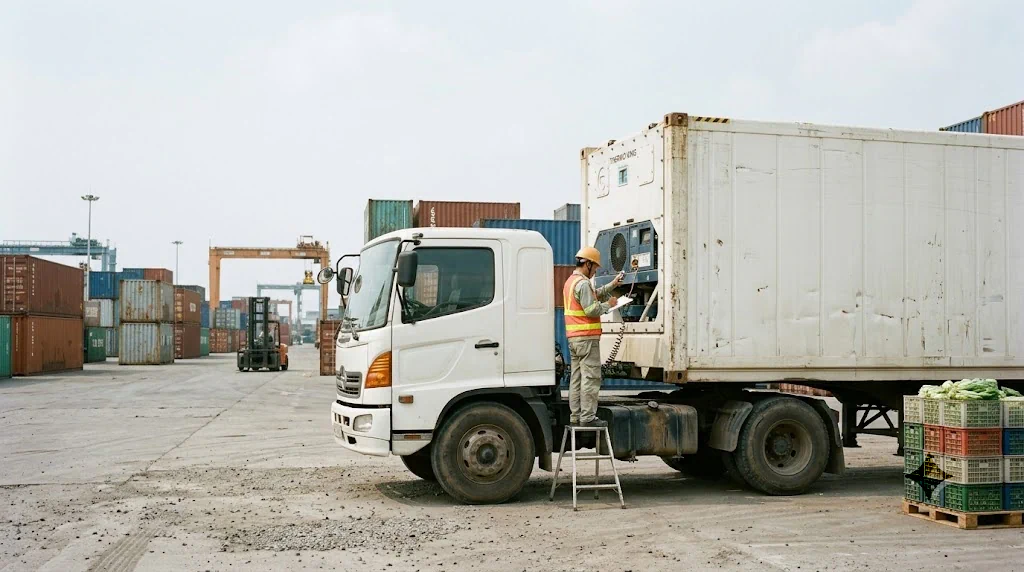
Classify chilled goods, frozen goods, and products requiring stable temperature maintenance according to manufacturers' storage requirements, transit time, and sensitivity to temperature fluctuations
For refrigerated transportation solutions in Ho Chi Minh City, cargo owners should determine whether their products are chilled goods, frozen goods, or items requiring specialized temperature control before booking a vehicle. Leafy vegetables, fresh milk, and many processed foods require different storage conditions from frozen meat or frozen seafood. A single temperature range should not be applied to all products, as actual requirements also depend on ingredients, preparation status, packaging, and manufacturers' instructions.
Important information to confirm includes the target storage temperature, permitted deviation limits, maximum transportation time, and delivery conditions. Goods that have been stably frozen have different operational requirements from newly chilled goods or products whose quality can easily deteriorate when temperatures fluctuate. When planning refrigerated transportation in Ho Chi Minh City, businesses should provide storage specifications and shipment details in advance so the transport provider can select a suitable vehicle rather than relying solely on the cargo's name.
Establish selection criteria for refrigerated trucks with different payload capacities, tractor units hauling refrigerated containers, and refrigerated container transportation in Ho Chi Minh City based on shipment volume, cargo dimensions, and accessibility at delivery points
During refrigerated transportation and customs clearance in Ho Chi Minh City, refrigerated trucks are often suitable for shipments delivered to stores, restaurants, central kitchens, or warehouses in areas with restricted vehicle access. Trucks with various payload capacities help businesses balance cargo weight, cargo compartment volume, and the number of delivery stops. When choosing refrigerated truck rental in Ho Chi Minh City, check the legally permitted cargo payload, cargo door dimensions, overall vehicle height, and ability to turn around, stop, and park at the receiving location.
To optimize the cost and schedule of refrigerated transportation in Ho Chi Minh City, tractor units hauling refrigerated containers may offer greater operational efficiency for large shipments, full-pallet loads, or routes connecting warehouses, ports, factories, and distribution centers. However, refrigerated containers require a suitable power supply when parked in storage yards or awaiting loading and unloading. Refrigeration equipment should not be assumed to operate continuously using the available power supply at every delivery point. The plan for refrigerated container transportation in Ho Chi Minh City must account for road access, turning areas, lifting equipment, and waiting times at both ends of the route.
Analyze the impact of truck restrictions by time slot, traffic density, vehicle height limits, and loading and unloading conditions at warehouses, wholesale markets, factories, or distribution centers in Ho Chi Minh City
Based on HNT Logistics' practical experience in refrigerated transportation in Ho Chi Minh City, local traffic conditions can significantly affect refrigerated truck operating times. Restricted travel hours, routes designated for specific vehicle categories, vertical clearance limits, and parking regulations can make an otherwise short route impractical for large trucks or tractor-trailers. Businesses should verify the regulations currently in force based on vehicle type, payload, route, and departure time rather than using outdated truck restriction schedules to plan deliveries.
When researching refrigerated transportation in Ho Chi Minh City, waiting times at wholesale markets, distribution warehouses, and factories must also be factored into temperature management plans. When a truck queues outside a gate or waits at a loading dock, the refrigeration system continues consuming energy and may experience increased loads if operating conditions are unsuitable. For delivery locations with narrow internal roads, weak pavement, or height restrictions, a preliminary site survey is recommended to determine whether the vehicle can reach the destination directly or whether the cargo must be transferred to a smaller vehicle.
Develop transportation plans using individual trips, dedicated vehicle hire, or scheduled vehicles based on shipping frequency, shipment volume stability, and time-specific delivery requirements
For refrigerated transportation solutions in Ho Chi Minh City, individual trips are suitable when demand is irregular, shipment volumes are small, or a business is testing a new delivery route. Hiring a dedicated vehicle allows cargo owners to control pickup schedules, minimize waiting for consolidated orders, and better manage delivery sequences. Conversely, when shipment volumes remain stable daily or weekly, a regular vehicle contract can reduce rate fluctuations and help standardize service requirements.
During refrigerated transportation and customs clearance in Ho Chi Minh City, selecting the right option requires comparing the total actual cost rather than looking only at the initial vehicle rental price. A low-cost trip involving long waiting times, excessive empty running, or missed delivery windows may result in higher overall costs than a more expensive transport option with better operational planning. When preparing a plan, businesses should define the pickup time, expected delivery time, free waiting period, and additional charges for exceeding the agreed waiting time in advance.
Refrigerated Transportation in Ho Chi Minh City: Establishing Temperature Control Procedures from Before Pickup Through Handover

Set target temperature ranges according to each product's storage documentation, distinguishing between the equipment setpoint, the air temperature inside the truck, and the actual product temperature
To optimize the cost and schedule of refrigerated transportation in Ho Chi Minh City, three operating parameters must be distinguished: the temperature set on the controller, the air temperature inside the cargo compartment, and the actual temperature of the product. A displayed controller setpoint does not mean that all goods have reached the target temperature. Air sensors may register rapid changes near air outlets or cargo doors, while the core temperature of packaged goods changes more slowly depending on their mass, packaging, and frozen state.
Businesses should use manufacturers' technical documentation, storage labels, and quality procedures as the basis for setting limits. If multiple products are transported in the same vehicle, their temperature requirements must be assessed for compatibility before consolidating the shipment. A single average temperature should not be selected merely for dispatch convenience, as it may fail to meet the storage requirements of every product in the load.
Develop a pre-trip vehicle inspection procedure covering the refrigeration unit, door seals, insulation, drainage system, power supply, and ability to maintain temperature under anticipated load conditions
Before each trip, drivers or operations personnel should inspect the refrigeration unit, circulation fans, door seals, hinges, door locks, interior cargo compartment surfaces, and insulation. Poorly sealed doors can allow hot, humid air to enter, increasing the equipment load and causing temperature fluctuations. The drainage system must also remain clear, with no standing water or accumulated ice that could compromise hygiene, obstruct airflow, or create slipping hazards during loading and unloading.
For refrigerated containers, confirm the condition of the refrigeration unit, power supply, connecting cables, and availability of power at the storage yard or waiting area. For refrigerated trucks, check fuel levels, refrigeration unit operation, and controller warnings. When carrying heavy loads or operating in hot weather, inspections should go beyond confirming that the equipment starts successfully and should assess its ability to maintain the required conditions under the anticipated load and travel time.
Design procedures for pre-cooling the cargo compartment, checking cargo temperature before loading, maintaining airflow clearances, and closing doors correctly to minimize temperature increases during transportation
The cargo compartment should be cleaned and pre-cooled according to an appropriate procedure before loading. Pre-cooling helps prevent warm air inside the compartment from raising cargo temperatures when the goods are loaded. However, pre-cooling the truck does not replace the product chilling or freezing process at the production facility. Refrigerated vehicles are primarily intended to maintain the storage conditions of goods that have already been prepared at the correct temperature, not to rapidly freeze shipments that are still warm.
During loading, leave sufficient clearance for air to circulate according to the vehicle's design, avoiding blockage of return air vents or supply air outlets. Pallets and packages must be securely arranged, must not exceed the load capacity, and must not obstruct emergency exits or doors. Once loading is complete, delivery personnel should check the quantity, condition of the goods, and temperature according to the agreed method, then close the doors immediately; each prolonged door opening can increase heat exchange with the external environment.
Establish a mechanism for monitoring temperature data over time, recording door-opening times, and issuing deviation alerts to identify causes, handle incidents, and retain evidence for quality reconciliation.
For temperature-sensitive goods, continuous data logging is more valuable than simply reading a thermometer at the beginning and end of a trip. Data loggers or remote monitoring systems should record timestamps, measured temperatures, and alert statuses; if supported by the equipment, vehicle locations or door-opening events can also be recorded. The recording frequency should be appropriate to the quality requirements and the response time needed when deviations occur.
The alert-handling procedure should identify who receives the information, the response time, and how corrective actions are documented. When the temperature exceeds the threshold, the operations team must check the duration of the deviation, equipment status, sensor location, and actual condition of the goods rather than automatically concluding that the entire shipment has been damaged. The data should be stored alongside delivery records, trip IDs, and shipment lot records to support quality reconciliation or complaint resolution.
Refrigerated Truck Rental in Ho Chi Minh City and Refrigerated Container Transportation: Comparison Table of Specifications, Carrying Capacity, and Costs
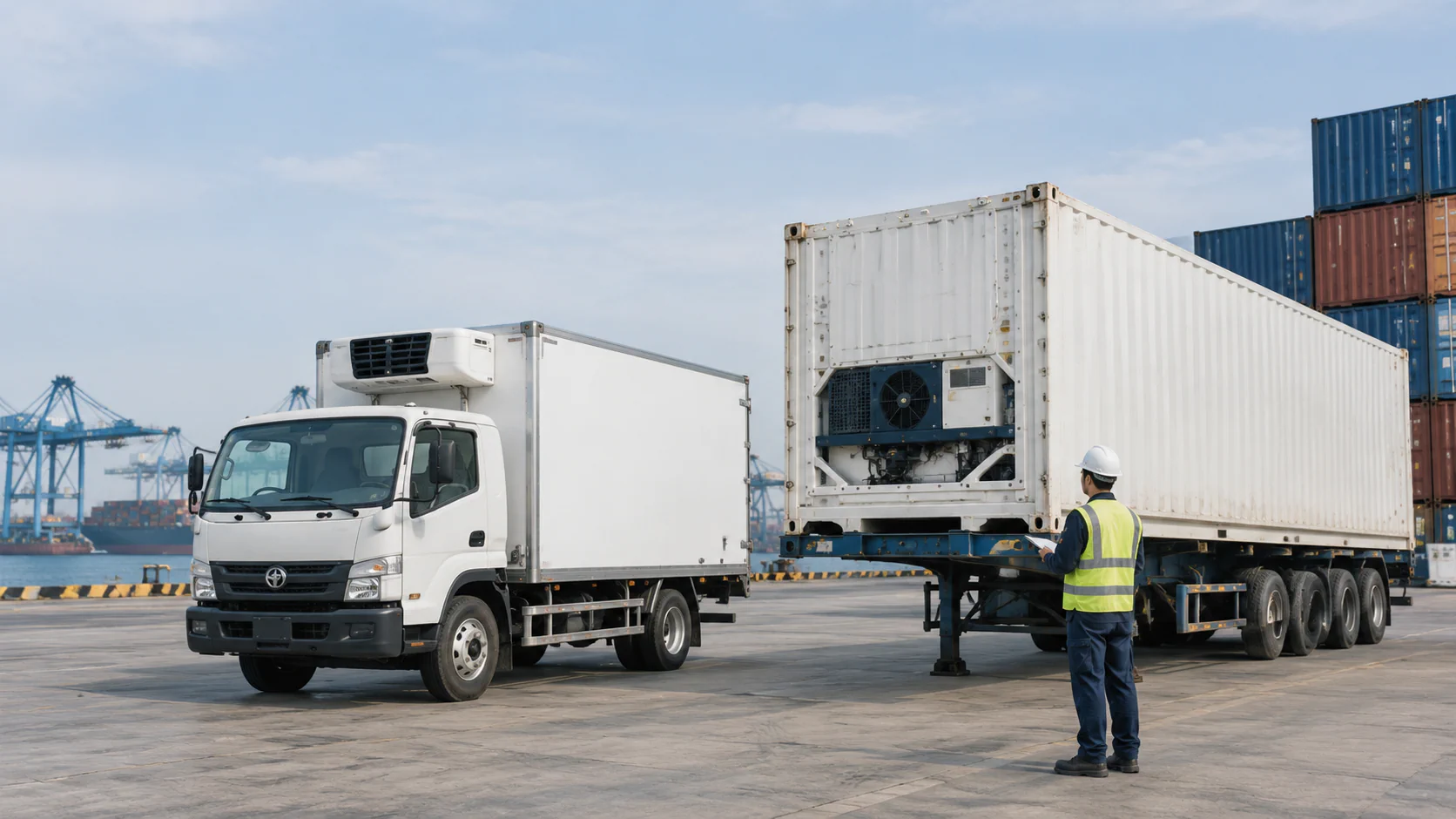
Create a comparison table of refrigerated trucks and refrigerated containers based on payload capacity, usable volume, accessibility to pickup and delivery points, power supply requirements, and suitable operating scope.
Vehicles should not be selected solely based on nominal volume or vehicle type. Actual payload capacity must account for the vehicle's permitted load limit, the combined weight of goods and packaging, axle load distribution, and road conditions. Usable volume also depends on the cargo compartment dimensions, pallet arrangement, clearance for airflow, and loading and unloading capabilities at the warehouse.
The table below provides reference specifications for preliminary option screening. Container dimensions and capacity may vary by manufacturer, container type, wall thickness, and refrigeration unit design. Permitted cargo payload must be verified against the CSC plate, specification plate, vehicle inspection documents, and actual vehicle configuration before booking a trip.
| Vehicle | Reference dimensions or capacity | Utilization capacity | Conditions to verify |
|---|---|---|---|
| Small refrigerated truck | Cargo compartment typically accommodates around 1–3 tons; dimensions vary by vehicle model | Urban deliveries, shops, restaurants, and locations with limited access | Registered payload capacity, vehicle height, cargo door dimensions, and stopping and parking locations |
| Medium refrigerated truck | Typically around 3–5 tons; capacity depends on cargo compartment length | Deliveries of multiple packages or service on warehouse and factory routes | Route-specific traffic restrictions, warehouse accessibility, and delivery schedules |
| Large-capacity refrigerated truck | Typically around 8–15 tons or according to the specific configuration | Transporting large shipments, distribution routes, and transshipment | Actual payload, turning radius, vehicle height, and road and bridge restrictions |
| 20-foot refrigerated container | External length approximately 6.06 m; internal volume typically around 28–30 m³ | Large shipments, palletized goods, or connections between warehouses and ports | Power supply availability, permitted payload, tractor unit, and loading and unloading yard arrangements |
| 40-foot reefer container | External length approximately 12.19 m; internal volume typically around 60–67 m³ | High-volume shipments, long-distance routes, or scheduled transportation | Container type, actual payload, access roads, and power supply arrangements |
The truck payload ranges in the table are for market segmentation reference only and do not guarantee the carrying capacity of any specific vehicle. Refrigerated 20-foot or 40-foot containers may also differ in volume and payload across models. For heavy shipments that occupy little volume, the weight limit may be reached before the cargo compartment is full; for lightweight, bulky goods, volume limits and airflow arrangement become the deciding factors.
Develop a reference table of storage temperature ranges for frozen goods, meat and fish, seafood, processed foods, vegetables, and chilled goods according to manufacturer instructions or the standards applicable to each product.
The temperature ranges below are illustrative references for operational planning and do not replace product labels, technical documentation, or industry-specific regulations. Some frozen meat, fish, and seafood products are commonly maintained at -18°C or below, according to product requirements; chilled goods may require approximately 0–5°C, while optimal temperatures for vegetables vary considerably by variety, ripeness, and sensitivity to chilling.
| Group of goods | Reference temperature range | Operational notes |
|---|---|---|
| Frozen meat, fish, and seafood | Typically -18°C or lower according to the product specifications | Check the frozen condition and minimize temperature fluctuations |
| Frozen processed foods | Typically -18°C or as specified on the product label | Control packaging, expiration dates, and hygiene conditions |
| Chilled meat and fish | Typically around 0–4°C depending on the product | Comply with specific shelf-life and temperature requirements |
| Dairy products and processed foods requiring refrigeration | Typically around 0–5°C depending on the brand | Check the manufacturer's instructions and applicable regulations |
| Fresh fruits and vegetables | May range from approximately 2–12°C depending on the type | There is no single temperature standard that applies to all types of fruits and vegetables |
| Goods requiring specialized, stable temperature conditions | According to the product dossier | Determine acceptable deviation limits, exposure time, and data recording requirements |
An important consideration is that the temperature set on the equipment must be configured according to storage requirements, but compliance assessment also depends on the measurement location and sampling method. When receiving goods, determine in advance whether to measure the surface temperature, the temperature at the center of the package, or the core temperature of the product; these measurements are not interchangeable. If the contract specifies explicit limits, both parties should agree on the measuring equipment, calibration method, and acceptance criteria before transportation.
Analyze the cost components of refrigerated truck rental in Ho Chi Minh City, including transportation distance, vehicle usage time, payload capacity, loading and unloading waiting time, road fees, delivery and handling fees, and refrigeration equipment operating requirements
Refrigerated truck rental prices in Ho Chi Minh City depend on the actual distance traveled, payload capacity, vehicle occupancy time, and delivery schedule. Routes with multiple stops, deliveries during peak hours, or long loading and unloading waits generally incur higher costs than direct pickup and delivery routes. In addition to the basic freight charge, quotations may include road fees, yard fees, charges for entering restricted areas, after-hours surcharges, and truck compartment cleaning costs as required.
For refrigerated vehicles, clarify whether the price includes operating the refrigeration equipment throughout the entire waiting period, whether surcharges apply when maintaining the required temperature for extended periods, and who is responsible if the delivery schedule changes. For refrigerated containers, charges related to power supply, lifting and handling, yard storage, free time, and container detention must be itemized separately when applicable. Do not provide a fixed price without knowing the pickup location, delivery location, type of goods, shipment volume, and vehicle usage duration.
Develop a cost calculation spreadsheet showing total cost per trip and cost per kilogram of goods delivered in acceptable condition. Compare refrigerated truck and refrigerated container options based on payload utilization, number of delivery points, and additional surcharges
For a fair comparison, businesses should use the total cost of completing a trip rather than comparing only the basic freight charge. The formula can be implemented as follows: total trip cost equals the truck or tractor unit charge plus road fees, delivery and handling fees, waiting charges, electricity or refrigeration operating costs, and confirmed surcharges. Cost per kilogram meeting requirements equals the total trip cost divided by the actual weight of goods delivered and accepted according to the quality criteria.
| Item | Refrigerated truck | Refrigerated container |
|---|---|---|
| Main transport freight | Pricing by trip, route, or rental duration | Tractor unit charges, container transportation, or route-based service packages |
| Loading, unloading, and waiting fees | Based on the number of delivery points and usage duration | Based on lifting and handling conditions, yard facilities, and waiting time |
| Refrigeration operating costs | Based on vehicle configuration and operating duration | Based on refrigeration unit configuration, power source, and power supply duration |
| Fee incurred | Road fees, after-hours surcharges, transshipment, or cleaning | Lifting and handling, power supply, yard storage, container detention, or schedule changes |
| Cost/kg | Total cost divided by the volume successfully delivered in compliance with requirements | Total cost divided by the volume successfully delivered in compliance with requirements |
For example, if a refrigerated lorry trip costs a total of VND 3,600,000 and successfully delivers 1,200 kg, the corresponding cost is VND 3,000/kg. If a refrigerated container option costs a total of VND 7,500,000 and successfully delivers 3,000 kg, the cost is VND 2,500/kg. These are illustrative hypothetical calculations, not market price lists or quotations from HNT Logistics. Actual costs must also account for the impact of empty running mileage, the number of delivery points and payload utilisation.
Frozen Goods Transportation in Ho Chi Minh City: Managing Quality Risks and Handling Operational Deviations

Analyse the causes of temperature control failures, such as goods not being sufficiently chilled before loading, doors being left open for extended periods, cargo obstructing airflow, refrigeration equipment being overloaded, or vehicles being held up unexpectedly.
Temperature risks often begin before the vehicle leaves the warehouse. If products have not reached their required storage temperature before being loaded, the refrigeration system may be unable to cool the entire cargo to the required level during transit. Leaving doors open for too long, placing goods in front of air vents, damaged door seals and deteriorating insulation in the vehicle compartment can also reduce cooling efficiency. Therefore, both product conditions and vehicle capabilities must be checked.
During transportation, unplanned stops, prolonged traffic congestion, or deliveries to multiple locations can increase door-open time and cause schedules to exceed expectations. If the refrigeration unit must operate continuously under high-load conditions, air temperatures may fluctuate while fuel or electricity consumption increases. The most effective preventive measure is to identify potential risk points before departure, allocate buffer time, and establish clear response procedures when alerts occur.
Develop an incident response matrix based on the degree of temperature deviation, exposure time, product characteristics and storage guidelines, identifying cases where consignments must be isolated or quality assessments carried out before delivery can continue.
When the temperature exceeds the agreed limits, dispatch personnel should record the measured value, the start and end times of the deviation if identifiable, the equipment status, and the condition of the goods. The level of risk depends not only on how far the temperature exceeds the threshold but also on the exposure duration, initial temperature, microbiological characteristics of the product, and storage instructions. A shipment should not automatically be deemed safe or spoiled based on a single measurement.
If the deviation is severe, prolonged, or the exposure duration cannot be determined, delivery of the affected goods should be temporarily suspended, appropriate storage conditions maintained, and the cargo owner or quality department notified. Delivery may resume only following an assessment by an authorized person in accordance with quality procedures and applicable regulations. For food products at risk of becoming unsafe, sensory inspection alone must not replace professional assessment or legal requirements.
Establish procedures for recording packaging conditions, product temperatures, package quantities, receipt times, seal photographs and handover reports to provide a basis for determining liability in the event of losses.
Delivery and receipt records should be prepared immediately at the pickup location and updated upon handover. Essential information includes the batch code, product category, number of packages, packaging condition, receipt time, temperature measured using the agreed method, and seal condition, if applicable. Photos of the goods before loading, the cargo compartment doors after closing, and the seal provide supporting evidence for all parties in the event of shortages, damage, or suspected temperature deviations.
The handover record should clearly distinguish between the condition confirmed by the sender, the condition during transportation, and the inspection results at the receiving location. If the recipient identifies a problem with the goods, they should specifically describe the number of affected packages, measurement readings, discovery time, and relevant photos rather than simply stating that the goods do not meet requirements. Records should be stored together with temperature data, vehicle dispatch orders, and transport documents to support contractual liability verification.
Develop contingency plans for refrigerated vehicle breakdowns, power supply failures, prolonged traffic congestion or goods being rejected at the receiving point. These should include arranging replacement vehicles and agreeing on how additional costs will be handled.
When a refrigerated vehicle encounters a malfunction, the first priority is to assess the potential impact on the goods and the ability to maintain appropriate storage conditions. The driver must immediately notify dispatch, record equipment alerts and the vehicle's location, and avoid unnecessary opening of the cargo compartment doors. The operations team must determine whether the issue can be fixed on-site or whether a replacement vehicle is needed, the cargo must be transferred to a compliant vehicle, or the goods must be moved to a suitable storage facility.
For refrigerated containers, if the power supply is interrupted at a depot or delivery location, the operating company must be contacted to restore power and assess the duration of the interruption. If congestion continues for an extended period or the recipient refuses the goods, do not open the doors, change the delivery location, or incur additional charges without documenting the situation and notifying an authorized person, except for emergency actions necessary to protect safety. Contracts should clearly specify the approval contact, cargo transfer arrangements, waiting charges, and cost allocation based on the cause.
Optimising Refrigerated Goods Transportation Costs in Ho Chi Minh City: Fleet Coordination, Delivery Schedules and Operational Efficiency
Analyse the break-even point between hiring vehicles per trip, hiring vehicles by the day and entering into regular transport contracts, based on shipment volumes, delivery frequency, number of stops and actual vehicle operating time.
Per-trip rentals are suitable when demand is irregular and each transportation assignment has defined pickup and delivery locations. Daily rentals may be more cost-effective when multiple stops are required or waiting is expected over an extended period, while recurring contracts are generally suitable for businesses with stable shipment volumes. To determine the break-even point, compare the total costs of each option using the same number of trips, distance, service duration, and temperature standards.
For example, if the per-trip rental rate is lower but the business needs to make many short trips each day, the total cost may exceed that of a daily rental. Conversely, renting a vehicle for an entire day to transport a single shipment may increase the cost per kilogram because the vehicle's available operating time is not fully utilized. Actual operational data covering a sufficiently representative cycle, including peak and off-peak days, should be collected before committing to minimum shipment volumes under a recurring contract.
Develop an order consolidation strategy based on delivery areas, receiving time slots and compatible temperature requirements, while assessing the limits of combining shipments to prevent odour cross-contamination or adverse effects on storage conditions.
Consolidating orders by area helps reduce empty mileage and limits travel time between delivery locations. For example, orders destined for the same industrial park or warehouse cluster can be assigned to one delivery route if receiving time windows and temperature requirements are compatible. However, route optimization should not rely solely on geographical distance; waiting time at each location, recipient flexibility, and cargo compartment door-open time must also be considered.
Cargo consolidation is appropriate only when temperature, hygiene, packaging, and product characteristics permit it. Products with strong odors, raw goods, and ready-to-eat processed foods require a cross-contamination risk assessment before being loaded onto the same vehicle. If products require different temperature ranges or incompatible hygiene conditions, separate trips or vehicles with technically compliant independent compartments should be used. All order consolidation decisions must prioritize product quality before considering potential cost savings.
Calculate operating costs over the entire vehicle trip lifecycle, including loaded mileage, empty running mileage, fuel, electricity for refrigeration systems, waiting time and payload utilisation efficiency.
Refrigerated transportation costs are not incurred only when the vehicle is carrying goods. The distance from the vehicle depot to the pickup location, the return journey after delivery, and vehicle waiting time all affect operational efficiency. For refrigerated trucks that consume fuel for both driving and operating the refrigeration unit, fuel consumption should be evaluated under actual operating conditions. For refrigerated containers, electricity costs and power availability during depot storage must also be calculated according to the service configuration.
Payload utilization can be calculated by dividing the actual cargo weight by the permitted usable payload capacity. This indicator should be considered alongside the volume utilization rate because a vehicle may reach its volume limit before reaching its weight limit, or vice versa. When analyzing the total cost per trip, businesses should also monitor empty-running rates, waiting time, number of delivery stops, and incident handling costs to identify factors that increase the actual unit cost.
Establish a set of KPIs for evaluating refrigerated trucking performance, including on-time delivery rates, temperature maintenance compliance, cost per order, payload utilisation rates and the number of quality incidents per operating period.
The operational KPI framework should simultaneously reflect service quality and economic efficiency. The on-time delivery rate indicates compliance with scheduled appointments; the percentage of trips maintaining temperatures within the specified limits reflects the ability to control storage conditions; and cost per order indicates budget efficiency. These indicators are meaningful only when calculation methods, data sources, reporting cut-off times, and update responsibilities are agreed upon between the business and the transport provider.
Businesses can also monitor payload utilization rates, empty mileage, average waiting time, and the number of quality incidents per 100 trips. When the on-time delivery rate declines, the causes should be separated into dispatch coordination, traffic, loading and unloading time, and receiving conditions. When costs increase, businesses should review base rates, surcharges, vehicle utilization, and emergency vehicle dispatches. Regular data-driven assessments enable both parties to adjust schedules and vehicle arrangements rather than simply negotiating lower freight rates.
For businesses involved in import and export activities, refrigerated trucking plans must be coordinated with warehouse schedules, port schedules, and shipment documentation. When documentation requirements, specialized inspections, or customs procedures arise, the official guidance of the competent authorities must be reviewed, including General Department of Customs regulations and other current regulations applicable to the specific goods. For ocean freight, container handling and handover requirements should also be checked against information from Vietnam Maritime Administration as well as the regulations of the port operator. These checks help prevent the use of outdated guidance or the incorrect application of requirements to different types of goods.
HNT Logistics Supports Cold Chain Transportation in Ho Chi Minh City with Trucking Solutions Tailored to Actual Needs
Receive information about cargo types, required temperature ranges, weight, dimensions, pickup points, delivery points, and transportation schedules to recommend suitable vehicles
To recommend the right vehicles, HNT Logistics needs information about the cargo type, whether it requires chilled or frozen conditions, the storage temperature range, weight, package or pallet dimensions, and estimated total volume. In addition to pickup and delivery locations, businesses should provide the desired collection and delivery times, warehouse access conditions, loading and unloading capabilities, and temperature monitoring requirements. Complete information helps reduce the risk of dispatching vehicles with unsuitable load capacities or requiring unplanned transshipment.
For cargo subject to strict quality requirements, storage documentation, acceptable deviation limits, hygiene requirements, and acceptance procedures should be provided in advance. If a shipment is subject to specialized industry regulations or involves imports or exports, the applicable documentation and inspection requirements must be determined separately for each product category rather than assuming that all food products follow the same procedures. Based on this information, transportation solutions can be arranged for individual trips, full truckloads, or scheduled regular transportation.
Coordinate refrigerated trucks, tractor units, and refrigerated containers according to operating conditions, aligning dispatch schedules, loading and unloading plans, and agreed temperature control checkpoints
Choosing between a refrigerated truck and a refrigerated container hauled by a tractor unit must take into account access to pickup and delivery locations and the total cargo volume. Refrigerated trucks are generally convenient for urban deliveries and routes with multiple stops, while refrigerated containers are more suitable for large shipments or transportation chains involving organized yards, warehouses, and lifting equipment. HNT Logistics can coordinate trucking solutions based on actual needs, provided that vehicle configurations and operating schedules are confirmed before implementation.
Dispatch schedules should be coordinated with cargo readiness, loading and unloading capacity, warehouse receiving hours, and temperature control checkpoints. Both parties should agree on pre-cooling times, inspection procedures before loading, methods for recording data during transit, and notification procedures in case of delays. For routes connected to sea freight or passing through ports, sufficient time should be allocated for formalities, gate coordination, and container pickup and delivery requirements imposed by the terminal operator.
Provide transparent quotations based on transportation scope, vehicle usage time, storage requirements, pickup and delivery points, and conditional surcharges
A manageable quotation should clearly specify the vehicle type, transportation route, estimated cargo volume, vehicle usage time, and included services. Conditional charges, such as waiting fees beyond the free waiting period, after-hours deliveries, additional stops, delivery location changes, yard storage, lifting and handling, or transshipment, should be listed separately. For refrigerated services, the scope of temperature monitoring, the type of data recording equipment, and responsibilities for responding to alerts should also be clarified.
Businesses should request confirmation of rates, applicable taxes, payment terms, free waiting periods, and surcharge approval procedures before dispatching vehicles. For shipments requiring consolidated transportation, compatibility conditions regarding temperature, hygiene, and pickup and delivery schedules must be established. Transparent quotations help cargo owners accurately compare the total costs of different options and avoid situations where a low base freight rate is offset by numerous additional charges that were not agreed upon during transportation.
HNT Logistics supports businesses in maintaining cold chain cargo quality, improving vehicle utilization, and optimizing total logistics costs through transportation solutions designed around cargo characteristics and actual pickup and delivery requirements
The efficiency of refrigerated transportation in Ho Chi Minh City is determined by coordination between vehicles, temperature control procedures, dispatch schedules, and incident response capabilities. When these conditions are planned from the outset, businesses are better positioned to minimize quality losses, reduce waiting times, and improve load utilization. HNT Logistics focuses on transportation solutions suited to cargo characteristics and actual pickup and delivery requirements rather than applying the same vehicle configuration to every need.
Businesses looking to rent refrigerated trucks in Ho Chi Minh City, transport frozen goods, or arrange refrigerated container transportation can contact HNT Logistics through its website https://hntshipping.com.vn to discuss shipment details and request a quotation. Prepare the route, pickup and delivery schedule, cargo weight, packaging specifications, and required temperature range in advance to ensure a more accurate consultation. An effective trucking solution must not only deliver cargo to the correct destination but also protect product quality and control total costs throughout the entire journey.