A batch of containers passing through Saigon port not only incurs trucking charges from the warehouse to the port. Businesses must also control the vessel schedule, container pick-up or return deadlines, free storage time, customs procedures, lifting, EIR, container condition and the likelihood of congestion in each area. If just one link is delayed by a few hours, waiting, yard or container storage costs can significantly change the logistics budget for the whole shipment.
Therefore, choosing between Hiep Phuoc port, Ben Nghe port, Tan Thuan port or another terminal within the HCMC seaport network must start from the shipping route, cargo type, factory location, stuffing and stripping requirements and actual delivery conditions. HNT Logistics approaches the problem across the whole journey, from booking and tractor dispatch to port procedures, customs declaration through to delivering the container at the final point, rather than quoting a single freight rate only.
What Is Saigon Port? An Analysis of the Role of the Ben Nghe, Hiep Phuoc and Tan Thuan Port Cluster in the HCMC Logistics Chain
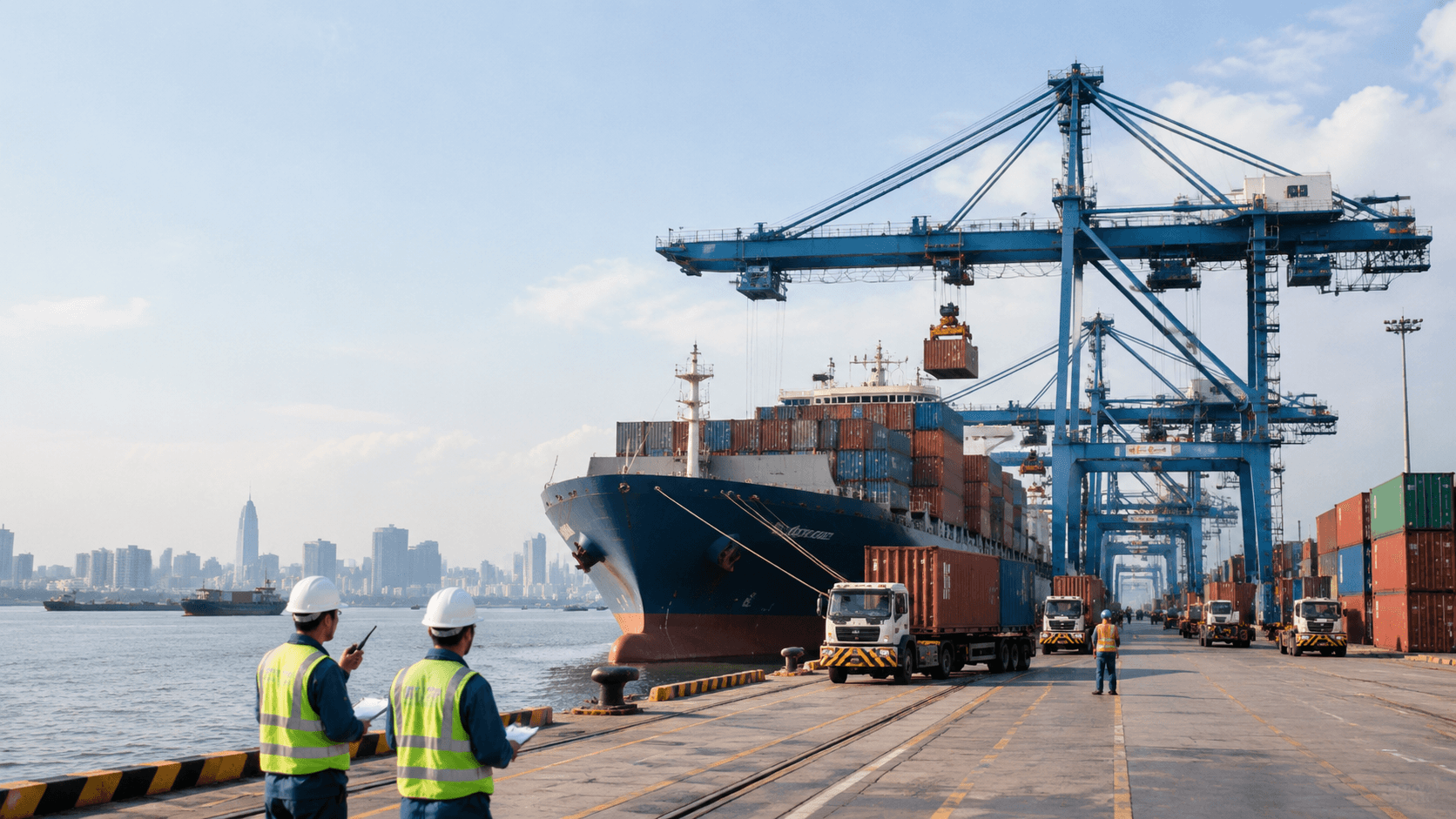
Overview of the Saigon port system and its position connecting import-export cargo in the southern region
Concept Saigon port in practice, businesses commonly use the term in a broad sense to refer to the port terminals along the Saigon, Nha Be and Soai Rap river systems and the HCMC seaport area. Saigon Port Joint Stock Company alone reports an operating system of several terminal areas with 21 berths in total, serving general cargo, warehousing and other port services.
From a supply chain perspective, the advantage of Saigon seaport lies in its quick connections to HCMC, Long An, Tay Ninh, Dong Nai, Binh Duong and the southern production hubs. However, geographic distance is not the only criterion. Cargo owners must also check the vessel route in operation, closing time, vehicle load limits on the road, the empty return depot location and the ability to collect empty containers of the right type before deciding on the plan.
Operating characteristics of Ben Nghe port, Hiep Phuoc port and Tan Thuan port within the Saigon seaport network
Hiep Phuoc port is located in the Hiep Phuoc industrial zone and has an advantage at the southern gateway of the city. According to information published by Saigon Port, the port area covers approx. 36 ha, has an 800 m quay, a container yard of approx. 3.3 ha and can receive vessels up to 50,000 DWT under the published operating conditions. This is a notable basis when building plans for container and general cargo.
Ben Nghe port is a multipurpose port handling bulk cargo, general cargo and domestic and international containers. The operator reports a total area of approx. 32.22 ha and has a dedicated container operations unit. This difference must be understood correctly: choosing Ben Nghe must be based on the actual vessel, service and cargo requirements, not on the assumption that every container route can be substituted with other dedicated container terminals.
For Tan Thuan port, the characteristics of each terminal must be checked before drawing up a plan. Data from the Vietnam Maritime Administration describes Tan Thuan 2 Port as a general quay serving bulk and dry cargo, with an area of approx. 25.7 ha and a published throughput capacity of 1.5 million tonnes per year. Therefore, businesses should not equate Tan Thuan with a dedicated container terminal.
Capacity to handle FCL containers, reefer containers and agricultural export cargo through the southern port cluster of HCMC
For FCL, the deciding factor is not only whether the port has a container yard or lifting equipment, but also whether the shipping line has designated that terminal on the booking. A 20-foot container suits high-density cargo; a 40-foot or 40-foot High Cube container is better suited to bulky, high-volume cargo. When stuffing, businesses must simultaneously control the cargo load, the total vehicle load and the technical limits stated on the container CSC plate.
| Type of Container | Reference external dimensions | Reference usable volume | Common applications |
|---|---|---|---|
| 20-foot Dry | Approximately 6.06 x 2.44 x 2.59 m | Approx. 33 m3 | Heavy cargo, machinery, raw materials, bagged goods |
| 40-foot Dry | Approximately 12.19 x 2.44 x 2.59 m | Approx. 67 m3 | Finished goods, carton goods, bulky cargo |
| 40-foot High Cube | Approximately 12.19 x 2.44 x 2.90 m | Approx. 76 m3 | Light, bulky cargo that needs extra height |
| 40 feet Reefer | Usable size varies by shipping line | Lower than dry due to the insulation layer | Fruit, food and temperature-controlled goods |
Reefer containers require a tighter control chain than dry containers. Beyond the set temperature, operators must consider ventilation, humidity, pre-cooling time, how cargo is stacked so as not to block airflow, and power supply during waiting time. For exported agricultural produce, one common temperature cannot be applied to all fruit; settings must be based on the type of cargo, ripeness, transit time and the protocol of the importing market.
Factors businesses should assess when choosing Saigon seaport as a cargo pick-up and delivery point
The first criterion is the shipping line booking, as the booking determines the terminal, the container drop-off deadline and the expected vessel schedule. Only then comes the distance from the factory to Saigon port, route conditions, vehicle restrictions or banned hours, empty pick-up time, the empty return depot and turning capacity. Choosing a closer port where empty containers are located at a distant depot, or where waiting times are long, does not necessarily result in a lower total cost.
The second criterion is the nature of the cargo. Refrigerated cargo needs power connection points and reefer control procedures; oversized cargo requires checking lifting equipment; plant cargo requires extra time for quarantine; cargo subject to specialised inspection must allow spare time for sampling or physical inspection. HNT usually treats this as a problem multimodal transportation, in which sea transport, tractors, depots, port and procedures are scheduled together rather than managed separately.
Container Transport Process Through Saigon Port, from Vessel Booking to Delivery at the Factory Warehouse
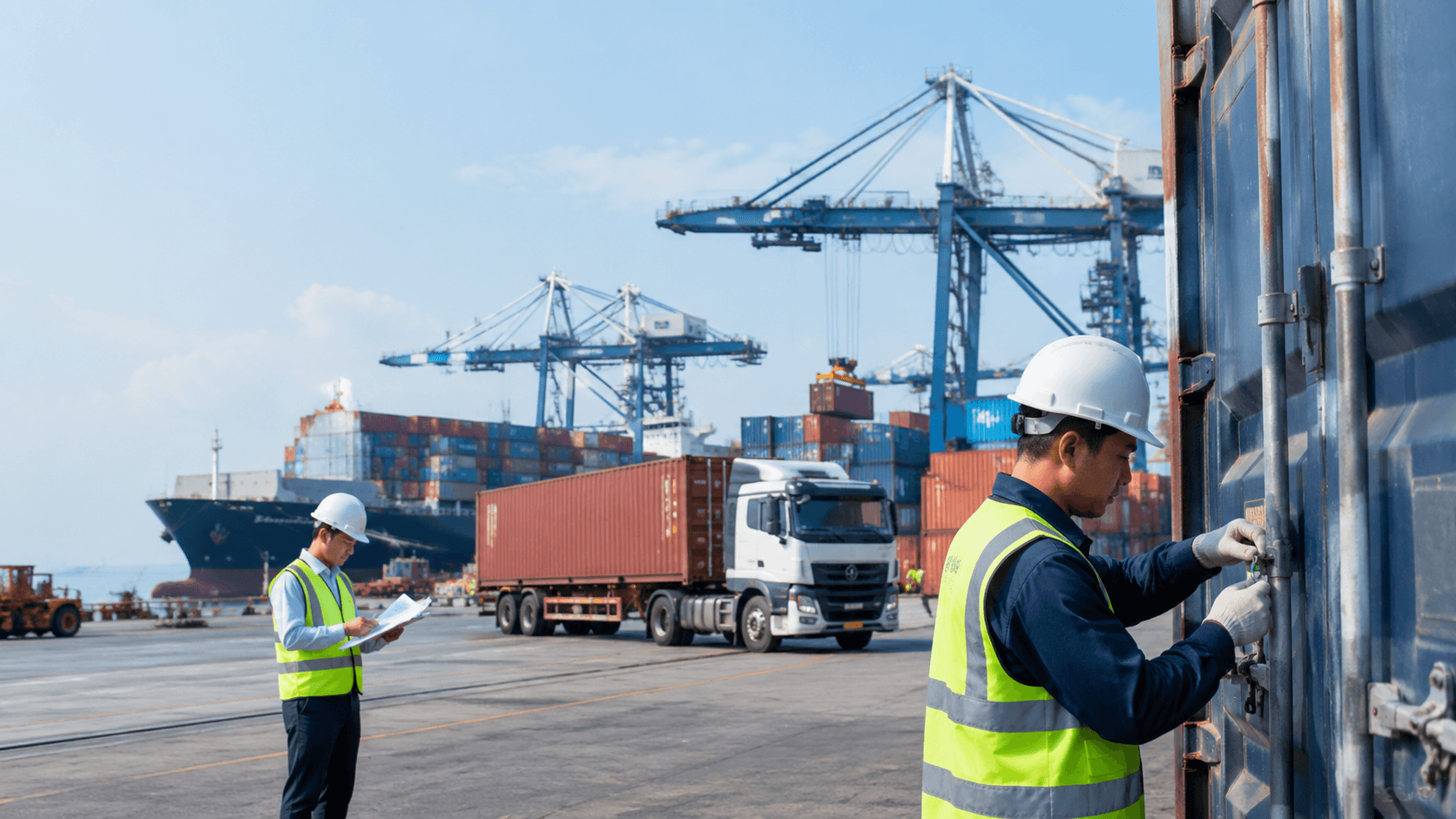
Receiving shipment information, checking the transport route, container type, and building a suitable operating plan
A correct transport plan must start from the shipment data. The logistics provider needs to know whether the cargo is export or import, the cargo name, the expected HS code, weight, number of packages, dimensions, Incoterms, the packing or delivery address, container type, the expected warehouse dispatch date, and the port of loading or port of discharge. For refrigerated cargo, the temperature set point, ventilation requirements, humidity and cold-chain holding time must also be added.
Once the data is received, HNT Logistics checks the vessel schedule, free time, document cut-off, CY cut-off, empty release depot, tractor route and customs processing time. The aim is not to bring the container to port as early as possible, but to move it within the right operating window, limiting storage charges while still leaving a buffer for customs processing if an incident occurs.
Coordination process between Ben Nghe port, Hiep Phuoc port, shipping lines, tractor trucks and import-export businesses
For export cargo, the shipping line issues the booking and specifies where the empty container is to be collected. The transport team checks the empty release order, arranges a tractor to the depot, and inspects the container condition before towing it to the packing warehouse. After loading, sealing and completing the necessary procedures, the container is transported to Hiep Phuoc port, Ben Nghe port or the terminal stated on the booking before the drop-off deadline.
On the import side the sequence is reversed, but the time risks are usually greater. After the vessel berths, businesses must complete document procedures, pay related charges, obtain the delivery order or electronic release, handle customs and schedule vehicles. Once the container is taken out of Ben Nghe port or the designated port, it must be delivered, unstuffed and returned empty to the correct depot within the time allowed by the shipping line.
Control of transport documents including booking, B/L bill of lading, delivery orders, EIR slips and customs records
The booking is the first operational basis of the export shipment, while the B/L is the key transport document confirming carriage under the shipping line's issuing conditions. The EIR records the handover of the container at the depot or port and is especially important when disputes arise over container condition. Customs records must be prepared consistently in terms of cargo name, quantity, weight, value, origin and transport information.
- Booking or shipping information from the shipping line.
- Commercial Invoice and Packing List.
- Bill of lading (B/L) or bill of lading data by stage.
- Customs declaration and documents within the corresponding customs file.
- C/O when the shipment requires a certificate of origin to claim preferential treatment or meet commercial requirements.
- Licence, phytosanitary certificate or specialised inspection records if the goods are subject to control.
- EIR and related container handover documents.
When carrying out customs declaration, businesses should not only check whether the declaration has been successfully transmitted. They must review the HS code, product regulations, value, tax, licences, and consistency between the invoice, packing list, contract, bill of lading and declaration data. These contents must be updated in line with Customs Department regulations and the legal regulations in force at the time the declaration is opened.
Solutions for incidents arising such as port congestion, vessel schedule changes, customs clearance delays and container storage
When the vessel changes its ETA or ETD, the tractor plan must be adjusted immediately rather than keeping the old schedule. For export cargo, dropping the container at the yard too early can increase storage time, but waiting too close to cut-off increases the risk of missing the vessel. Operating buffers must be built according to factory distance, route conditions and the complexity of customs procedures.
For import cargo, businesses must monitor in parallel the vessel arrival date, container free time, yard free time and clearance progress. If inspection or specialised checks arise, the logistics provider must immediately assess the risk of exceeding free time. Detention, demurrage or storage charges should not be regarded as unexpected costs; they are a category of costs that can be managed if warnings are set up early enough.
Saigon Port, Hiep Phuoc Port and Ben Nghe Port: Optimal Sea Transport and Road Transport Routes
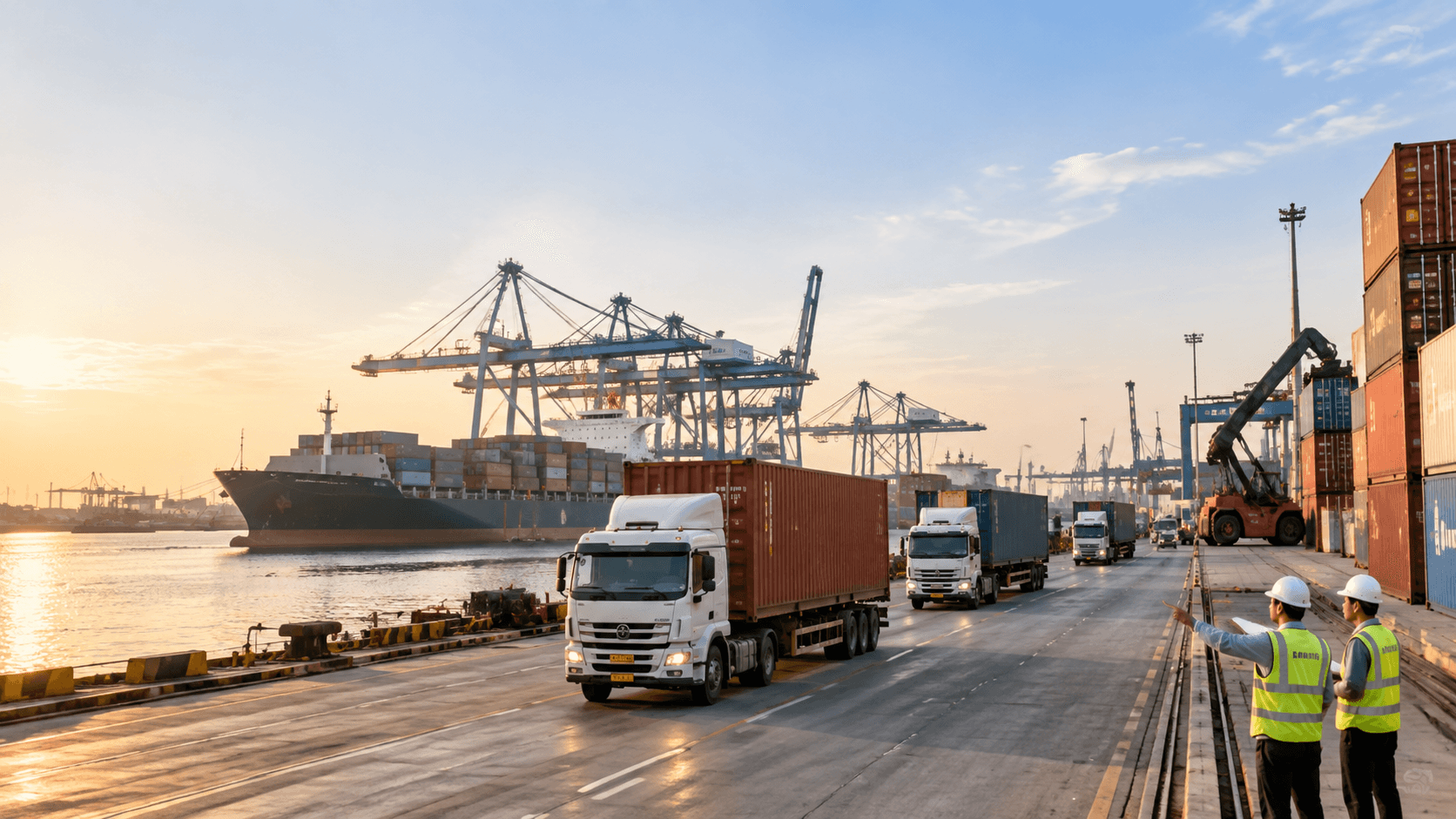
Analysis of options for connecting Saigon port with warehouses, factories and industrial zones in HCMC
Distance in kilometres only reflects part of the container haulage cost. A route from Saigon port to the warehouse may be short but pass through frequently congested areas, be subject to vehicle time restrictions, or involve long waiting times at the factory, so the total turnaround time remains high. HNT therefore calculates the plan based on distance, time windows, waiting time at both ends, the ability to pick up or return empties, and the number of trips the vehicle can make in a day.
For a factory in southern HCMC or Long An, Hiep Phuoc may offer a geographic advantage for some routes if the booking and shipping line are suitable. For warehouses in the inner city or the eastern area, businesses must carefully assess connection times and alternative terminals. There is no single optimal port for every shipment; the best plan depends on the matrix of cargo source, shipping route, depot and delivery conditions.
Choosing the right transport route between Hiep Phuoc port, Ben Nghe port and Tan Thuan port according to cargo characteristics
Hiep Phuoc port has a container yard and a development direction for a port-logistics ecosystem in the southern area of HCMC, so it is suitable to consider when the shipping route and operating plan allow. Saigon Port has announced its direction of continuing to develop Hiep Phuoc into a hub connecting ports, warehouses and logistics in the new phase.
Ben Nghe port has the advantages of a multipurpose port with the capacity to handle both containers and multiple general cargo groups. Tan Thuan port also plays a role for general cargo, but businesses need to check precisely the berth, function and vessels in operation rather than choosing based only on the port name. Technical data and operating conditions should be verified against the information of Vietnam Maritime and Inland Waterway Administration before shipments with specific requirements.
Combining container tractors, depots and multimodal transport to reduce vehicle turnaround time
Tractor costs are not created by kilometres alone. A truck that collects an empty from a depot, drives to the warehouse, waits for loading, travels to port and then returns to another area can create a turnaround far longer than the route suggests on a map. Coordinating depot and tractor must therefore be done together with the booking. If trips can be combined or container pick-up and return points optimised, vehicle productivity will be better.
This is also the reason multimodal transportation must be understood as a coordination system, not simply a sum of sea and road transport. When cargo can also connect via barges, off-dock depots or a network of transit warehouses, businesses gain more options to reduce pressure at the port gate and limit tractors waiting at peak times.
Safety control for dry and reefer containers during transport from port to the final receiving point
Before receiving a dry container, drivers and site staff must check the container number, seal number, the condition of the shell, doors, floor and any visible signs of damage. At handover, the EIR and condition photos are important evidence. For heavy cargo, the distribution of load inside the container must avoid excessive concentration in one area and must suit the load capacity of the equipment and vehicle.
Reefer containers require additional checks on the condition of the refrigeration unit, set point, power supply, alarms and any power interruption during transit. In particular, the set point does not equal the product core temperature. If cargo is loaded into the container before reaching the required temperature, the reefer unit may not always be able to pull the whole load down to the target temperature quickly enough. Pre-cooling must therefore be considered right at the packing warehouse.
Transport Costs and Operating Parameters Through the Saigon Seaport Cluster

Analysis table of cost components for container transport through Saigon port: port charges, lifting, container haulage and surcharges
Do not use one fixed price list for every shipment at Saigon port because port tariffs, shipping line surcharges, fuel prices, depot locations and transport distances can change over time. The table below therefore shows the cost structure so that businesses can control quotations. The specific amounts must be confirmed according to the booking, terminal, container type and date of service.
| Cost group | Basis of formation | Key points to monitor |
|---|---|---|
| Container haulage charges | Distance, container type, route and vehicle time | Waiting fees, toll charges, out-of-hours delivery, load limits |
| Container lifting | Tariffs at the port or depot | Full or empty container handling, yard transfer or special handling |
| Free port | Actual service at each terminal | Check the currently valid price list |
| Terminal storage charges | Number of days the container is held at the terminal | Start time of charging and port policy |
| Demurrage/Detention | Shipping line free time policy | Calculated separately based on booking and shipping line conditions |
| Refrigerated container electricity | Reefer plug-in time and terminal tariffs | Reefer storage time control |
| Customs and specialised inspection | Scope of service and cargo characteristics | HS code, inspection, sampling, quarantine or licence |
Comparison table of operating options for 20-foot, 40-foot and reefer containers at Hiep Phuoc, Ben Nghe and Tan Thuan ports
| Criteria | Hiep Phuoc port | Ben Nghe port | Tan Thuan port |
|---|---|---|---|
| Key characteristics | Has a container yard, general cargo and a logistics development direction | Multipurpose port with container and general cargo operations | Some berths lean towards general cargo; the function of each berth must be checked |
| Container 20’/40′ | Feasible when the booking and designated shipping route allow | Feasible depending on the service and actual vessel calls | Not a default; the specific terminal and service must be confirmed |
| Refrigerated container | Reefer service, power points and booking need to be confirmed | Capacity and service of the specific voyage need to be confirmed | Needs to be checked separately before drawing up a plan |
| Points to check | Vessel schedule, depot, connecting roads to the southern area | Vessel schedule, operating hours, cargo type | Berth function, vessel type and cargo types accepted |
The table above does not mean that containers can freely be moved from Hiep Phuoc port to Ben Nghe port or Tan Thuan port. The delivery terminal is part of the booking and the vessel operating plan. Any change must be approved by the shipping line or the relevant parties. Businesses should use the table as an initial screening tool for options, then verify the specific service before finalising the plan.
Checklist of shipment processing times, documents to prepare and control points in the delivery process
| Phase | Documents/data | Control point |
|---|---|---|
| Receive booking | Booking confirmation | Vessel, voyage, terminal, cut-off, empty release depot |
| Container pick-up | Empty release order, EIR | Container number, shell condition, pick-up deadline |
| Packing | Packing data, seal | Weight, load distribution, seal numbers, VGM where applicable |
| Customs declaration | Invoice, packing list and related documents | HS code, cargo policy, routing, inspection |
| Port drop-off | Booking, container data | CY cut-off, receipt status, container/seal discrepancies |
| Import delivery | D/O or electronic release order, EIR | Free time, vehicle schedule, cargo withdrawal time |
| Empty return | Return order and EIR | Designated depot, return deadline, container condition |
Table of factors affecting logistics budgets, including vessel schedules, transport distance, cargo type and preservation requirements
| Elements | Impact on budget | Management measures |
|---|---|---|
| Vessel schedule changes | Longer waiting times or container storage | Track ETA/ETD and adjust the vehicle schedule |
| Distance | Higher fuel, toll charges and turnaround time | Choose suitable routes and depots |
| Refrigerated | Higher power, genset and monitoring costs | Reduce waiting time, control the cold chain |
| Customs inspection | Longer time and additional handling at port | Standardise documents, arrange site staff early |
| Cargo requiring quarantine inspection | Additional time for sampling and certificates | Register documents in advance and coordinate the inspection schedule |
| Exceeding free time | Storage, demurrage or detention charges arise | Deadline alerts and prioritise high-risk shipments |
Customs Procedures and Cargo Control Through Saigon Port to Ensure Fast Clearance
Preparing the import-export document set and customs declaration process when transporting through Saigon seaport
Fast clearance does not start at the moment the container arrives Saigon seaport , but from the check of cargo policy. Businesses must determine the appropriate HS code, tax rate, specialised management, licences and import-export conditions before shipping. An incorrect HS code, or missing documents discovered after the cargo has reached port, can leave the container waiting and generate costs far greater than the declaration fee.
The specific document set depends on the type of transaction and cargo, but the invoice, packing list, bill of lading, contract or commercial documents, licences, C/O and specialised certificates must all be consistent. When using the service customs declaration, HNT Logistics focuses on checking in advance the points where discrepancies between commercial documents and declaration data may arise, to reduce amendments once the cargo has entered customs clearance.
Coordinating specialised inspection, plant quarantine and export processing for fresh agricultural products through the HCMC port cluster
Fresh fruit is a category requiring special attention to the phytosanitary requirements of the importing country. Vietnam's competent authorities maintain procedures for issuing phytosanitary certificates for export or re-export and publish the requirements of many markets. For each fruit exported to China, businesses must check the applicable protocol, growing area code, packing facility and the technical requirements currently in force.
The schedule should be planned backwards from the vessel departure time. Harvest, pre-processing, packing, cold treatment, inspection, container stuffing, declaration transmission and port drop-off must all sit within one common timeline. If inspection is completed but the container misses cut-off, the fruit quality continues to change while waiting. Therefore, the goal of agricultural logistics is not only customs clearance but also preserving the commercial life of the product.
Managing reefer containers for transporting durian, dragon fruit, mango and jackfruit with temperature and cargo quality control requirements
The transport temperature must be set according to the physiological characteristics of each fruit and the buyer's requirements. As a reference, dragon fruit typically needs a lower temperature than tropical fruits sensitive to cold; mango and jackfruit are usually controlled in a higher temperature range; fresh durian also needs its own temperature programme. A set point should not be copied from the previous shipment to the new one if the variety, ripeness or transit time has changed.
| Group of goods | Reference temperature range | Key control points |
|---|---|---|
| Whole fresh durian | Approx. 12–15°C depending on variety and process | Ripeness, ventilation, transit time and market requirements |
| Dragon Fruit | Approx. 5–8°C depending on variety and storage time | Avoid chilling injury, control humidity and ventilation |
| Mango | Approx. 10–13°C depending on ripeness | Risk of chilling injury, ethylene and ripeness |
| Jackfruit | Approx. 10–13°C depending on the condition of the cargo | Ripeness, ventilation and moisture loss control |
The temperature levels above are technical reference values only, and are not mandatory parameters for every shipment. The shipper must prioritise the export protocol, the packer's instructions, the buyer's requirements and the settings confirmed by the shipping line. Beyond the set point, attention must be paid to fresh air ventilation, relative humidity if the equipment supports it, pre-trip inspection and the power supply status from the time of stuffing until the container is loaded onto the vessel.
The role of a logistics provider in connecting port, customs, shipping lines and import-export businesses
The value of a logistics provider lies not in relaying information between parties, but in its ability to detect conflicts between operational milestones. For example, customs may require a physical inspection on the CY cut-off day; a depot may change its empty release location; a shipping line may reschedule the vessel while the terminal does not change the drop-off deadline. If each party is managed separately, the cargo owner can very easily react too slowly.
The role of HNT Logistics is to bring booking, tractors, documents, port and procedures into one unified coordination schedule. The person in charge of the shipment needs to know which status is pending, who is responsible and which time milestone will generate cost if missed. This is the foundation for shifting shipment handling from reactive problem-solving to planned risk management.
Optimising Logistics Costs Through Saigon Port with a Comprehensive Supply Chain Management Solution
Planning container transport to limit storage, container yard and waiting time charges at the port
To reduce costs through Saigon port, businesses need to look at the total landed logistics cost rather than choosing the carrier with the lowest unit truck rate. A low tractor rate combined with unstable vehicle scheduling, poor free-time management or frequent waiting can result in a higher total cost. A good solution balances freight charges, schedule reliability and the ability to handle incidents.
For export cargo, the timeline should run backwards from the CY cut-off through to the yard drop-off, customs declaration, stuffing, empty collection and document preparation. For import cargo, the plan runs backwards from the final free-time date through to warehouse delivery scheduling, clearance and release order collection. Planning backwards helps businesses identify early any tasks that do not have enough buffer time.
Journey tracking, tractor dispatch and container status monitoring application across the entire transport route
Effective journey management needs at least four status layers: empty container, loaded container, container at port, and container delivered or returned empty. Each status change must be linked to time and relevant documents. For tractors, location data helps dispatching but is not sufficient alone; it must be combined with ETA, gate waiting time, handling status and the schedule of the next trip.
For reefer containers, monitoring must additionally cover unit status, temperature and any abnormal alerts if the equipment or tracking system supports them. When an alarm appears, the key question is where the container is and which party has the authority to intervene at that moment. A clear escalation process prevents situations where all parties receive the information but nobody takes responsibility for handling it.
Building a plan that combines sea transport, road transport and customs declaration in one synchronised process
Logistics costs tend to rise at the handover point between two providers more than on each individual leg. If the trucking company does not know the customs progress, the vehicle may arrive early and wait. If the documentation team does not know the cut-off, correcting the declaration may run right up to the vessel time. If the depot changes but dispatch is not updated, the vehicle has to run an extra distance that adds no value.
The integrated solution is to use one common operating plan for sea transport, tractors and customs declaration. HNT Logistics identifies the milestones from receipt of the booking until delivery is completed, and sets warning thresholds ahead of the CY cut-off, free time and document deadlines. When one milestone changes, the plan for the related legs must be updated rather than handling only the leg where the issue arose.
HNT Logistics provides transport solutions through Hiep Phuoc port and Ben Nghe port that are safe, transparent and cost-optimised for import-export businesses
For businesses that regularly ship FCL, the greatest value lies not in a single truck trip but in the ability to maintain stable delivery schedules across many shipments. HNT Logistics structures plans based on shipping routes, terminals, depots, tractors, documents and cargo characteristics, so that businesses know in advance the main costs, the deadlines to be met and which risks need buffers.
HNT Logistics has experience in delivering FCL container transport by sea and road, North-South reefer transport, international multimodal transport, C/O procedures, plant quarantine and logistics services for import-export businesses. For shipments passing through Hiep Phuoc port, Ben Nghe port or other hubs within the HCMC seaport network, plans are built on the actual information of each booking rather than applying a general formula.
An effective logistics chain must answer three questions before the truck departs: where the container is going, when each milestone must be completed, and which costs may arise if there is a delay. When these data are controlled from the start, businesses can reduce waiting time, limit storage and better protect the delivery plan. To build a transport plan via Saigon port, businesses can contact HNT Logistics for advice and a quotation based on actual shipments.