


When researching dragon fruit shipping to Shekou, an export container of fresh dragon fruit travelling from Ho Chi Minh City to Shekou Port may incur significant costs if the cargo is loaded at the wrong temperature, misses the terminal cut-off deadline or has to wait for customs clearance in China. For a commodity whose commercial value depends directly on freshness, the colour of the fruit's bracts and delivery lead time, choosing the fastest sailing is not necessarily the most cost-effective logistics option.
Dragon Fruit Shipping to Shekou must be organised as a continuous operational chain, from post-harvest quality control and pre-cooling to refrigerated container loading, customs declaration, phytosanitary inspection through to delivery and receipt at the destination port. Each stage must be scheduled according to the vessel timetable and actual storage conditions, rather than focusing solely on ocean freight rates.
For dragon fruit shipping solutions to Shekou, HNT Logistics approaches the Ho Chi Minh City–Shekou route with a focus on controlling total shipment costs, delivery and collection times, and the risk of quality deterioration. The analysis below outlines container selection options, technical requirements, export documentation, freight cost components and key shipping schedule milestones that must be confirmed before implementation. The timeframes and cost scenarios are intended for planning purposes and do not replace a confirmed booking or a valid quotation from the shipping line.
Shipping Dragon Fruit to Shekou from HCMC: Designing the Route Based on the Characteristics of Fresh Dragon Fruit
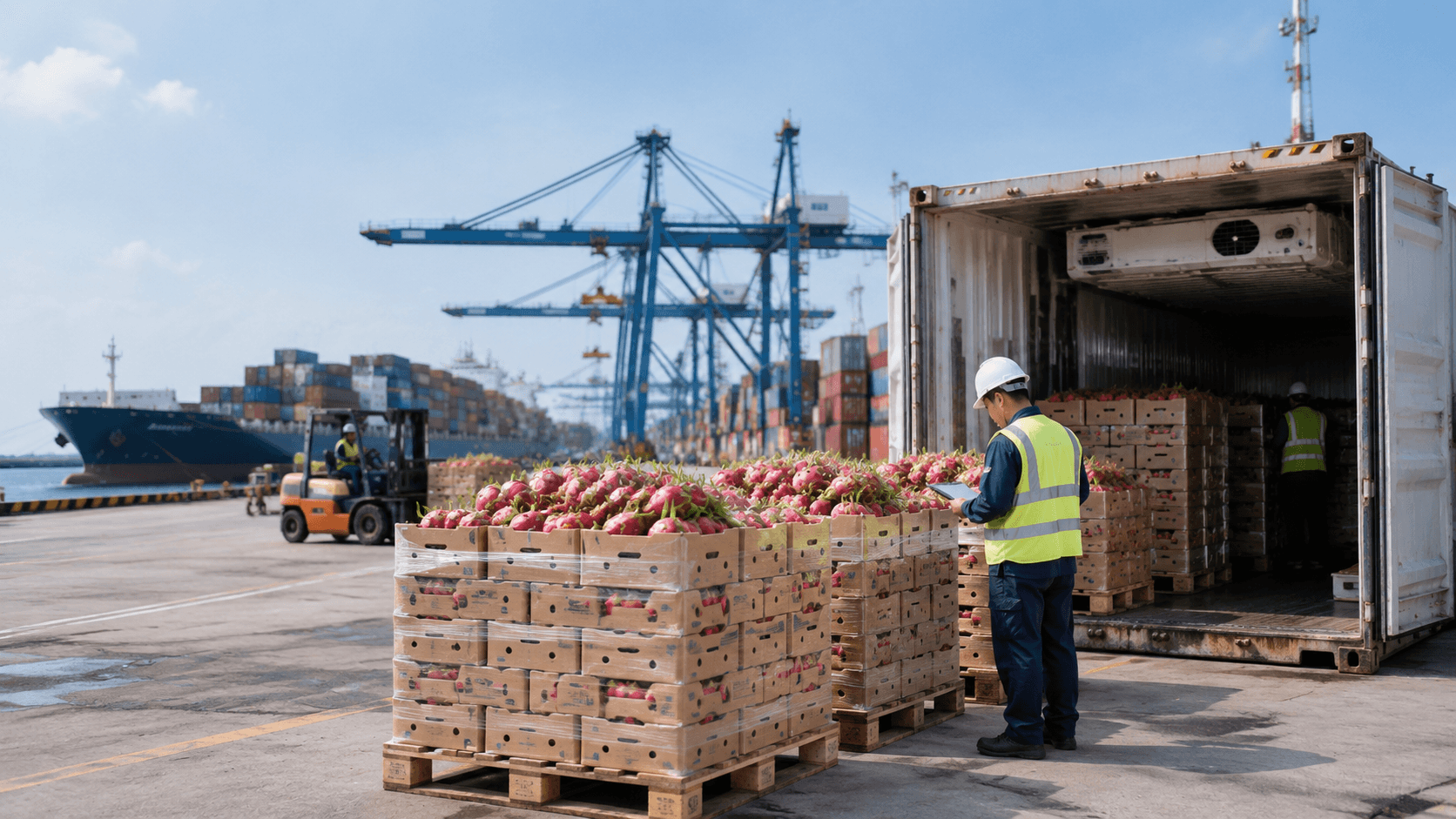
Determine the shipment volume, packaging specifications, and pickup location in HCMC to select the appropriate shipping option
During the transportation and customs clearance process for shipping dragon fruit to Shekou, businesses should determine the actual shipment weight, number of packages, weight per carton, packaging dimensions and loading warehouse address before requesting a quotation. A 12-tonne consignment packed in 5 kg cartons will have a different container loading configuration from a 24-tonne consignment packed in 10 kg cartons. In addition to weight, stacking height and ventilation between packages determine how effectively the refrigerated container's capacity can be used.
To optimise the cost and transit schedule for shipping dragon fruit to Shekou, the collection point in Ho Chi Minh City also has a direct impact on the overall cost. Warehouses in Binh Chanh, Hoc Mon, Cu Chi or areas near Cat Lai differ in transport distances, traffic conditions and waiting times. If dragon fruit is consolidated from growing areas outside Ho Chi Minh City, the upstream transport costs must be calculated separately before determining the total cost of delivery to the port. HNT Logistics needs to collect the actual address details to arrange a suitable tractor unit and the collection time for the empty container.
Door-to-door dragon fruit shipping to Shekou is only effective when the cargo weight is assessed alongside the container's payload capacity, road weight limits, pallet specifications and the consignee's requirements. Do not decide to use a 40-foot container solely because the cargo volume is large; for dragon fruit, maintaining cold airflow is even more important than filling the entire container.
Analyze post-harvest dragon fruit storage requirements to determine the refrigerated container, ventilation settings, and cargo loading plan
Dragon fruit belongs to the group of fresh fruits that are susceptible to water loss and an increased risk of deterioration when stored at unsuitable temperatures. According to the postharvest technical resources of the University of California, Davis, the recommended optimal storage temperature for common white-fleshed and red-fleshed dragon fruit varieties is approximately 10°C, relative humidity of approximately 85–90%. Some other varieties of dragon fruit have distinct physiological characteristics, so the same temperature settings cannot be applied.
A lower temperature does not necessarily mean better preservation. Some dragon fruit varieties may develop chilling injury at around 5–6°C, depending on ripeness, growing conditions and exposure time. Common symptoms include skin browning, softening of the flesh, wilting of the fruit scales and reduced sensory quality. Before confirming the set temperature, businesses should verify the variety, ripeness, fruit core temperature and the buyer's requirements.
Refrigerated containers must have unobstructed air supply and return paths. Fresh air vents should be adjusted in accordance with the technical instructions of the cargo owner and shipping line, as well as the product's respiration characteristics. They should not automatically be set fully open or completely closed for every shipment. Cartons must have suitable ventilation holes, the cargo stack must not exceed the load limit line, and the air distribution channels beneath the container floor must not be blocked.
Design the transportation flow from the growing region to HCMC, container delivery, vessel loading, arrival at Shekou Port, and final delivery in China
The transport route is designed around the following chain: an approved growing area or packing facility, a consolidation warehouse in Ho Chi Minh City, a depot for collecting empty containers, the loading location, the port of departure, sea freight, and Shekou Port in the Shenzhen area of China. After customs clearance at the destination port, the goods are transported onwards to the importer's warehouse or distribution centre in accordance with the agreed delivery terms.
For shipments exported via Cat Lai, HNT Logistics must check the actual receiving port specified in the booking, as not all shipments to Shekou use the same container discharge location or the same direct transport arrangements. If the shipping line designates a different terminal or transhipment port, the tractor unit arrangements, refrigerated container power supply, and cargo receiving deadlines must be adjusted accordingly.
For shipments collected from Long An, Tay Ninh or growing areas far from Ho Chi Minh City, a multimodal transport solution can combine refrigerated trucks to transport the goods to the packing facility with refrigerated container trucks to deliver them to the port. This arrangement helps centralise quality control, but is only effective when sufficient cold storage capacity, receiving schedules and compatible loading and unloading equipment are available.
Define the responsibilities of the shipper, logistics provider, shipping line, and consignee at each handover milestone
The responsibilities of each party must be determined by the sales contract and Incoterms 2026. Under FOB, the seller is generally responsible for delivering the goods on board the vessel at the port of loading in accordance with the contractual terms. Under CFR or CIF, the seller must also arrange and pay for ocean freight, while CIF additionally requires insurance coverage in accordance with the applicable level of obligation. Under FCA, CPT, CIP or DAP, the point at which risk transfers and the allocation of costs may be entirely different.
The shipper is responsible for the origin, quality and accuracy of the commercial documents. The logistics provider carries out the tasks agreed under the service contract, including transport coordination and related procedures. The shipping line is responsible for transportation within the scope of the contract of carriage, while the importer prepares the customs clearance arrangements and takes delivery of the goods in China.
Handover minutes The condition of the cargo, product temperature, container number, seal number, time of door closure, set temperature and photographs of the site should therefore be recorded. This is an important set of data for determining the cause if any disputes arise after the journey concerning product quality or delivery times.
Shipping Dragon Fruit to Shekou: Shipment Handling Procedures from Packaging to Vessel Loading
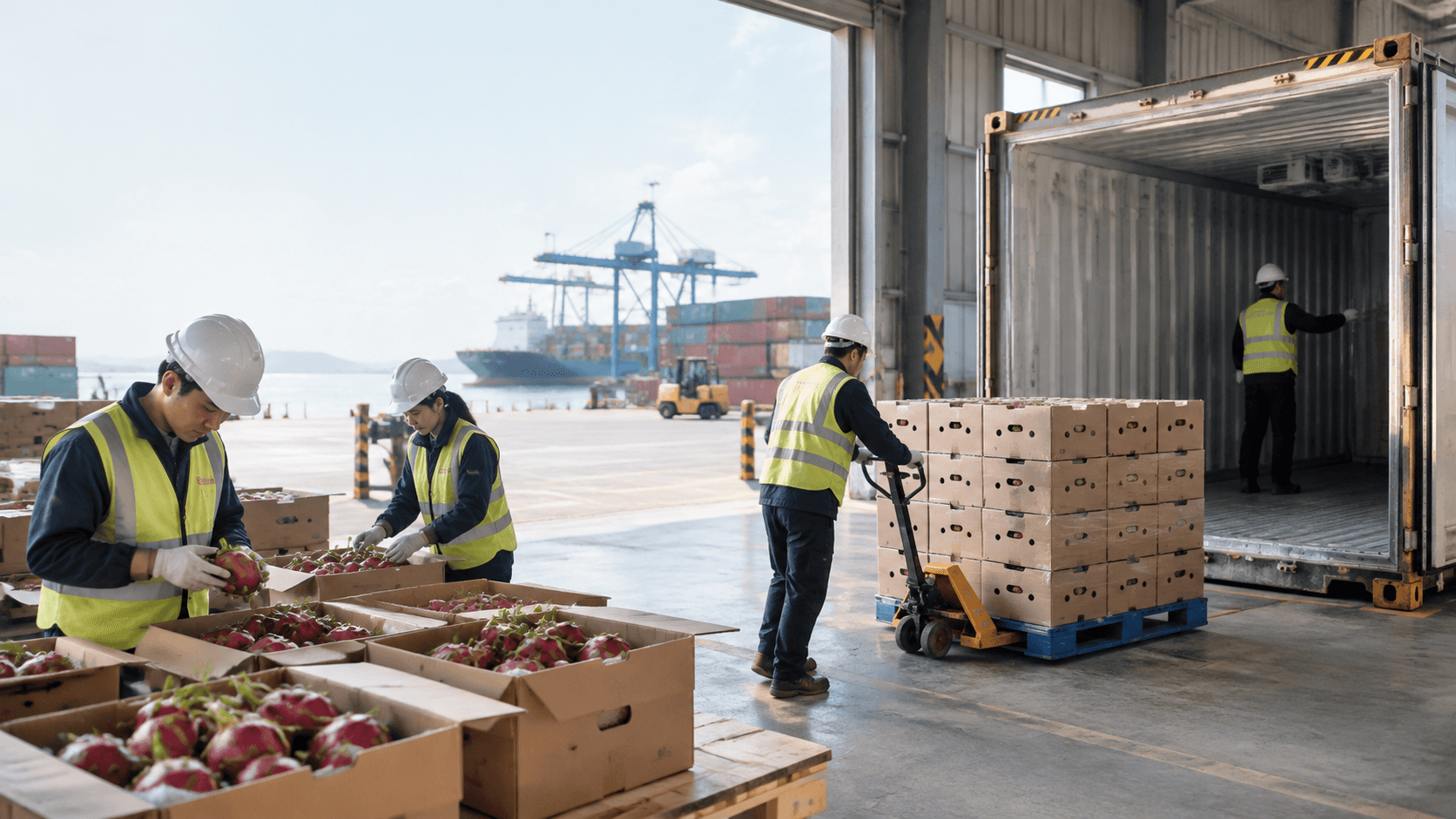
Inspect quality, sort the dragon fruit, and standardize packaging before introducing the cargo into the cold-chain logistics process
Export dragon fruit must be inspected at the packing facility, with particular attention to ripeness, size uniformity, mechanical damage, pests, mould and the condition of the fruit bracts. Any fruit that is cracked, bruised or shows signs of deterioration must be sorted out of the commercial consignment. Pre-selection not only ensures the quality of incoming produce but also helps prevent cross-contamination throughout transportation.
Packaging typically consists of corrugated cardboard boxes designed to withstand compression in high-humidity environments. Pack sizes of 5 kg or 10 kg per box are examples for planning loading arrangements, rather than mandatory requirements for every contract. The boxes must be suitable for the stacking method, protect the fruit skin and allow cold air to circulate through the ventilation holes.
Labelling and traceability information must be consistent with China's import requirements, including the origin, packing facility details, approved registration numbers and batch identification data in accordance with applicable regulations. Businesses must check the validity of registration numbers for growing areas and packing facilities before export, avoiding situations where container loading is completed but quarantine requirements are not met or the documentation is rejected by the importer.
Carry out pre-cooling, load the cargo, and arrange airflow inside the container to minimize hot spots during transportation
Pre-cooling is a separate process from container refrigeration. Refrigeration units in containers are primarily designed to maintain the temperature of cargo that has already reached the appropriate storage condition, rather than rapidly cooling a large volume of freshly harvested, warm fruit. Loading dragon fruit directly while its core temperature is high will prolong the cooling time, increase temperature variations between different areas, and reduce its commercial shelf life.
Before loading, the operating facility should check the temperature in several representative cartons. The choice of pre-cooling method, whether using a cold room or another suitable cooling solution, should be based on the actual equipment available and the characteristics of the product. During loading, the container doors should only remain open for as long as necessary. The loading environment should be protected from direct sunlight and rain, while preventing the ingress of hot, humid air.
For palletised loading, the total height of the pallet and cartons must be calculated, allowing for the clearance below the container's load line. For floor loading, the carton layers must form a stable block without obstructing the airflow channels. Do not fully enclose the entire pallet with stretch wrap unless the ventilation design has been validated, as this method of packing may result in uneven cooling between the outer layers and the centre of the cargo.
Coordinate phytosanitary inspection, customs declarations, and document completion before the container delivery cut-off
Dragon fruit exports to Shekou must comply with Vietnam's phytosanitary requirements and the applicable import conditions in China. On the sourcing side, the registration numbers of the growing areas and packing facilities must be checked against the list recognised by the Chinese authorities. It is also necessary to verify that each registration number is used by the correct entity for the correct product and remains valid at the time of export.
The standard operational documentation typically includes the commercial contract, commercial invoice, packing list, booking details, container data, export customs declaration and phytosanitary certificate, where required. The bill of lading is issued in accordance with the shipping line's procedures once the relevant requirements have been fulfilled. A Certificate of Origin (C/O), such as the appropriate form under a trade agreement, is only obtained when the shipment meets the rules of origin and the business wishes to benefit from preferential treatment or the trading partner requires it.
For customs declaration, businesses should review the HS code based on the actual nature of the goods. Fresh dragon fruit is generally considered under the dragon fruit category in Chapter 08, but the specific classification code must be verified against the applicable tariff schedule and the description of the goods currently in force. Net weight, gross weight, number of packages, value and buyer details must be consistent across the supporting documents and customs declaration.
Businesses should consult the regulations issued by the General Department of Vietnam Customs at https://www.customs.gov.vn and the phytosanitary guidance provided by the Department of Crop Production and Plant Protection at https://ppd.gov.vn. In particular, regulations on growing area codes and packing facilities have been adjusted in 2026. Businesses should cross-check Decree No. 38/2026/ND-CP and Resolution No. 36/2026/NQ-CP, together with the latest applicable guidance. A set of documents used for previous export seasons should not be reused without verification.
Control bookings, cut-off times, VGM, seals and container delivery schedules to the port to minimise the risk of missing the vessel.
The booking must clearly specify the port of loading, destination port of Shekou, container type, quantity, estimated time of departure (ETD), estimated time of arrival (ETA), empty container release location, container receiving terminal and all cut-off deadlines. For refrigerated cargo, confirm the availability of power supply at the container drop-off point and the technical requirements for the refrigeration equipment. The shipping schedule advertised on the carrier's website should not be treated as a substitute for the carrier's final confirmation.
Businesses must separately monitor the deadlines for delivering containers to the depot, submitting Shipping Instructions, declaring VGM, and meeting customs clearance or quarantine requirements. Under the International Maritime Organization's SOLAS regulations, the gross mass of a packed container must be verified using an approved method before it is loaded onto a vessel. VGM is not just the weight of the dragon fruit; it also includes the container's tare weight, the cargo and any associated securing materials.
The seal number must be recorded during loading and checked before handover. If the seal needs to be broken for customs inspection or quarantine, the opening and resealing process must be documented, and the relevant parties' records must be updated. A container that has entered the port gate but lacks a VGM declaration or does not yet meet the loading requirements may still be rolled over to a subsequent sailing.
Dragon Fruit Exports to Shekou: Cold Chain Management and Quality Risks on the Sea Route

Set temperature thresholds and ventilation conditions based on the condition of the cargo rather than applying a fixed configuration to every shipment
The storage configuration must be based on the dragon fruit variety, its ripeness at harvest, the actual temperature after pre-cooling, transit time and packaging method. The reference conditions of 10°C and 85–90% relative humidity are suitable for some common red-skinned, white-fleshed dragon fruit varieties, according to UC Davis postharvest guidelines. However, these conditions are not a technical guarantee for every consignment or variety.
The fresh air exchange rate in the container must be calculated according to the required gas exchange and the product's transport guidelines. Excessive ventilation in hot and humid external conditions may increase energy losses and the risk of condensation. Insufficient ventilation, on the other hand, may allow gases produced by respiration to accumulate. HNT Logistics should coordinate with the shipper and shipping line to confirm the vent settings before sealing the container.
When selecting temperature alarm ranges, it is important to distinguish between supply air temperature, return air temperature and the fruit core temperature. A brief fluctuation in the return air sensor reading does not prove that the temperature of the entire shipment has risen by the same amount. Conversely, a stable temperature displayed by the refrigeration unit does not guarantee that all cartons are being cooled evenly if the loading arrangement obstructs airflow.
Check the PTI, refrigeration unit condition, actual temperature and container data before handing it over to the shipping line
PTI, short for Pre-Trip Inspection, is an inspection of a refrigerated container's technical condition before a transport journey. The checks should cover the refrigeration equipment, power supply, sensors, container doors, rubber seals, drainage system and technical alarms. Shippers should request equipment in a suitable condition rather than checking only the exterior appearance of the container.
Before loading, the person in charge records the container number, the PTI status according to the supplied documentation, the set temperature, the ventilation opening and the actual operating condition. Once loading is complete, confirm that the doors are securely closed, the seal number is correct and the refrigeration unit is operating normally. If the container must be transported by road without being connected to a power supply, assess the power interruption period and the suitability of a container-mounted generator.
Temperature measurement should combine the container's sensors with an independent temperature data logger if the value of the cargo or the buyer's requirements call for a higher level of monitoring. Temperature data must be stored together with timestamps, sensor locations and batch codes so that it can be used when analysing the causes of damage.
Monitor temperature, location and key journey milestones from HCM to Shekou to detect potential risks to cargo quality at an early stage
After the container has been discharged at the port, its yard entry status, power supply connection, vessel loading status, actual ETD, updated schedule, ETA and discharge time at Shekou should be monitored. Shipment tracking data may be provided through the shipping line's tracking system or the monitoring platform specified in the contract.
The ability to monitor temperature remotely depends on the container type, shipping line and service package purchased. Not all refrigerated containers allow cargo owners to access continuous, real-time data. Businesses should confirm the scope of information provided, update frequency and procedures for handling alerts, particularly while containers are at transhipment ports.
HNT Logistics can organise a tracking table for each shipment reference, linking delivery and receipt milestones to documents and responsible contacts. This approach helps identify cases where vessels are rescheduled, containers have not been loaded or consignees have not prepared the necessary documents before additional costs arise.
Develop contingency plans for vessel schedule delays, transshipment, temperature alerts affecting containers, or extended cargo collection waiting times.
The major risks associated with fresh produce shipments are not limited to transit time at sea; they also include the total waiting time before and after the voyage. When the shipping line changes its schedule, it is necessary to check whether the container is still at the warehouse, has been delivered to the terminal yard or has already been loaded onto the vessel in order to select the appropriate solution. Each status entails different cost responsibilities and opportunities for technical intervention.
If a temperature-related alert occurs, the coordinating party should contact the shipping line or terminal to request an inspection in accordance with the relevant procedures, while retaining the alert log, time of detection and handling results. Do not change the temperature setting remotely without first identifying the cause and obtaining proper authorisation. In the event of a prolonged power outage, quality should be assessed in coordination with the relevant parties, taking into account the duration and actual conditions.
At Shekou, the importer must have all documentation and collection arrangements ready. Delays in paying local charges, missing permits or additional specialised inspections may cause the container to remain in the yard beyond the free time allowed. For dragon fruit shipments, quality deterioration and container storage charges may increase simultaneously, significantly reducing commercial profits.
Shipping Rates from Thanh Long to Shekou: Cost Breakdown, Containers and Transit Times
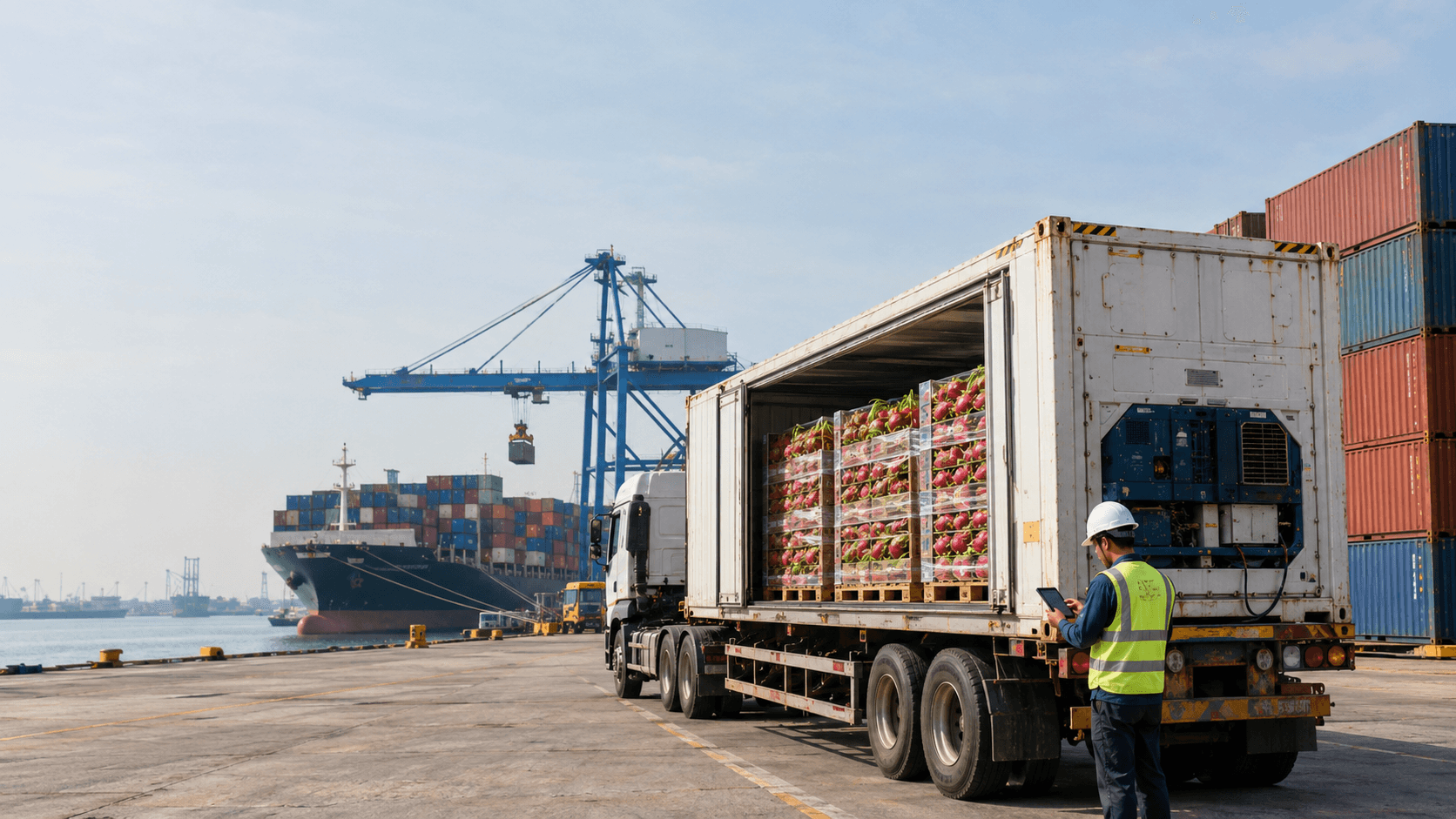
Breakdown of freight charges, including domestic transport in Ho Chi Minh City, refrigerated containers, port fees, documentation, customs declarations and international ocean freight
Dragon fruit shipping costs to Shekou must be determined based on the container type, collection location, loading date, shipping line and scope of services. Ocean freight is only one component of the total cost. A quotation with low ocean freight but high local surcharges or a short free storage period may result in higher overall costs than an alternative option.
The table below outlines the cost structure that should be requested when obtaining a quotation. Booking data and the tariff schedule effective on 16 October 2026 are not yet available to confirm specific market freight rates. Therefore, no assumed USD or VND unit prices are presented as actual quotations.
| Cost item | Common calculation method | Required confirmation content |
|---|---|---|
| Domestic transport in Ho Chi Minh City | VND per trip or container | Warehouse, depot and discharge port addresses, waiting time and road tolls |
| Collection and return of empty containers | VND per container | Designated depot, lift-on/lift-off fees, depot transfer if applicable |
| Reefer container and operation | By container, date or service | PTI, generator set, power connection at warehouse and port, included charges |
| THC and outbound port fees | By container type | THC, lift-on/lift-off and terminal surcharges per quotation |
| Transport document | By set or bill of lading | Documentation fee, SI, B/L issuance fee |
| Customs exporter | By declaration or batch | Service fee, customs inspection if applicable, government fees |
| Plant quarantine | By documents and operations | Fees, duties, sampling, additional handling if applicable |
| HCM – Shekou ocean freight | USD/container | 20RF or 40RH, direct or transshipment route, freight validity period |
| Carrier surcharges | By tariff and quotation | Bunker surcharge, peak season, reefer equipment and other charges if applicable |
| Charges at Shekou | USD or CNY/container | Import port charges, D/O, formalities, delivery and payer |
| Cargo insurance | By insured value and terms | Coverage for fresh goods, temperature fluctuation and exclusions |
To compare quotes accurately, businesses should request two options with the same trade terms, the same scope of origin and destination charges, the same destination and the same equipment type. Charges not included must be shown separately. HNT Logistics can prepare a door-to-port or door-to-door quotation based on the agreed service scope.
Comparison table of 20-foot and 40-foot reefer containers by dragon fruit volume, utilization capacity, and cost efficiency
20-foot and 40-foot High Cube reefer containers differ significantly in volume, but maximum cargo payload does not increase in proportion to volume. For dragon fruit, the container choice must be based on actual weight, number of cartons, pallet layout, the permitted load on the route and airflow conditions during transit.
| Parameters | 20-foot reefer container (20RF) | 40-foot High Cube reefer container (40RH) |
|---|---|---|
| Reference external dimensions | 6,058 × 2,438 × 2,591 mm | 12,192 × 2,438 × 2,896 mm |
| Reference internal dimensions | 5,456 × 2,294 × 2,273 mm | 11,584 × 2,294 × 2,557 mm |
| Nominal capacity | 28.6 m³ | 68 m³ |
| Usable volume below the load line | Approximately 27.3 m³ | Approximately 65.3 m³ |
| Reference tare weight | 3,010 kg | 4,740 kg |
| Reference technical payload | 27,470 kg | 29,260 kg |
| Cargo groups to consider | Small to medium shipments; check actual stowage capacity | Shipments with many cartons or pallets; volume efficiency is the priority |
| Points to note | Limited volume; cost per kg may be high for small volumes | Good use of volume, but must not exceed the weight limit |
Reference specifications based on CMA CGM's reefer container technical documentation at https://cmacgm-group.com/en/activities/shipping-everything/reefer/technical-specifications. Dimensions and payload vary by equipment model. The maximum weight in the table does not mean the actual dragon fruit weight that can be loaded, because pallets, packaging, dunnage and road transport limits must also be deducted.
For example, with 18 tonnes of dragon fruit, businesses can compare costs between the two container types based on a checked loading plan. If the total cost of the 20RF option is lower but does not provide a safe volume, that option is not feasible. If a 40RH is used for a cargo quantity that fills only part of the container, a suitable load-securing plan and airflow distribution must be in place; cargo should not be stacked unevenly or left unstable.
Table of milestones from container pickup, cargo loading, quarantine inspection, terminal gate-in, and cut-off to the sailing schedule to Shekou
Transit time for dragon fruit from Ho Chi Minh City to Shekou depends on whether the service is direct or transshipped, waiting time for connecting vessels, the loading port and congestion levels. For preliminary planning, businesses may use an operational assumption of roughly 2–5 days at sea for a suitable direct service, and it can be considerably longer if transshipment is required. This is not a verified sailing schedule or a committed transit time.
| Work milestones | Illustrative planning timeline | Control conditions |
|---|---|---|
| Confirm booking and equipment plan | About 5–7 days before ETD or earlier | Shipping line confirmation, reefer type and discharge port |
| Check cargo source and documents | Before the cargo loading date | Verify growing area code, packing facility and import requirements |
| Pick up empty container | Per empty release order and permitted validity period | PTI, equipment condition, pick-up location |
| Pre-cooling and cargo loading | Before cut-off, according to the actual plan | Product temperature, packing, seal, photos |
| Quarantine and declaration | Completed by the applicable deadline | Documents and processing results from the competent authority |
| Container drop-off at port | Before the shipping line's CY cut-off | Container accepted and with suitable power supply |
| Submit SI and VGM | Before each separate deadline | Accurate data accepted by the system |
| ETD at Ho Chi Minh City | According to confirmed booking | On-board check or loading status |
| Shekou ETA | According to shipping line updates | Track schedule changes and prepare for cargo receipt |
| Customs clearance and delivery in China | Depends on procedures and appointment schedule | Complete documents, refrigerated transport and payment of charges |
The 5–7 day milestone before ETD should not be understood as a mandatory requirement for every shipping line. Some sailings have shorter acceptance deadlines or require documents earlier. When preparing an actual quotation, HNT Logistics needs at least the ETD, ETA, CY cut-off, SI cut-off, VGM cut-off, container pick-up location and transshipment information, if any.
Table identifying additional costs arising from container detention, terminal storage, booking changes, rolled cargo, customs inspection, or extended customs clearance time
Additional costs often arise when businesses only track vessel sailing dates without monitoring the container and terminal free time. Demurrage, detention and storage may be charged under different rules depending on the shipping line, port and contract. The start date for charges, the number of free days and the progressive tariff must be confirmed precisely.
| Risk | Potential costs | Control measure |
|---|---|---|
| Empty pick-up too early | Equipment usage fee beyond the free period under applicable conditions | Synchronise empty pick-up date with the packing schedule |
| Early yard drop-off or delayed receipt | Storage, power supply and container storage charges | Control free time and delivery schedule |
| Missing ship | Booking changes, yard storage, power connection, extended operations | Prepare documents before each deadline |
| Change booking or cancel sailing | Booking amendment, cancellation or no-show fees if applicable | Check terms before confirming space |
| Customs inspection | Lifting, labour, seal opening and closing, truck waiting | Accurate documents and proactive inspection schedule |
| Reefer container alert | Technical inspection, power consumption and handling costs | Keep PTI records, alert monitoring and response procedures |
| Prolonged import clearance | Container storage, yard storage, cold-chain costs and quality deterioration | Receiving party prepares documents and vehicles in advance |
For fresh goods, potential commercial losses beyond the logistics invoice must also be counted. For example, a 20,000 kg dragon fruit shipment with an extra 2% commercial loss will lose the equivalent of 400 kg of saleable product, not counting price reductions caused by uneven quality. Therefore, a plan that saves a small amount of ocean freight but increases the risk of late delivery does not necessarily bring a benefit.
Dragon Fruit Transportation to Shekou: Optimize Freight Rates Based on Volume, Vessel Schedules, and Total Shipment Costs
Calculate total logistics costs instead of comparing only the quoted ocean freight rates across shipping options
To assess the option shipping dragon fruit to Shekou, businesses should build a total cost model for each container. The management formula can be: total logistics cost equals upstream transport, pre-processing and cold storage costs within scope, container haulage, port charges, documentation, quarantine, customs, ocean freight, surcharges, insurance, destination charges according to the trade terms, and contingency for additional costs.
Cost per kg of commercial cargo is calculated as total allocated cost divided by the actual volume eligible for sale, or the volume based on the defined management target. Distinguish between cost per kg shipped and cost per kg sold at destination, because loss rates can significantly change the result.
Purely illustrative example: if the total logistics cost of a 20,000 kg shipment is VND 60 million, the average cost before losses is VND 3,000 per kg. If only 19,600 kg meets commercial standards, the corresponding cost rises to about VND 3,061 per kg. This is a hypothetical management calculation, not a quotation or actual freight rate for the Shekou route.
Choose the appropriate booking time and vessel schedule to balance transportation costs, transit time, and cargo freshness
Booking too late may leave businesses short of reefer containers, especially during the peak fruit export season. However, locking in containers too early, before cargo is ready, also creates equipment storage pressure. A reasonable approach is to forecast volumes according to the harvest schedule, confirm packing capacity and reserve space when the cargo is ready for export.
When comparing vessel schedules, besides ETD and ETA, check the number of transshipments, transshipment ports, connection waiting time and service reliability. A route with an early expected ETA but frequent schedule changes creates risk if the buyer needs dragon fruit at a specific distribution time or under a short-term delivery contract.
Dragon fruit shipping providers to Shekou should present at least two suitable scenarios: a time-priority option and a total-cost-priority option. Route confirmation must be based on a valid booking schedule, not on an old sailing schedule or an indicative rate without an expiry date.
Optimize cargo loading capacity, packing volume, and reefer container turnaround to reduce costs per unit of product
Optimising containers does not mean packing as much as possible. For carton-packed dragon fruit, the weight limit may not be reached while the usable volume is already full. Conversely, with heavy packaging or wooden pallets, the permitted payload may become the limiting factor. Volume, weight, carton compression strength and airflow clearance for cold air circulation must all be calculated together.
Before delivery, businesses should prepare an actual loading plan based on carton dimensions, number of layers, pallet size and weight of each package. This plan helps verify the number of units that can be loaded, avoids requests for extra vehicles at the last minute, and prevents cargo being removed when the container does not meet transport limits.
Container turnaround is also affected by packing time at the warehouse, specialist inspections, waiting for port entry, ocean transport and receipt at destination. Shortening unnecessary waiting steps helps businesses control equipment costs and maintain cold-chain stability, but must not reduce the time needed for pre-cooling or quality inspection.
Prepare contingency plans for sailing schedule changes to minimize demurrage costs and dragon fruit quality losses
A contingency plan should be prepared from the time of booking. If the vessel is delayed before loading, the harvest schedule can be adjusted or the product kept in suitable cold storage. If the container has already been packed and lifted onto the vessel, the choice depends on power connection availability, customs status, yard storage time and the shipping line's plan to move the container to the next sailing.
Containers should not be automatically transferred to another service without checking the shipping line change fee, port cargo release procedures, documentation status and ability to return the equipment. A change that appears to shorten the journey may incur port transfer costs, container re-inspection or amendments to the bill of lading.
Regular exporters can set warning thresholds based on hours of delay, remaining storage days and the maximum additional cost allowed. When a threshold is exceeded, the export team, logistics provider and buyer need an agreed mechanism to decide, instead of leaving the container waiting without a specific commercial plan.
HNT Logistics' Comprehensive Dragon Fruit Shipping Services to Shekou
Coordinate dragon fruit transportation from the pickup point in HCM to the port, combining reefer containers with international sea freight
HNT Logistics provides coordination capability for cargo handover, container transport and import-export procedures, suitable for businesses that need a single point of contact for a dragon fruit shipment to Shekou. Based on pick-up warehouse details, volumes and expected delivery dates, HNT can advise on the truck arrangement, reefer container type and ocean transport connection plan according to confirmed service terms.
For shipments exported through Cat Lai, synchronising container pick-up schedules, vehicle arrangement, packing and yard drop-off reduces the risk of trucks waiting or containers arriving at port after the deadline. For cargo gathered outside Ho Chi Minh City, businesses can also discuss domestic transport connection options and upstream temperature control.
The objective of dragon fruit shipping service to Shekou is to coordinate operational milestones consistently, rather than selling a single standalone ocean freight leg. The scope of work, reefer equipment provider, insurance conditions and monitoring responsibilities must be stated in the quotation, booking and contract.
Support customs declarations, phytosanitary inspections, and documentation control for dragon fruit exports to Shekou
HNT Logistics can support businesses in reviewing the export document set and coordinating customs declaration and quarantine procedures within the scope of service. This work should start at the cargo sourcing stage to detect discrepancies between the invoice, packing list, growing area code, packing facility code and booking data.
Businesses must comply with requirements from quarantine authorities and from China for fresh fruit. The guidance of the Plant Protection Department at https://ppd.gov.vn, along with information on the list of eligible facilities, should be checked before packing. Issuing certificates or quarantine conclusions falls under the authority of competent agencies and is not a result that a freight forwarder can guarantee.
For international ocean transport rules, the SOLAS verified gross mass (VGM) principle must be applied before loading. Businesses can refer to the IMO VGM guidance at https://www.imo.org/en/mediacentre/hottopics/pages/container-default.aspx. Parallel control of customs declaration data, VGM and bill of lading reduces discrepancies and the risk of correcting documents at the last minute before sailing.
Advise on freight options and sailing schedules based on shipment volume, delivery timelines, storage conditions, and the requirements of Chinese partners
For each dragon fruit export request to Shekou, HNT Logistics needs to confirm the volume in tonnes, expected number of containers, type of dragon fruit, pick-up point, packing specifications and the date the cargo will be ready. This information is the basis for asking the shipping line to confirm equipment, ETD and ETA schedules, transit time and relevant free time limits.
For regular exporters, space booking can be evaluated weekly or according to the seasonal plan, depending on committed volumes and shipping line policy. If the buyer requires delivery to a warehouse in Shenzhen, the quotation must also consider destination charges and domestic transport in China rather than stopping at port-to-port freight.
A good advisory proposal clearly states what is included, what is not included, the payment currency, validity period, responsibility for charges at Shekou and conditions for schedule changes. These details help the sales team accurately calculate the export selling price and assess its ability to meet the contract.
HNT Logistics supports the management of schedules, costs, and cargo safety throughout the entire HCM–Shekou journey
The value of a logistics provider is most evident when several steps happen at the same time: the warehouse prepares packing, the shipping line adjusts cut-off, the quarantine agency completes procedures and the port receives the reefer container. HNT Logistics can act as the consolidated point of contact so the shipper can monitor progress and handle changes within the agreed scope of responsibility.
Businesses should request reports on key milestones including container pick-up date, packing completion, seal, customs clearance, port entry, loading onto the vessel, updated ETA and delivery status at destination. In addition, technical container records, temperature data, handover documents and incident reports should be kept for review after the shipment.
Efficient dragon fruit shipping to Shekou is a combined problem of cost, cold chain and document readiness. A properly designed transport route helps reduce waiting time, control the risk of damage and improve the ability to deliver in line with commercial commitments. Businesses should not choose a provider based on a single ocean freight figure without the operating conditions attached.
If you are preparing a dragon fruit export shipment from Ho Chi Minh City to Shekou, you can contact HNT Logistics for advice on the reefer container plan, checking available vessel schedules, reviewing export procedures and receiving a quotation based on your actual information. Please provide volume, packing location, carton specifications, expected shipping date and delivery terms so that the freight calculation is more accurate.
HNT Logistics contact information: Website https://hntshipping.com.vn; consultation request page https://hntshipping.com.vn/lien-he/; hotline 0911.446.060 or 0949.393.300. HNT Logistics aims to provide transport solutions suited to the characteristics of fresh goods, transparent cost scope and close coordination from Ho Chi Minh City to Shekou.