

An export shipment of dragon fruit can incur significant additional costs if the refrigerated container arrives at the loading point too early, phytosanitary documents are not yet complete, or the vessel schedule changes after the cargo has been delivered to the port. For businesses exporting dragon fruit to Thailand from Ho Chi Minh City, the logistics challenge involves more than transportation rates. It also requires preserving fruit quality, managing timelines, and coordinating import and export procedures.
When exploring dragon fruit exports to Thailand, it is important to recognize that dragon fruit is a fresh product susceptible to moisture loss, mechanical damage, and quality deterioration when storage conditions are unsuitable. Choosing sea freight, road transport, or a multimodal solution depends on shipment volume, the delivery location in Thailand, the remaining shelf life, and the importer's requirements. An effective transportation plan must be developed from the initial shipment preparation stage.
For dragon fruit export solutions to Thailand, HNT Logistics draws on its experience in refrigerated container transportation, international freight forwarding, and import-export procedures to provide coordinated solutions from loading points in the Ho Chi Minh City area to ports or delivery locations in Thailand. This article examines the operational process, storage specifications, cost components, and critical control points to help businesses plan their exports proactively.
Ensuring Cargo Safety When Exporting Dragon Fruit to Thailand
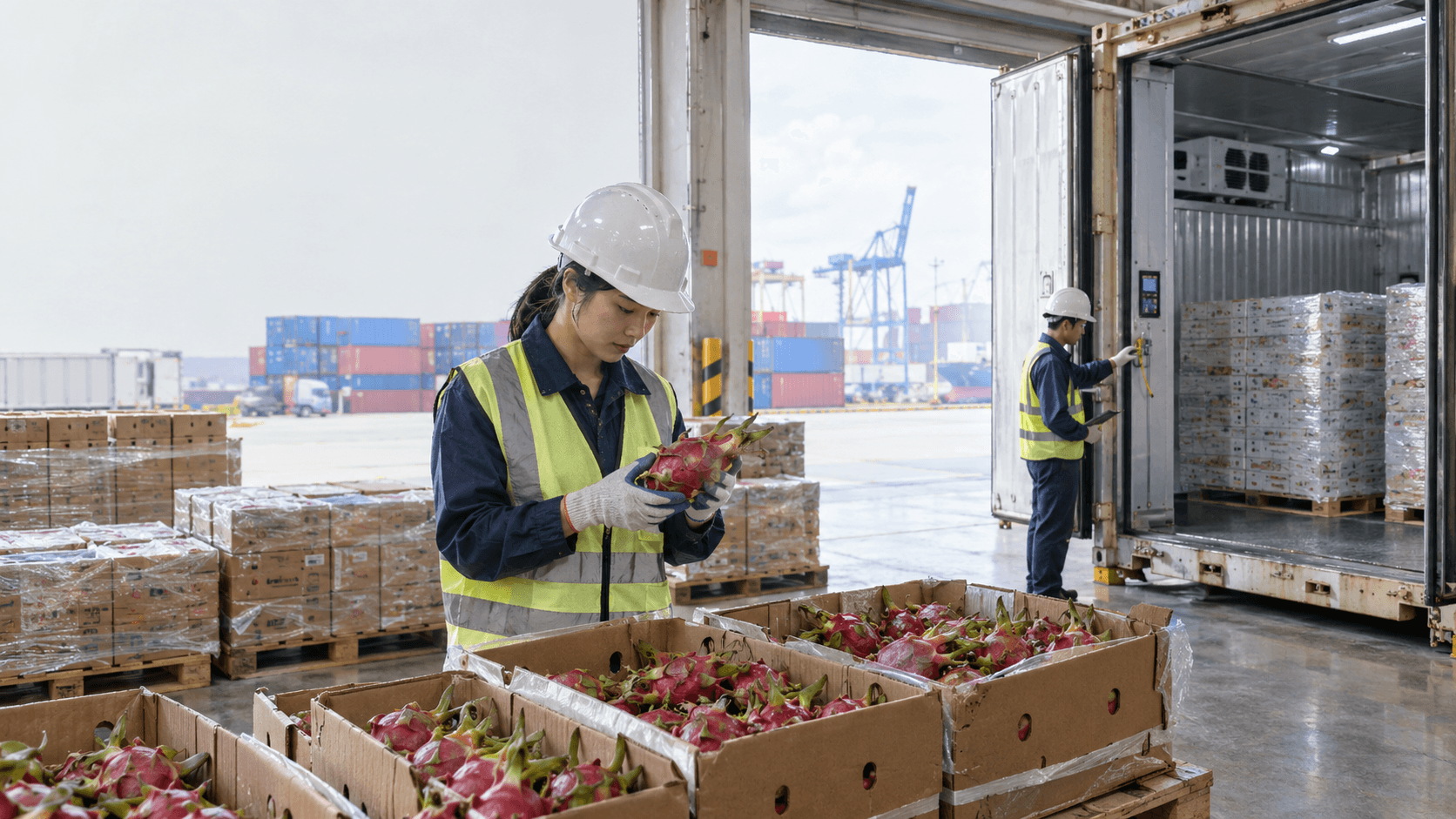
Throughout the transportation and export customs clearance process for dragon fruit shipments to Thailand, cargo safety must be managed through specific control points, from post-harvest handling until the buyer receives the goods. Maintaining the refrigerated container at its set temperature does not guarantee that all the fruit inside remains in good condition if it was bruised, dehydrated, or infected before loading.
Establish quality control checkpoints from post-harvest handling and packaging to container loading
To optimize costs and timelines for dragon fruit exports to Thailand, the first control point is the harvesting stage and receipt at the packing facility. Dragon fruit should be inspected for ripeness, bract appearance, scratches, and signs of pests or disease. Substandard fruit must be separated to prevent increased contamination risks or deterioration in the overall quality of the shipment.
Based on HNT Logistics' practical operational experience with dragon fruit exports to Thailand, quality control personnel should check net weight, uniformity, cleanliness, and packaging strength during sorting and packing. Before loading the goods into the container, they must verify the actual product temperature and pallet condition. Inspection records should be linked to batch codes to facilitate traceability in the event of a claim.
Verify container condition, temperature settings, seal, and handover documents before transportation
When arranging dragon fruit exports to Thailand, the handover record must match the container number against the booking and transport documents. The seal number must be recorded accurately, with photographs taken when operational conditions permit. If a security seal is used, its type, integrity, and sealing procedure must be checked in accordance with the requirements of the shipping line or receiving party.
For dragon fruit export solutions to Thailand, the handover personnel must clearly record the reefer setpoint, machinery status, ventilation settings, operating start time, and relevant temperature data. If any parameters change after loading, the decision and approving party must be documented. This helps minimize disputes when operating data does not match the original instructions.
Identify risks affecting dragon fruit quality, including temperature fluctuations, bruising, moisture loss, and prolonged transit times
During transportation and export customs clearance for dragon fruit shipments to Thailand, temperature fluctuations can accelerate quality deterioration, especially when the fruit has not been adequately precooled. Conversely, excessively low temperatures can cause chilling injury, manifested by color changes, softening of the flesh, or deterioration in sensory quality. Temperature control must therefore account for the variety and ripeness of the fruit rather than applying one standard cooling level to all fruit types.
To optimize costs and timelines for dragon fruit exports to Thailand, bruising risks are often associated with cargo handling, insufficiently durable cartons, or improper stacking. Moisture loss reduces fruit weight, causes the bracts to wilt, and diminishes commercial value. According to UC Davis postharvest guidance, dragon fruit is notably susceptible to moisture loss, making it essential to combine appropriate temperature and humidity control with suitable packaging.
Based on HNT Logistics' practical operational experience with dragon fruit exports to Thailand, extended transit times also place pressure on distribution operations in Thailand. Even when the shipment meets phytosanitary requirements, buyers may face difficulties if the remaining sales window is too short. Risk assessments should consider the likelihood of acceptance and sale, rather than relying solely on the container's condition upon arrival at the port.
Establish a coordinated incident response mechanism among the cargo owner, transportation provider, and receiving partner
When arranging dragon fruit exports to Thailand, the parties must identify the person responsible for handling incidents and define decision-making authority. The cargo owner or its authorized representative decides on the commercial response; the logistics provider coordinates with the shipping line, port, and carrier; and the receiving party arranges inspections, continued storage, and feedback on the actual condition of the goods at the destination.
The response process should begin by recording the time and signs of the abnormality, verifying the data, notifying the parties, evaluating solutions, and retaining written records. If an independent inspection is required, it should be conducted before the goods are destroyed, sold at a discount, or reprocessed, except when urgent action is required by a competent authority or necessary to ensure safety.
Claims procedures, deadlines for reporting damage, and compensation conditions must be determined according to the transport contract, commercial contract, and insurance policy, if applicable. A logistics provider is not automatically liable for all quality-related losses, just as temperature data does not automatically absolve any party of responsibility without a comprehensive assessment of the causes.
HNT Logistics' Comprehensive Dragon Fruit Transportation Services to Thailand
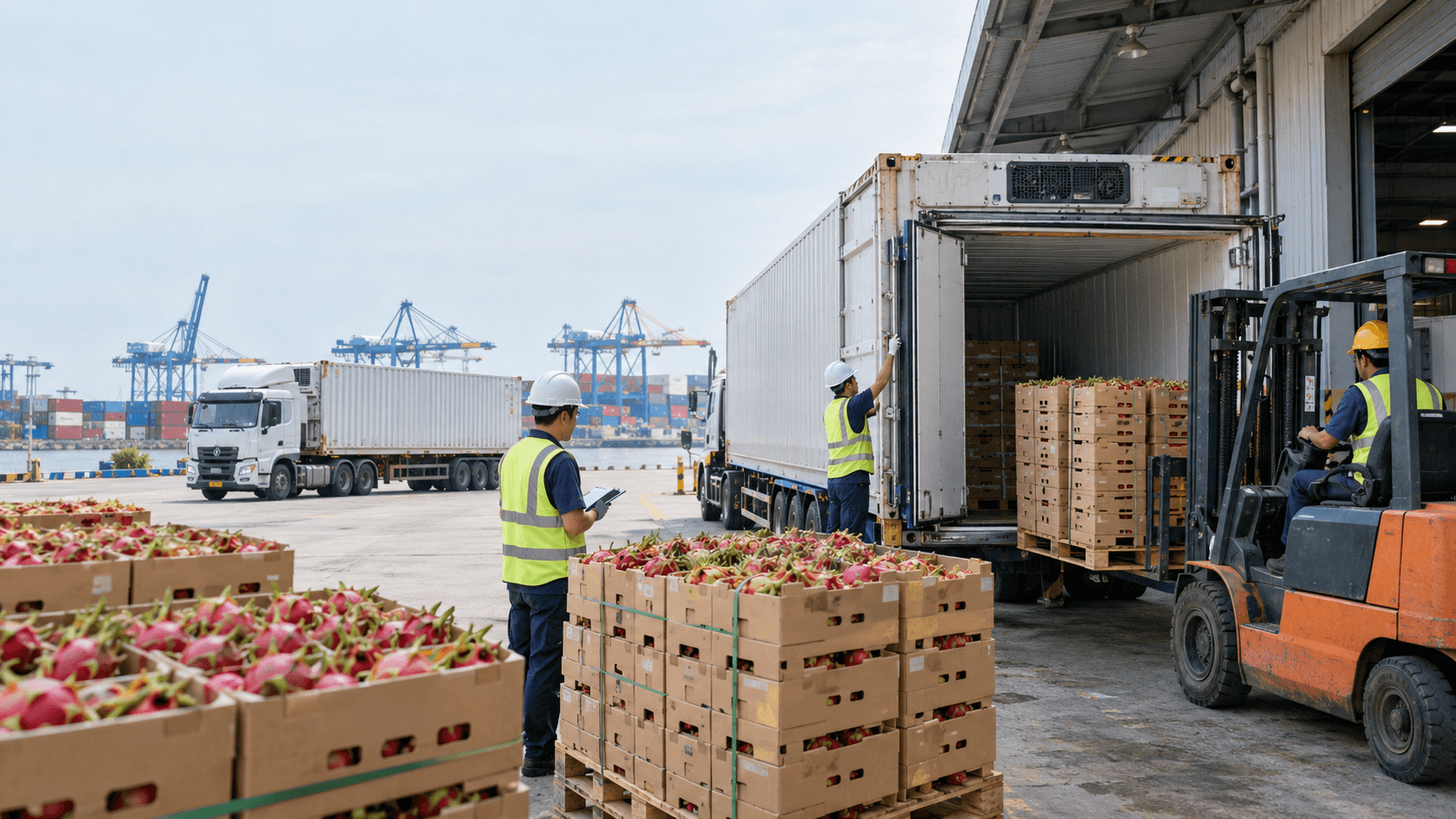
HNT Logistics operates in international freight forwarding, refrigerated container transportation, and import-export procedural support. According to the services published at https://hntshipping.com.vn/dich-vu/, the company has experience providing transportation services for exported fruit, including routes serving Asian markets and Thailand. The specific scope of services for each shipment is confirmed during consultation and quotation.
Combine domestic transportation in Ho Chi Minh City, refrigerated containers, international freight, and delivery coordination under one integrated plan
For cargo owners shipping from Ho Chi Minh City, HNT Logistics can advise on coordinating container pickup, domestic transportation, international route bookings, and delivery arrangements according to contractual requirements. The benefit of unified management is that it reduces the risk of individual parties optimizing their own stages without controlling the time or cost of the entire journey.
During implementation, information on cargo volume, container type, storage temperature, loading schedule, and destination port should be consolidated into a single coordination plan. Responsibilities performed directly or through partners must be clearly defined. This is particularly important when the service involves tractor-trailers, shipping lines, and agents in Thailand.
Coordinate customs declarations, phytosanitary inspections, and export documentation to reduce bottlenecks in shipment processing
HNT Logistics can assist cargo owners in reviewing documentation and coordinating customs declaration relevant specialized procedures within the agreed service scope. Coordination should begin before the shipping date to identify discrepancies in commercial information, commodity codes, quantities, and phytosanitary documents at an early stage.
For phytosanitary certificates or certificates of origin, issuance authority belongs to the agencies or organizations designated by law. The logistics provider advises on, prepares, and coordinates documentation under valid authorization without replacing the issuing authority. Specific requirements imposed by Thailand must be confirmed before procedures begin.
Tailor dragon fruit transportation to Thailand according to shipment volume, delivery deadlines, and actual storage requirements
Every business has a different export model. A packing facility shipping containers on a regular schedule requires a different booking and coordination plan from a business exporting dragon fruit to Thailand for the first time. HNT Logistics can develop a suitable solution based on shipment volume, carton specifications, receiving location, and delivery schedule before providing a quotation.
For requests for comprehensive dragon fruit transportation to Thailand, the scope must clearly specify packaging, precooling, container provision, domestic haulage, booking, port charges, export procedures, international transportation, and delivery in the destination country. Only items confirmed in the quotation or contract are considered part of the service scope.
HNT Logistics can also coordinate comparisons of options based on cost per container, cost per kilogram, and estimated arrival time. These comparisons should account for potential additional charges, refrigerated equipment conditions, and the remaining sales window. This provides a basis for businesses to select an option that suits their actual commercial objectives.
HNT Logistics helps manage costs, timelines, and cargo safety throughout the journey from Ho Chi Minh City to Thailand
The value of logistics services for fresh dragon fruit lies in their ability to connect individual stages into a controllable process. When shipment information is standardized from the outset, businesses can better manage container selection, document preparation, loading schedules, and additional costs.
HNT Logistics provides freight forwarding and refrigerated container transportation solutions based on cargo characteristics and each customer's requirements. For dragon fruit export shipments, businesses should provide the expected volume, dragon fruit variety, loading location, port or receiving location in Thailand, desired delivery date, and trade terms in advance to receive accurate advice.
Efficient dragon fruit exports to Thailand involve more than delivering a container to the correct port. They also require a suitable transportation plan, compliant documentation, and cost control from the outset. To arrange transportation from Ho Chi Minh City and receive a quotation based on the actual shipment, businesses can contact HNT Logistics – Hotline: 096 309 78 19, email marketing@hntshipping.com. Head office: 8A Hoang Minh Giam Street, Ho Chi Minh City, Vietnam.