


For an FCL shipment, a few centimeters of error at the container door or confusion between technical load capacity and the permitted operating load on a route can lead to container replacement, re-yard handling, second lifting operations, or missing the cut-off. Therefore, choosing 20 feet container is not simply about reading a dimension table; businesses need to simultaneously check package specifications, actual weight, tractor-trailer arrangement, port conditions and vessel loading plans.
This article uses representative specifications of standard 20 feet and 40 feet dry containers from major shipping lines for initial calculations. Actual measurements may vary depending on manufacturer, year of manufacture, floor type and equipment provided by the shipping line. HNT Logistics recommends always cross-checking the CSC plate, tare weight, max gross, container number and booking before stuffing; especially for heavy cargo, machinery, pallets close to the door or shipments requiring inspection.
What Is a 20 Feet Container? Structure And Role In Sea Freight Transportation
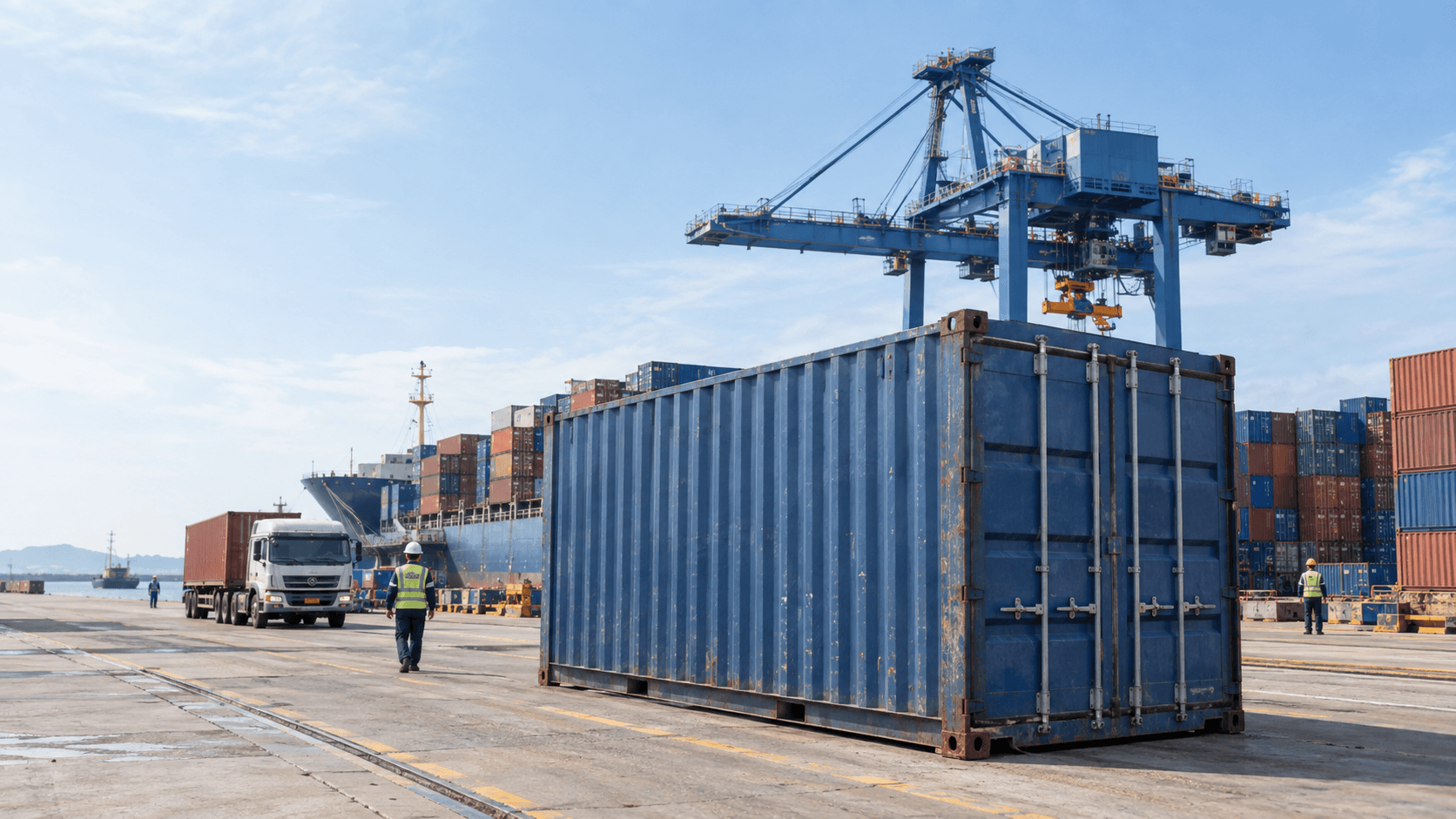
Standard 20 feet container and how to identify by container size code
20-foot container standard, commonly called 20GP or 20DV, is a dry container with a nominal length of 20 feet, width of 8 feet and height of 8 feet 6 inches. A 20 feet container equals 1 TEU, a common conversion unit when referring to container ship capacity and port throughput. With standard configuration, the commonly used ISO size/type code is 22G1; Hapag-Lloyd publishes 22GP group and 22G1 code for standard 20 feet dry containers.
When receiving empty equipment at a depot or container yard, do not only look at the “20’” marking on the container body. Field staff need to check the container number, owner code, equipment type, CSC plate and tare weight printed on the door. Two containers that are both 20 feet may differ in tare weight by several tens to over one hundred kilograms, differ in door height or floor structure; these small differences become important when cargo approaches load or door size limits.
Floor, wall, door structure and points to inspect before stuffing cargo
A standard dry container consists of a load-bearing steel frame, corner castings at four corners, corrugated steel walls, roof, double doors, watertight seals and a floor usually made of specialized plywood or equivalent materials. The floor handles concentrated loads well, but this does not mean every point can receive the same force. For machinery or steel coils, contact area, load distribution dunnage and lashing positions must be calculated instead of only checking total tons.
Before stuffing cargo, observe from inside the container with the doors closed to detect holes, check odors, oil, chemical residues, floor dryness, door seals, hinges, locking bars and lashing points. For food, agricultural products or moisture-sensitive packaging, a damp container and dirty floor can create greater risks than an external dent. The container must be suitable for the cargo characteristics, not merely “still usable”.
Which cargo groups are suitable for 20 feet containers in sea FCL transportation
In FCL transportation, 20 feet containers are often suitable for high-density cargo or volumes insufficient to utilize a 40 feet container, such as bagged rice, raw materials, plastic pellets, certain metals, small machinery, spare parts, non-specialized chemicals and heavy palletized goods. HNT usually evaluates tons per CBM ratio first because heavy cargo may reach weight limits before filling the volume.
Dry containers do not have active temperature maintenance systems. If cargo requires temperature control, it must be moved to reefer containers and the setpoint established according to each product. Referencing shipping line equipment, standard 20 feet reefers often can control approximately -30°C to +30°C, but set temperature, ventilation and humidity must follow cargo requirements. For exported fruits, cold specifications must also comply with quarantine conditions and destination market requirements.
Relationship between 20 feet containers, container ships, container ports and container yards
A 20 feet container is the physical unit moving throughout the logistics chain: the depot provides empty equipment, tractors transport it to the warehouse for stuffing, the container is delivered to the container yard, accepted by the port according to booking and then loaded onto container ships. Each transfer point has its own timing, conditions and costs. A good stuffing plan that does not match yard closing time or cut-off can still miss the voyage.
This is also why businesses should view the journey under a model multimodal transportation instead of separating road and sea transportation. For shipments from factories to container ports, HNT Logistics coordinates empty pickup schedules, trucking, stuffing, declarations, yard delivery and vessel booking under one shared timeline. This approach reduces responsibility gaps between warehouses, trucking teams, forwarders, ports and shipping lines.
Actual Operating Dimensions of 20 Feet Containers According to Standards
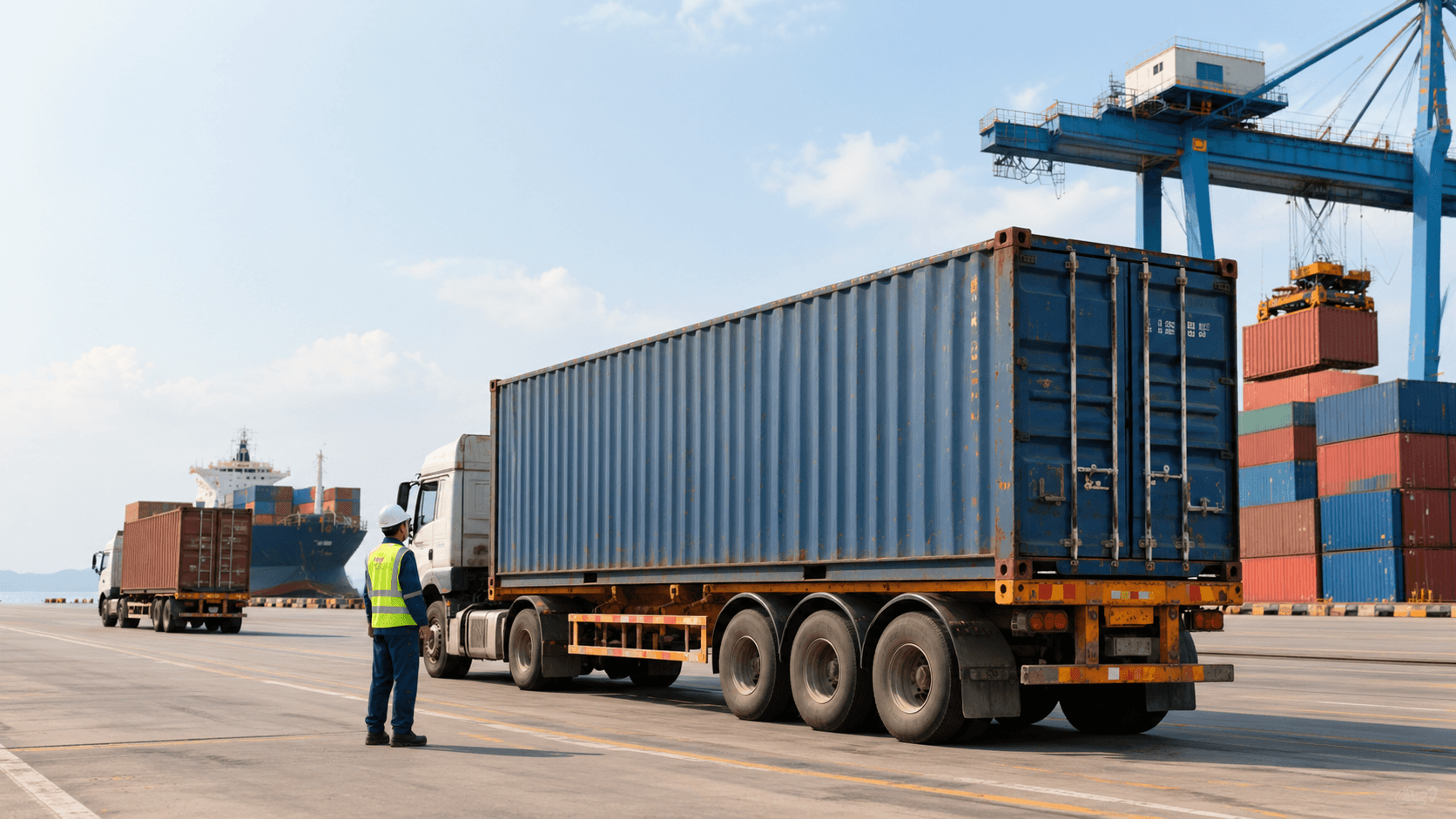
External dimensions, internal dimensions, door height and usable volume of 20 feet containers
The typical external dimensions of a standard 20 feet container are approximately 6.058 m long, 2.438 m wide and 2.591 m high. Representative internal dimensions are usually around 5.90 m × 2.35 m × 2.39 m; door width is about 2.34 m and height about 2.28–2.29 m. The common nominal volume is around 33.2 m³. Hapag-Lloyd and CMA CGM publish very similar values but still have equipment-specific variations.
Businesses should not understand 33.2 CBM as a volume that can be filled 100%. Usable volume depends on package shapes, pallets, handling gaps, door clearance, package expansion, securing materials and ventilation requirements. With uniform cartons, efficiency can be high; with irregular machinery or pallets not modular to the 2.35 m width, the “lost” volume between packages can be significant.
Container tare, cargo capacity and operating limits must be distinguished when planning stuffing
Three easily confused concepts are tare weight, payload and max gross. Tare weight is empty container weight; payload is the maximum cargo weight according to the container design; max gross is the total weight of container plus cargo. For a standard 20 feet configuration, Hapag-Lloyd publishes max gross of 30,480 kg, tare around 2,350 kg and max payload around 28,130 kg.
However, the payload printed on the container is not always the tonnage businesses are allowed to load onto trucks and operate on every route. Operations are also limited by axle loads, tractor-trailer configuration, roads, route regulations, shipping line and port requirements. Therefore, for heavy but compact cargo, HNT separates three inspection layers: container limits, road vehicle limits and transport route acceptance limits.
Converting cargo dimensions, pallets and optimizing 20 feet container space
The basic CBM calculation is length × width × height of each package, converted to meters and multiplied by quantity. However, total CBM only shows mathematical volume and does not indicate whether packages will fit. For 20 feet containers, a layout must be created based on internal dimensions and door dimensions; packages 2.30 m wide may theoretically fit but leave almost no handling space if the actual door is only around 2.34 m.
For pallets, pallet orientation directly affects quantity. Based on common floor-loading practices, a 20 feet container can accommodate around 11 Euro pallets of 1,200 × 800 mm or around 10 pallets of 1,200 × 1,000 mm if shape and weight limits allow. This is a preliminary design figure, not an operating guarantee; when pallets overhang, stretch wrap expands or weight distribution is uneven, actual quantity may decrease.
Actual differences between manufacturer specifications and container operating conditions at ports
Shipping line website specifications should only be used for planning. Hapag-Lloyd notes container specifications may vary by manufacturer; even within the same fleet, tare, door height and max gross can differ. Therefore, when cargo approaches dimension or weight limits, businesses need to request the correct equipment, inspect the allocated container and remeasure limiting points before stuffing.
Operational deviations also come from field conditions: uneven warehouse floors, container ramps with slopes, forklifts requiring turning radius, container doors not fully opening due to limited space, or container yards applying delivery procedures by time slots. At ports, confirming booking, container number, seal, VGM and yard delivery status is just as important as dimensions. Missing one data point can prevent a container from being included in the vessel loading plan.
20 Feet Containers And 40 Feet Containers: Differences When Planning Transportation
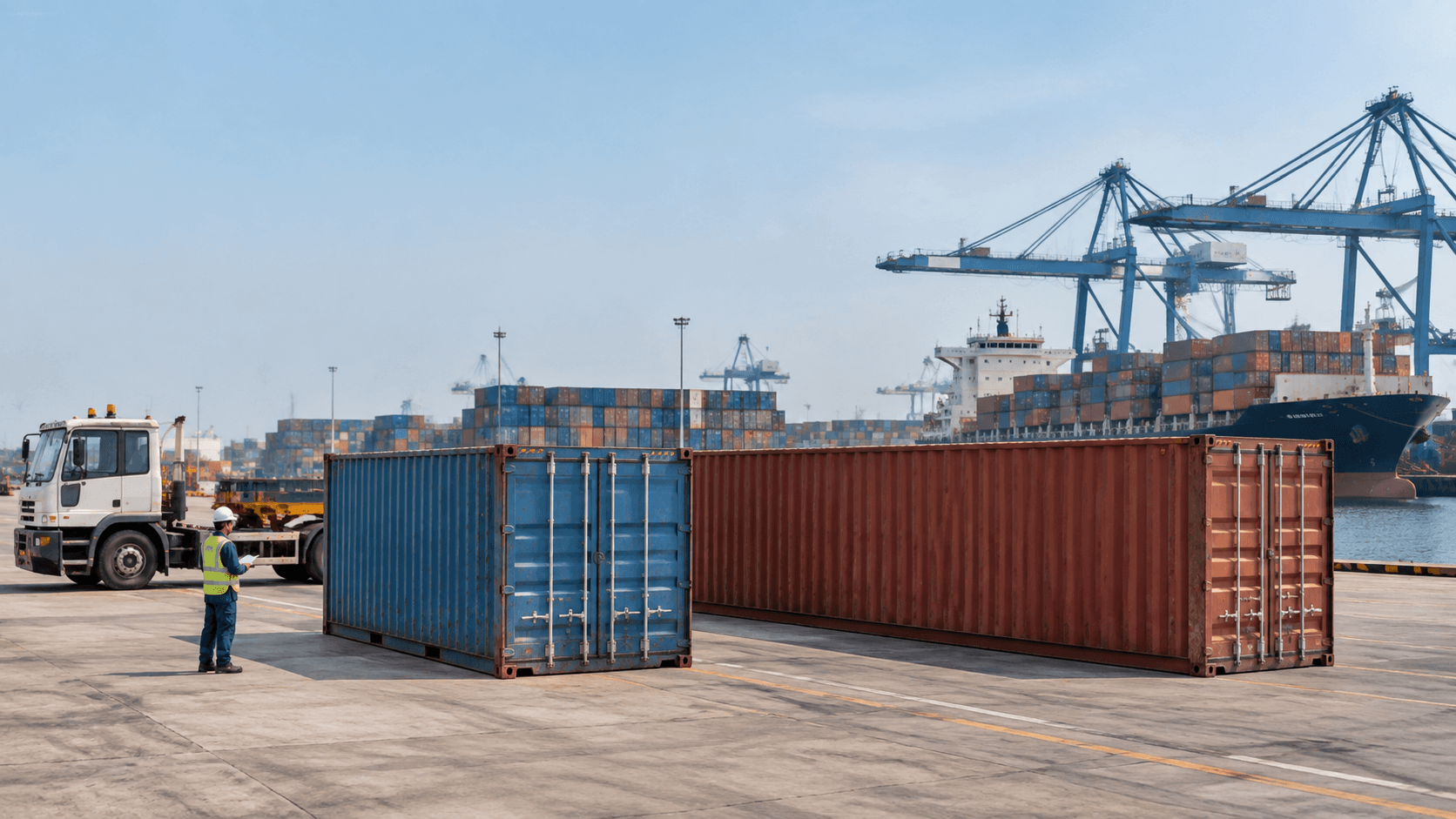
Comparing length, volume, operating weight and cargo arrangement capability between two container types
A standard 40 feet container has an external length of approximately 12.192 m, nearly twice that of a 20 feet container, while external width and height remain basically around 2.438 m and 2.591 m. Nominal volume is usually around 67–68 CBM, slightly more than double 20 feet due to more efficient shared end structures. CMA CGM publishes 40ST at around 67.8 m³ and 20ST at around 33.2 m³.
The key point is that the cargo capacity of a 40 feet container is not double that of a 20 feet container. Depending on configuration, max gross for 40 feet may be 30,480 kg or 32,500 kg, while tare is higher. Therefore, 40 feet provides advantages for bulky, lightweight or palletized cargo; very heavy cargo is often more suitable for 20 feet. Comparing based on “twice the length means twice the weight capacity” is technically incorrect.
When the larger capacity of 40 feet containers creates cost advantages per cargo unit
40 feet containers are advantageous when shipments have enough volume to fill most of the container and 40 feet freight does not increase proportionally compared with 20 feet. In that case, transportation cost per CBM, carton or pallet may decrease. However, the benefit only appears if businesses actually use the space; booking a 40 feet container for 30–35 CBM of light cargo can mean paying for unused air.
Costs after ocean freight must also be calculated: trucking, handling, yard fees, stuffing time, access conditions and delivery risks. A 40 feet container may reduce unit cost but may not fit if the warehouse is in an industrial alley, has short turning space or vehicle restrictions complicate operations. Optimization must consider total landed logistics cost, not only ocean freight.
Impact of container dimensions on tractors, routes, delivery points and turning capability
40 feet containers require longer tractor-trailer combinations, larger turning radius and wider docking space. Before dispatching vehicles, check gate width, turning angles, roof clearance, overhead wires, slopes, stuffing location and waiting space. With 20 feet containers, handling is usually more flexible, but heavy cargo makes axle load a more important control point.
HNT usually surveys or requests customers to provide videos, images and actual gate dimensions if a delivery location has never handled containers before. For intermodal routes or deliveries into vehicle-restricted areas, multimodal transportation additional transshipment, vehicle changes or consolidation points may be required. This design should be completed before booking, not waiting until empty pickup day to resolve issues.
How to choose containers based on volume, packaging specifications and cargo characteristics instead of only volume
The right choice should begin with four data points: total gross cargo weight, total CBM, largest package dimensions and cargo characteristics. If cargo is heavy, prioritize checking payload, axle load and weight distribution. If cargo is light, prioritize cube utilization. If cargo is oversized, do not force it into a dry container; consider open top, flat rack or suitable breakbulk solutions for the route.
Cargo requiring temperature control, ventilation, quarantine or hygiene standards must be treated as a separate equipment planning issue. For example, fresh fruit should not be placed in dry containers simply because CBM fits; reefer, pre-trip inspection, temperature, ventilation and quarantine documentation are required. For exports, businesses must also review requirements from Customs authorities, specialized management agencies and destination country conditions before finalizing the plan.
20 Feet And 40 Feet Container Specification Table For Cost, Load Capacity Calculations
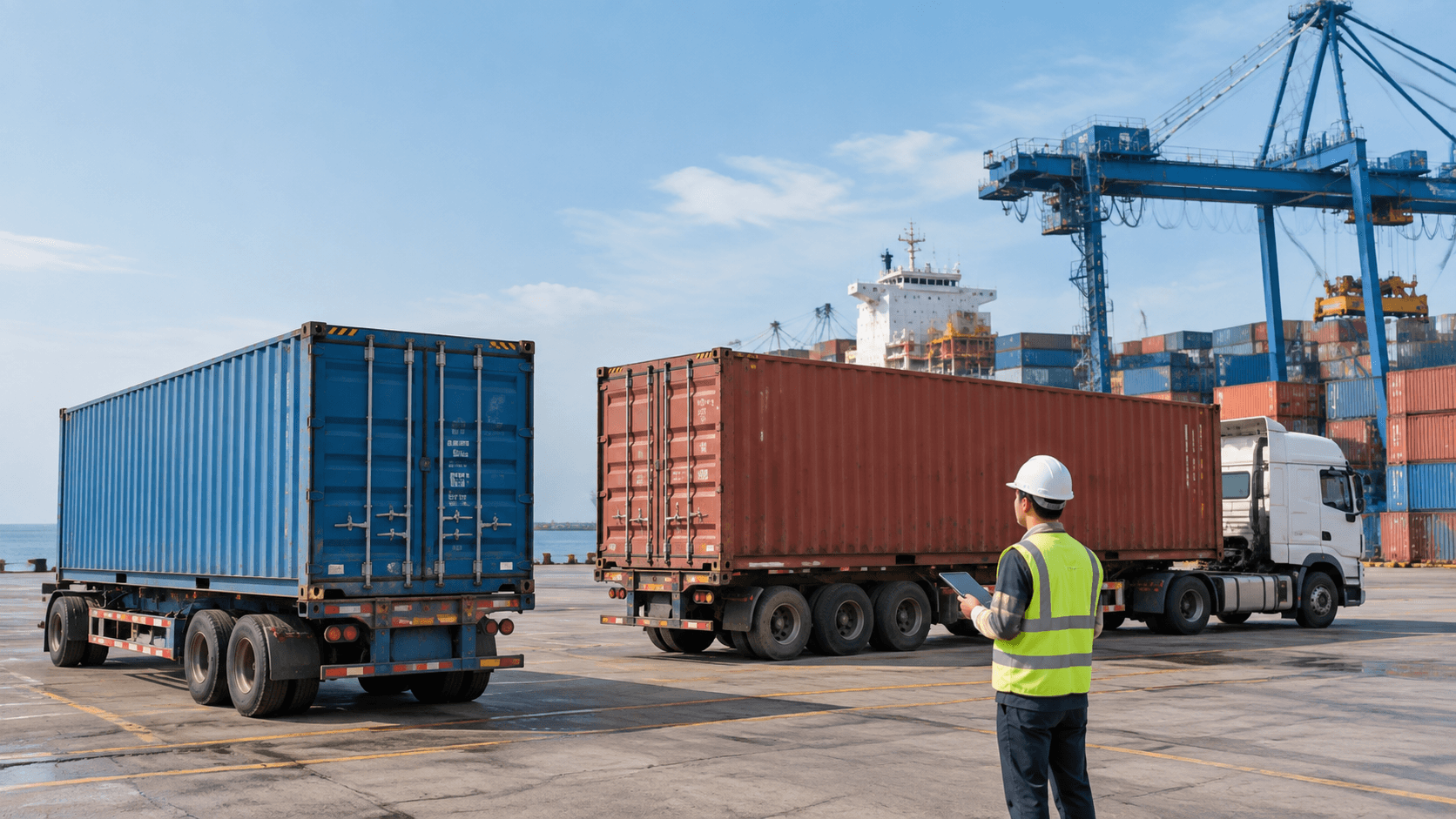
External dimensions, internal dimensions, container doors, volume and tare weight table
The table below uses representative data for preliminary planning of standard dry containers. Since shipping lines operate equipment from multiple manufacturers, tare, door height and max gross may vary. When cargo approaches door dimensions or total gross cargo approaches limits, specifications on the assigned container must be the final reference. Technical references include Hapag-Lloyd and CMA CGM.
| Parameters | 20 feet standard container | 40 feet standard container | Operational notes |
|---|---|---|---|
| External dimensions L × W × H | Approximately 6.058 × 2.438 × 2.591 m | Approximately 12.192 × 2.438 × 2.591 m | Standard nominal dimensions |
| Internal dimensions L × W × H | Approximately 5.900 × 2.352 × 2.393–2.395 m | Approximately 12.032–12.034 × 2.352 × 2.393–2.395 m | Re-measure if cargo approaches limits |
| Door W × H | Approximately 2.340 × 2.280–2.292 m | Approximately 2.340 × 2.280–2.292 m | Doors are usually lower than internal height |
| Nominal volume | Approximately 33.2 m³ | Approximately 67–67.8 m³ | Does not equal actual loading volume |
| Reference tare weight | Approximately 2.23–2.35 tons | Approximately 3.64–3.72 tons | Read tare on the actual container door |
| Reference max gross | Usually 30.48 tons, with higher containers depending on equipment fleet | Approximately 30.48–32.50 tons depending on container | Does not replace road load limits |
Operating load, pallet quantity and reference loading arrangement comparison table
The pallet quantities below are references for standard pallets and common floor loading methods, excluding overhanging cargo, securing materials, door clearance or individual pallet weight limits. For actual cargo, HNT creates loading plans based on measured pallet dimensions after wrapping, not only empty wooden pallet dimensions.
| Criteria | 20 feet | 40 feet | Selection suggestion |
|---|---|---|---|
| Euro pallet 1,200 × 800 mm | Approximately 11 pallets | Approximately 24–25 pallets | Check height and gross weight |
| Pallet 1,200 × 1,000 mm | Approximately 10 pallets | Approximately 20–21 pallets | Optimize with pallet rotation plans |
| Heavy cargo, low CBM | Usually more efficient | May reach payload before cube capacity | Prioritize weight and axle load |
| Light, bulky cargo | Easy to lack volume | Usually more efficient | Compare cost per CBM/pallet |
| Large machinery packages | Suitable if door access and load distribution are possible | Suitable if length is required | Consider open top/flat rack if oversized |
Cost analysis table by container type, cargo weight and volume utilization efficiency
Ocean freight varies by route, season, carrier, free time, surcharges and equipment availability; therefore a “fixed price” table quickly becomes outdated. A more professional approach is comparing variables. Let total all-in cost of 20 feet be C20 and 40 feet be C40; then divide by CBM, tons or actual pallets used to find unit cost.
| Scenario | Usage level | Calculation metric | Explanation |
|---|---|---|---|
| 20 feet, 26 CBM | Approximately 78% of nominal volume | C20 / 26 = cost per CBM | Suitable when cargo is relatively heavy and volume is moderate |
| 20 feet, 20 tons | Compared with payload and vehicle limits | C20 / 20 = cost per ton | Must check axle load, not only payload |
| 40 feet, 55 CBM | Approximately 81% based on 67.8 CBM | C40 / 55 = cost per CBM | May outperform 20 feet if freight does not increase proportionally |
| 40 feet, 30 CBM | Excess unused volume | C40 / 30 | Compare with 20 feet or adjust shipment size |
When quoting, HNT Logistics recommends separating ocean freight, local charges, trucking, handling, documentation fees, quarantine or specialized inspection fees if applicable, together with costs caused by storage and container detention. Only then can businesses correctly compare total costs between 20 feet and 40 feet containers. Transport prices should not be decided only by one ocean freight line item.
Quick checklist of specifications to confirm before container booking and trucking arrangement
The following checklist is suitable for booking approval before empty pickup. For heavy cargo or temperature-controlled shipments, additional confirmation from the shipping line and transport provider is recommended. Having complete data before working at container ports helps limit booking changes, equipment changes or truck rescheduling.
- Container type: 20GP, 40GP, 40HC, reefer, open top or flat rack.
- Largest package dimensions after packing; total CBM; total gross cargo.
- Tare, max gross, payload of assigned container; VGM requirements.
- Number of pallets, loading plan, heavy cargo positions, securing materials and lashing.
- Empty pickup address, stuffing address, warehouse schedule, vehicle restrictions and turning radius.
- Closing time, CY cut-off, SI cut-off, VGM cut-off and vessel schedule.
- Customs documents, C/O, permits, quarantine or specialized inspections if applicable.
20 Feet Containers In Stuffing, Yard Delivery And Vessel Loading Process
Inspecting container condition and planning cargo allocation before stuffing
Immediately after receiving empty equipment, inspect exterior condition and take photos of all four walls, floor, ceiling, doors, container number and seal status if already issued. For moisture-sensitive cargo, checking light penetration from outside is a simple way to detect holes. If the container is unsuitable, report to the depot early; discovering problems after stuffing greatly increases handling costs.
Cargo allocation plans must determine which packages go in first, which stay near the door, where the container center of gravity is and which points require securing. For mixed cargo, do not place low-compression light packages under heavy cargo simply to “fill space”. HNT often requires packing lists with gross weight by package or pallet to control load distribution and support accurate VGM calculation.
Weight control, securing, sealing and preventing cargo movement
Cargo inside containers experiences longitudinal, lateral vibration and forces during braking, turning, lifting, handling or rough seas. Therefore, large empty spaces must be managed with blocking, bracing, dunnage, airbags or suitable straps. For high-center-of-gravity cargo, machinery or metal coils, lashing plans should be individually designed; closing the door tightly does not mean the cargo is safely secured.
Regarding weight, SOLAS requires packed containers to have Verified Gross Mass before loading onto ships; the shipper is responsible for providing VGM, and VGM must be available early enough for loading plans. IMO specifies two methods: weighing the entire packed container or calculating the total of packages, pallets, securing materials and adding tare weight according to an approved method.
Coordinating container pickup, port delivery and vessel cut-off compliance
A good stuffing schedule should work backward from ETD and shipping line cut-offs. Determine empty pickup time, travel time from depot to warehouse, stuffing duration, customs declaration, VGM weighing, yard delivery and buffer time. If only following ETD while ignoring CY cut-off or VGM cut-off, a container may arrive at the port before the vessel but still not be loaded.
At this stage, coordination between shipper, HNT, trucking team, warehouse and port determines supply chain stability. The phrase “cargo has been stuffed” is not enough to consider a shipment complete; a container is only truly ready when delivered to the correct yard, booking information matches, documents are correct, VGM is recorded and no hold remains. For transshipment routes, missing the first voyage may delay the entire connecting chain.
In actual container hauling through Cat Lai area and ports in Hai Phong such as Dinh Vu, Lach Huyen and Tan Vu, empty pickup locations may differ from cargo delivery terminals and change according to booking instructions. Therefore, trucking must follow empty release orders, depot schedules, yard conditions and the exact voyage cut-off. Do not use previous shipment schedules as defaults even with the same route and carrier.
For routes with Vietnam–Laos–China intermodal segments, the plan also includes road limitations, border crossing time and customs procedures. A container suitable for the sea segment may not be optimal for the whole chain if weight limits or transshipment points create additional costs. HNT usually checks compatibility between containers, trucks, border gates, documents and delivery schedules from the beginning to avoid optimizing one segment while increasing total route costs.
Checking seal, container number, documents and yard status before vessel loading
After stuffing, seal numbers must be recorded and matched on shipping instructions, internal documents and related systems. One incorrect character in container or seal numbers can create discrepancies between field operations and documents. HNT recommends photographing the closed door with visible container number and seal, then checking booking details before the truck leaves the warehouse to avoid corrections after yard delivery.
For exports, businesses need to monitor declaration status, specialized inspections, C/O if available and destination market requirements. Public administrative procedures related to import-export goods are currently published on the system of Customs authorities, while maritime specialized management and port matters fall under the scope of Vietnam Maritime and Inland Waterway Administration. Hồ sơ phải được kiểm tra theo loại hàng, tuyến và thời điểm thực tế.
For exported fruits to China, reefer containers are only one part of the plan. Businesses must also control growing area codes, packing facilities, plant quarantine, stuffing conditions, temperature, ventilation and required documentation under current regulations. HNT Logistics can coordinate customs declaration, C/O issuance, quarantine and transportation, but shipment data must be standardized before trucks enter the warehouse for stuffing.
Frequently Asked Questions (FAQ) About 20 Feet And 40 Feet Container Dimensions
The following questions focus on issues businesses commonly face when moving from specification tables to actual operating plans. Answers use representative data; each booking requires confirmation of exact equipment and route conditions before stuffing.
Frequently Asked Questions (FAQ)
How many CBM and tons of cargo can a 20 feet container actually hold?
Q: How many CBM and tons of cargo can a 20 feet container actually hold?
A: Nominal capacity is usually around 33.2 CBM, but actual loading volume is lower because of pallets, gaps, dunnage and package shapes. Technical payload of many containers is around 28 tons, but operating tonnage depends on tare, max gross, truck axle load, route, carrier and port. HNT does not recommend using “28 tons” as a default number for every shipment.
What is the difference between 20 feet and 40 feet containers in dimensions and transportation costs?
Q: What is the difference between 20 feet and 40 feet containers in dimensions and transportation costs?
A: 40 feet containers are nearly twice as long and have around 67–68 CBM compared with around 33.2 CBM for 20 feet, but cargo weight capacity is not doubled. Costs should be compared by total all-in cost and utilization efficiency: light, high-volume cargo often benefits from 40 feet; heavy, low-volume cargo usually requires evaluating 20 feet. Actual freight depends on route, season, carrier and surcharges.
What is the maximum cargo package size that can pass through a 20 feet container door?
Q: What is the maximum cargo package size that can pass through a 20 feet container door?
A: Typical doors are about 2.34 m wide and 2.28–2.29 m high. However, packages should not be designed exactly to door dimensions because container tolerances, forklift angles, package overhangs, pallets and handling space must also be considered. If cargo approaches limits, HNT recommends measuring the assigned container directly or considering open top/flat rack instead of relying entirely on catalog specifications.
When cargo is heavy but low in volume, what criteria should be considered for choosing a 20 feet container?
Q: When cargo is heavy but low in volume, what criteria should be considered for choosing a 20 feet container?
A: First check gross cargo weight, package weight, floor loading points, tare and max gross of the container. Then check tractor-trailer limits and road route restrictions, VGM weighing capability, lashing plan and carrier requirements. If a package creates high concentrated loads, load-distribution dunnage must be designed. Only when the entire chain meets requirements is a 20 feet container a safe option.
Conclusion: Choose Containers Based On Shipment Data, Not Habit
20-foot container is an effective choice for many FCL shipments, especially when cargo has high weight density or volumes do not require 40 feet. However, the correct decision must be based on package dimensions, weight, pallets, vehicle conditions, container yards, container ports, cut-off times and vessel requirements. Catalog data is only the starting point; actual equipment and operating conditions are the final basis.
HNT Logistics hỗ trợ doanh nghiệp xây phương án từ booking, điều xe kéo container, vận tải đường biển, khai báo hải quan, C/O, kiểm dịch đến giao nhận đa chặng. Với lô hàng cần báo giá hoặc kiểm tra quy cách đóng container, doanh nghiệp có thể liên hệ với HNT Logistics để được rà soát theo dữ liệu lô hàng thực tế.