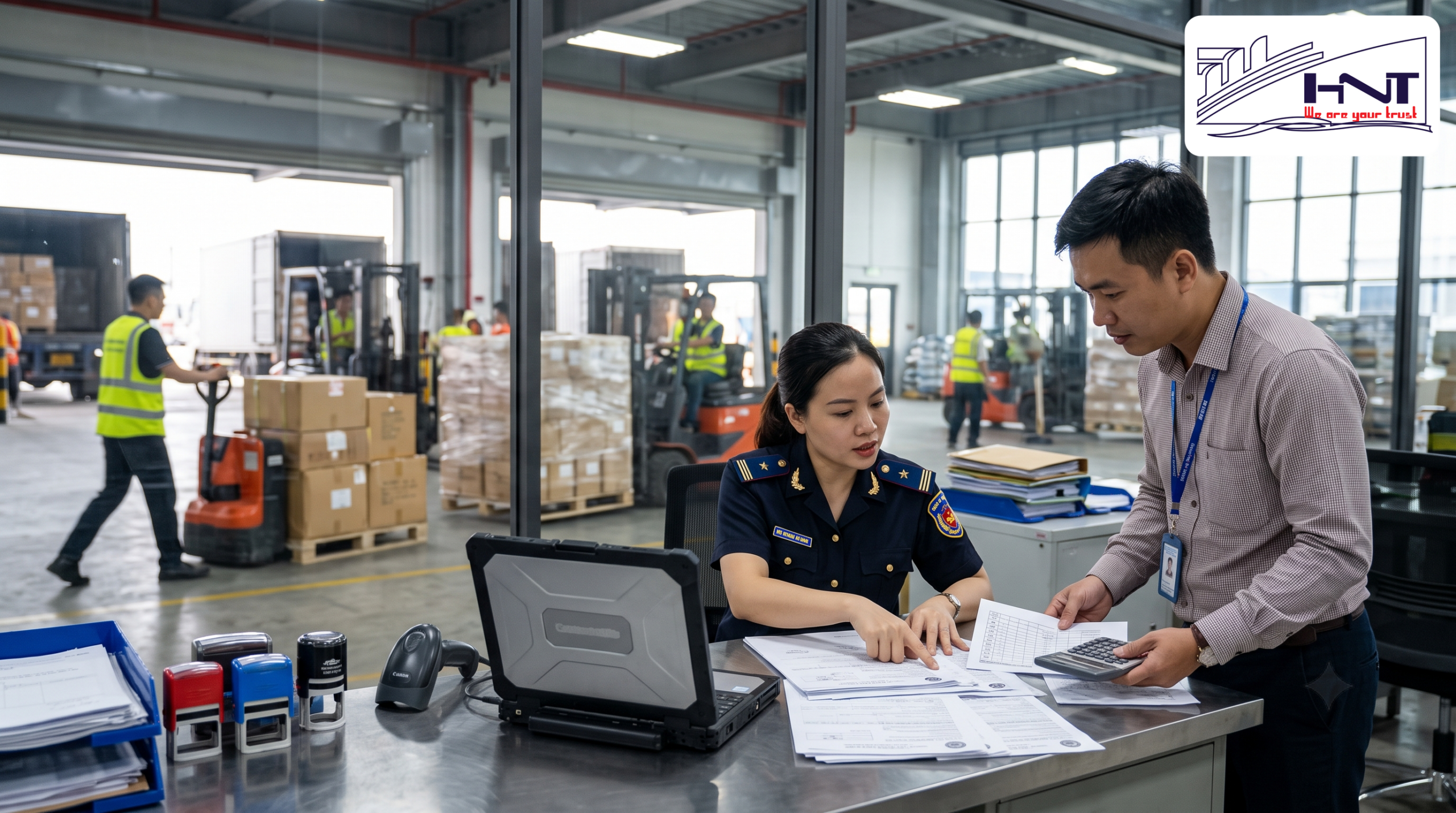
A container of dragon fruit departing Tien Giang for Cat Lai Port could miss its vessel simply because of an incorrect HS Code. What is customs, how does customs clearance work, and what fees are included in customs costs? These three questions determine costs, time, and delivery reputation.
In the first six months of 2026, the General Statistics Office recorded total merchandise import and export turnover of USD 549.69 billion, an increase of 27.11%. The United States was Vietnam's largest export market, with USD 86.5 billion. The Ministry of Agriculture and Environment also estimated that agricultural, forestry, and fishery exports reached USD 35.88 billion during the same period.
Against this backdrop, customs procedures are no longer a minor logistical task. They are the legal control point for an entire shipment. This article helps cargo owners understand the process correctly, prepare documentation, and break down costs before finalizing selling prices.
What Is Customs and Why Does Customs Clearance Determine Import-Export Cash Flow?
Customs is the government authority responsible for inspecting and supervising goods exported and imported across borders. For businesses, customs is also the gateway that verifies a shipment's legality. Without passing through this gateway, goods cannot leave the port, be received into a warehouse, or be delivered to buyers.

What Is Customs from a Business Perspective?
From an operational perspective, customs is where actual goods are compared against commercial documents and tax obligations. Declarants must demonstrate the correct product description, HS Code, customs value, origin, delivery terms, and applicable specialized management policies. Decree 08/2015/ND-CP and Decree 59/2018/ND-CP remain important foundational regulations governing customs procedures for imported and exported goods.
- Determine the correct HS Code before signing the contract because this code affects taxes and regulatory policies.
- Cross-check the commercial invoice, packing list, contract, and Bill of Lading before making the customs declaration.
- Check permits, quarantine requirements, or quality inspections if the goods are subject to specialized management.
- Estimate the time required for container yard entry, scanning, physical inspection, and obtaining the delivery order at the port.
- Prepare a budget for taxes, fees, port charges, and container charges (Demurrage/Detention).
| Perspective | Customs Inspection | Business Impact | Task |
|---|---|---|---|
| Legal | Product Regulations | Authorized for Import and Export | Check Permits |
| Taxes | HS Code and Customs Value | Impact on Cost of Goods | Classify Early |
| Documentation | Invoices, C/O, B/L | Avoid Declaration Amendments | Cross-check |
| Operation | Inspection Channel | Impact on Shipping Schedule | Allow Extra Time |
How Is Customs Clearance Different from Customs Declaration?
A customs declaration is the step of submitting declaration data. Customs clearance is the result achieved after the customs system or customs officer accepts the shipment. Put simply, completing a declaration does not necessarily mean the goods can proceed. A shipment is truly cleared only after inspections are completed, financial obligations are paid, and customs clearance confirmation is received.
For example, An Phuc Fruit Company in Tien Giang exports one refrigerated container of dragon fruit to Shanghai through Cat Lai Port. When the company standardized its C/O, phytosanitary certificate, and HS Code two days before ETD, processing time decreased by approximately 14 hours. HNT LOGISTICS recommends that fresh fruit exporters finalize their documentation before loading containers rather than waiting until the truck arrives at the port to make corrections.
In another example, Minh Thanh Mechanical Company in Binh Duong imports machine components from Japan. Because the product descriptions on the invoice were too general, the shipment was assigned to the document inspection channel. After submitting a technical catalog in Vietnamese, the company obtained cargo release on the second day, but still incurred storage charges.
Key takeaway: Treat customs as a cash flow control point, not merely a paperwork procedure.
What Is Customs in the Electronic Customs Declaration Process?
Today's process relies heavily on electronic declarations and risk management. Circular 38/2015/TT-BTC, as amended by Circular 39/2018/TT-BTC, regulates various aspects of documentation, declaration criteria, and declaration processing. Therefore, the cleaner the initial data, the lower the likelihood of having to amend a customs declaration.

Documents to Prepare Before Opening a Customs Declaration
A document package is not sufficient simply because all the required document names are present. The documents must be logically consistent. Package quantities, weights, FOB, CIF, or DDP delivery terms, buyer names, and product descriptions must match. For goods requiring quarantine, specialized inspection results must be incorporated into the customs clearance schedule rather than treated separately from the shipping schedule.
- Obtain the sales contract, commercial invoice, and packing list from the sales department.
- Check the Bill of Lading or shipping instructions before the cargo cut-off deadline.
- Determine the HS Code, applicable tax rates, and specialized management policies.
- Prepare the C/O, quarantine certificates, quality certificates, or product declaration documents if required.
- Submit the electronic customs declaration, receive the inspection channel assignment, and handle requests from customs authorities.
- Pay taxes and fees, then complete the delivery order procedures or obtain confirmation that the goods have passed through the supervision area.
| Documentation | Role | Common errors | Consequences |
|---|---|---|---|
| Invoice | Valuation | Incorrect Pricing Terms | Value consultation |
| Packing list | Identify Cargo Packages | Weight discrepancy | Recheck |
| Care of | Tax incentives | Incorrect origin criteria | Loss of incentives |
| Quarantine | Meet Specialized Requirements | Late Submission | Customs clearance delay |
| Bill of lading | Receive or Deliver Goods | Incorrect product name | Amend the Manifest |
How Should Green, Yellow, and Red Inspection Channels Be Understood?
The green channel generally allows rapid customs clearance once financial obligations have been fulfilled. The yellow channel requires document inspection. The red channel may involve physical inspection of the goods. A red-channel assignment should not automatically be considered a negative risk indicator. It simply signals the need to prepare personnel, documents, and inspection schedules more carefully.
Based on HNT LOGISTICS' experience, businesses exporting frozen seafood from Ca Mau should submit temperature records, quarantine certificates, and refrigerated container specifications in advance. A factory named Nam Hai Foods once maintained a stable temperature of -18 degrees Celsius during a shipment from Hai Phong to Long Beach. By preparing seal photographs and temperature logs, the shipment avoided prolonged inspections.
In another case, Gia Lam Wood Company in Dong Nai imported wooden accessories from China. Its shipment was assigned to the yellow channel because the product description did not clearly explain its intended use. After providing an HS Code analysis and product photographs, the declaration was processed that afternoon. A practical tip is to prepare an explanatory document package before the system assigns an inspection channel.
Key takeaway: Customs clearance speed does not come from luck; it comes from clean declaration data.
What Is Customs When Calculating Customs Costs and Fees?
When asked about customs costs, many businesses think only of taxes. This perspective overlooks important expenses. Total costs also include administrative fees, service charges, port charges, documentation fees, inspection charges, storage fees, and opportunity costs caused by delayed deliveries. A low quotation that excludes additional charges often leads to budget inaccuracies.

Government Taxes and Administrative Fees
Government charges generally include import duties, value-added tax, special consumption tax where applicable, environmental protection tax where applicable, and customs fees. The electronic customs payment portal supports the payment of taxes and fees through participating banking systems, helping reduce the time required to fulfill financial obligations.
- Import duties depend on the HS Code, country of origin, and applicable trade agreements.
- Value-added tax is calculated based on the taxable value and import duty, if applicable.
- Customs fees are generally small but should be recorded in the cost-of-goods calculation for each shipment.
- Specialized inspection costs arise when goods require quarantine or quality testing.
- Document amendment costs arise when information on the Bill of Lading, invoice, or manifest is incorrect.
- Financing costs increase when businesses pay taxes late and their goods are held at the port.
| Item | Who Collects the Fee? | When it occurs | Control method |
|---|---|---|---|
| Import tax | Government | Taxable Imported Goods | Review the HS Code |
| Value-Added Tax | Government | Most Imported Goods | Cash Flow Forecast |
| Customs Fees | Customs | Open customs declaration | Include in Cost of Goods |
| Quarantine | Specialized agency | Food and Plant Products | Register early |
| Document correction | Shipping Line or Agent | Incorrect Data | Check Before ETD |
Service, Port, and Container Charges
In common industry usage, customs fees are often confused with logistics service charges. It is important to distinguish customs brokerage fees, handling charges, documentation fees, scanning fees, storage charges, and container charges (Demurrage/Detention). According to experts at HNT LOGISTICS, a budget table should contain three columns: mandatory charges, conditional charges, and potential additional costs.
For example, Mekong Aroma Company in Can Tho exports frozen mangoes to Busan. When switching from less-than-container-load (LCL) shipments to full-container-load (FCL) shipments during peak season, documentation costs per ton decreased. However, the company had to carefully control container detention charges because the loading schedule was close to the port cut-off time.
In another example, Anh Duong Textile Company in Da Nang imports fabric from Shanghai. Its shipment was held for an additional day because tax payment had not been completed. The storage charge was not substantial, but it delayed a three-shift sewing production line. This is a real cost, even though it does not appear on the customs declaration.
Businesses should request separate quotations for customs brokerage services, domestic transportation, port charges, and shipping line surcharges. Any cost category without clearly defined conditions for additional charges should be questioned immediately. Do not sign a quotation simply because its total amount is low.
Key takeaway: Optimizing customs costs starts with identifying who collects each charge, when it is collected, and under what conditions it arises.
What Is Customs for Agricultural Products, Seafood, and Fresh Fruit?
For agricultural products, seafood, and fresh fruit, customs does not operate in isolation. The process is often accompanied by quarantine, food safety, traceability, packaging requirements, and temperature controls. VASEP reports that seafood exports in 2026 could exceed USD 12 billion, but the industry continues to face logistics pressures and trade barriers.

Quarantine, Food Safety, and Specialized Documentation
Fresh goods present a paradox: the longer the legal processing time, the more their commercial quality deteriorates. Therefore, quarantine procedures must be incorporated into the production schedule, not just the export schedule. For markets such as China, the United States, the EU, and Southeast Asia, businesses must check requirements for each product, packing facility, and growing area code.
- Verify growing area codes, packing facilities, and traceability records before accepting orders.
- Schedule quarantine inspections according to the loading date to avoid refrigerated containers waiting for certificates.
- Check the C/O, phytosanitary certificate, and product labeling against the requirements of the destination market.
- Photograph the container seal, container number, and set temperature immediately after loading.
- Prepare an alternative shipping plan if the vessel is delayed or the transshipment port becomes congested.
| Group of goods | Critical Documents | Risk Point | Measures |
|---|---|---|---|
| Fresh fruit | Plant quarantine | Incorrect Growing Area Code | Check Before Harvest |
| Frozen seafood | Safety Certification | Temperature deviation | Maintain Refrigeration Logs |
| Rice | C/O and Fumigation | Failure to Meet Importing Country Standards | Review the Contract |
| Vegetables | Residue Monitoring | Specialized inspection | Retain Test Results |
Cold Chain and the Risk of Cargo Being Held
The cold chain is one of the most easily overlooked aspects of customs clearance. A container with correct documentation but incorrect temperature settings can still become subject to complaints at the destination port. Businesses should verify refrigerated container dimensions, ventilation capacity, and temperature settings for each type of cargo before collecting an empty container.
For example, Loc Phat Farm Company in Long An exports frozen durian to Guangzhou. The company uses refrigerated containers set to -18 degrees Celsius, installs temperature data loggers, and submits quarantine documentation before the loading date. As a result, the shipment passed through the border on schedule without incurring storage charges.
Another example is Bien Xanh Ca Mau Company, which exports frozen cooked shrimp to Rotterdam. The shipping schedule was delayed by 18 hours due to transshipment in Singapore. By allowing extra time for reefer plug-in charges and purchasing refrigerated cargo insurance, the company maintained product quality. This is practical risk management, not just a slogan.
Key takeaway: Fresh goods require the simultaneous management of three schedules: production, quarantine, and transportation.
What Is Customs in Post-Clearance Risk Management?
Customs clearance does not mean that all responsibilities have ended. Customs authorities may conduct post-clearance audits when they suspect issues involving HS Codes, customs values, origin, or product regulations. Therefore, documentation should be retained as a commercial audit file, not merely as paperwork for cargo release.

Common Mistakes That Cause Delays
The Drewry World Container Index on July 16, 2026, decreased by 2% but remained at USD 4,547 per 40-foot container, demonstrating that delay-related costs remain significant amid high freight rates. When freight rates and surcharges fluctuate, a single day's delay can wipe out the profit margin of a low-value shipment.
- Incorrectly declaring the HS Code based only on the commercial product name rather than the actual nature of the goods.
- Using different delivery terms in the contract, invoice, and Bill of Lading.
- Submitting quarantine certificates late, forcing refrigerated cargo to wait at the port yard.
- Failing to budget for container detention charges when the vessel schedule changes or the buyer receives documents late.
- Using the same product description for multiple markets even though import regulations differ.
- Failing to retain supporting records for customs value, origin, and technical catalogs after customs clearance.
| Risk | Early signs | Associated Costs | Prevention |
|---|---|---|---|
| Incorrect HS Code | Overly General Description | Additional tax assessment | Technical Analysis |
| Quarantine Delays | Sampling Schedule Not Yet Arranged | Refrigerated Storage | Register in Advance |
| Wrong bill of lading | Product Name Mismatch | Document correction | Approve the Draft B/L |
| Port Congestion | Constantly Changing ETA | Delayed Delivery | Route contingency |
| Missing Post-Clearance Documentation | Disorganized Record Keeping | Prolonged Explanations | Digitize Documentation |
Tips for Working with Freight Forwarders
A good freight forwarder does more than ask where the goods are going. They must ask which regulations apply to the goods, what quarantine requirements are necessary, who is responsible for additional charges, and which delivery deadlines cannot be missed. Businesses should request import-export documentation advice from the quotation stage onward.
For example, Son Ha Foods Company in Khanh Hoa exports frozen tuna to Los Angeles. When its freight forwarder provided early warnings about inspection risks and peak-season surcharges, the company renegotiated its delivery terms. It retained a profit margin of 3.2% compared with the original quotation.
In another example, Green Delta Company in Ben Tre exports fresh coconuts to Bangkok. By checking the growing area code, fumigation schedule, and trucking time to Cat Lai Port in advance, the shipment did not need to be rescheduled. Customs clearance time was reduced to less than one working day.
What Is Customs When Viewed Through a Management Perspective? It is a system for ensuring the legal compliance of cargo flows, cash flows, and commercial data. Import-export professionals should remember the following points:
- Customs inspects goods, documents, taxes, and product regulations.
- A customs declaration is the act of submitting data, while customs clearance is the result of that declaration being accepted.
- Customs costs must be separated from port charges, shipping line surcharges, and service fees.
- Agricultural products, seafood, and fresh fruit require quarantine procedures to be coordinated with refrigerated transportation schedules.
- Yellow or red inspection channels are not something to fear when supporting documentation is ready.
- Post-clearance audits require businesses to retain records as if preparing for an audit.
During a period of fluctuating freight rates and increasingly stringent import market standards, businesses should not wait until their goods are sitting at the port to ask what customs is. Build the process before the shipment. When you need to review documentation, transportation routes, or customs fee budgets, HNT LOGISTICS can accompany you as a trusted freight forwarding and logistics partner for Vietnamese exporters nationwide.